

moment of carbon monoxide (via counterpolarization) [78] and can be also used to
characterize charge transfers and repolarization upon light absorption [79, 80].
Finally, it should be stressed that this full energetic decomposition, coined
“interacting quantum atoms” (IQA) by Pendás and coworkers (who have applied it
to very different systems, proving its versatility [81–87]), is in principle exact.
However, as it is grounded on the partition of the first-order reduced density matrix
(RDM) for the kinetic part and of the second-order RDM to decompose the total
electron-electron repulsion energy, it should a priori be used only in conjunction
with (post Hartree-Fock) wavefunction theory. We will mark this fact by explicitly
writing these energetic terms as functionals of the wavefunction (E ¼ E½w).
Indeed, density functional theory (DFT) in principle provides (in the
Hohenberg-Kohn as well as in its Kohn-Sham (KS) formulation) only the exact
electron density, but does not afford direct ways to evaluate the first and
second-order RDMs, and this would remain true even if the exact density functional
was known in analytical form. Nevertheless, the IQA approach can be used in a KS
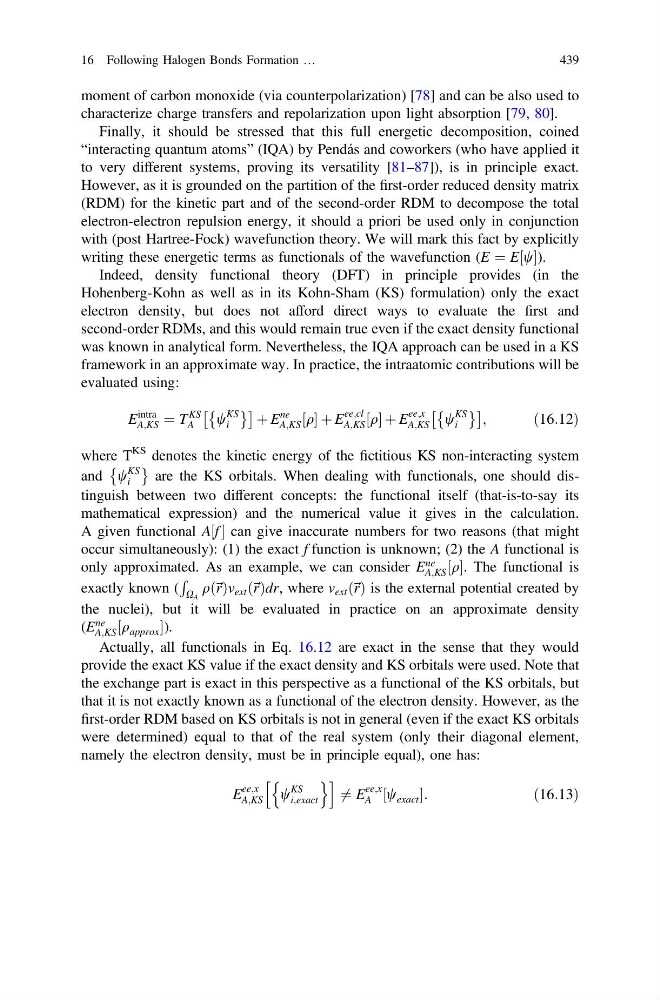
framework in an approximate way. In practice, the intraatomic contributions will be
evaluated using:
E
intra
A;KS ¼ T
KS
A
w
KS
i
È
É
Â
à þ E
ne
A;KS ½q þ E
ee;cl
A;KS ½q þ E
ee;x
A;KS w
KS
i
È
É
Â
Ã
;
ð16:12Þ
where T
KS denotes the kinetic energy of the fictitious KS non-interacting system
and w
KS
i
È
É
are the KS orbitals. When dealing with functionals, one should distinguish between two different concepts: the functional itself (that-is-to-say its
mathematical expression) and the numerical value it gives in the calculation.
A given functional A½f can give inaccurate numbers for two reasons (that might
occur simultaneously): (1) the exact f function is unknown; (2) the A functional is
only approximated. As an example, we can consider E
ne
A;KS ½q. The functional is
exactly known (
R
X A
q ~ r
ð Þv ext ~ r
ð Þdr, where v ext ~ r
ð Þ is the external potential created by
the nuclei), but it will be evaluated in practice on an approximate density
(E
ne
A;KS ½q approx ).
Actually, all functionals in Eq. 16.12 are exact in the sense that they would
provide the exact KS value if the exact density and KS orbitals were used. Note that
the exchange part is exact in this perspective as a functional of the KS orbitals, but
that it is not exactly known as a functional of the electron density. However, as the
first-order RDM based on KS orbitals is not in general (even if the exact KS orbitals
were determined) equal to that of the real system (only their diagonal element,
namely the electron density, must be in principle equal), one has:
E
ee;x
A;KS
w
KS
i;exact
n
o
h
i
6 ¼ E
ee;x
A ½w exact :
ð16:13Þ
16 Following Halogen Bonds Formation …
439
characterize charge transfers and repolarization upon light absorption [79, 80].
Finally, it should be stressed that this full energetic decomposition, coined
“interacting quantum atoms” (IQA) by Pendás and coworkers (who have applied it
to very different systems, proving its versatility [81–87]), is in principle exact.
However, as it is grounded on the partition of the first-order reduced density matrix
(RDM) for the kinetic part and of the second-order RDM to decompose the total
electron-electron repulsion energy, it should a priori be used only in conjunction
with (post Hartree-Fock) wavefunction theory. We will mark this fact by explicitly
writing these energetic terms as functionals of the wavefunction (E ¼ E½w).
Indeed, density functional theory (DFT) in principle provides (in the
Hohenberg-Kohn as well as in its Kohn-Sham (KS) formulation) only the exact
electron density, but does not afford direct ways to evaluate the first and
second-order RDMs, and this would remain true even if the exact density functional
was known in analytical form. Nevertheless, the IQA approach can be used in a KS
framework in an approximate way. In practice, the intraatomic contributions will be
evaluated using:
E
intra
A;KS ¼ T
KS
A
w
KS
i
È
É
Â
à þ E
ne
A;KS ½q þ E
ee;cl
A;KS ½q þ E
ee;x
A;KS w
KS
i
È
É
Â
Ã
;
ð16:12Þ
where T
KS denotes the kinetic energy of the fictitious KS non-interacting system
and w
KS
i
È
É
are the KS orbitals. When dealing with functionals, one should distinguish between two different concepts: the functional itself (that-is-to-say its
mathematical expression) and the numerical value it gives in the calculation.
A given functional A½f can give inaccurate numbers for two reasons (that might
occur simultaneously): (1) the exact f function is unknown; (2) the A functional is
only approximated. As an example, we can consider E
ne
A;KS ½q. The functional is
exactly known (
R
X A
q ~ r
ð Þv ext ~ r
ð Þdr, where v ext ~ r
ð Þ is the external potential created by
the nuclei), but it will be evaluated in practice on an approximate density
(E
ne
A;KS ½q approx ).
Actually, all functionals in Eq. 16.12 are exact in the sense that they would
provide the exact KS value if the exact density and KS orbitals were used. Note that
the exchange part is exact in this perspective as a functional of the KS orbitals, but
that it is not exactly known as a functional of the electron density. However, as the
first-order RDM based on KS orbitals is not in general (even if the exact KS orbitals
were determined) equal to that of the real system (only their diagonal element,
namely the electron density, must be in principle equal), one has:
E
ee;x
A;KS
w
KS
i;exact
n
o
h
i
6 ¼ E
ee;x
A ½w exact :
ð16:13Þ
16 Following Halogen Bonds Formation …
439