

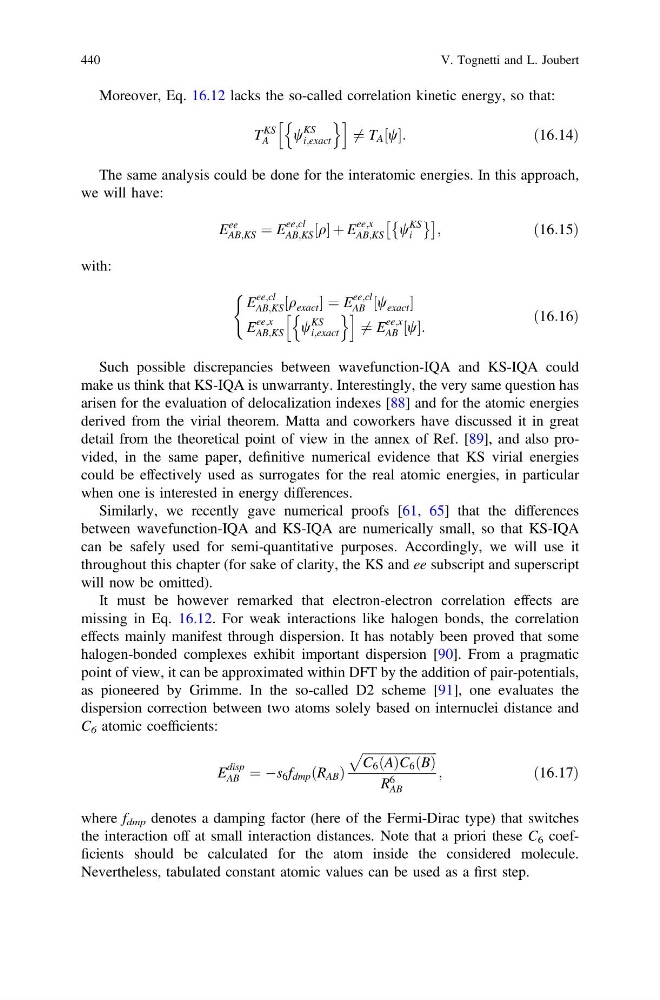
Moreover, Eq. 16.12 lacks the so-called correlation kinetic energy, so that:
T
KS
A
w
KS
i;exact
n
o
h
i
6 ¼ T A ½w:
ð16:14Þ
The same analysis could be done for the interatomic energies. In this approach,
we will have:
E
ee
AB;KS ¼ E
ee;cl
AB;KS ½q þ E
ee;x
AB;KS w
KS
i
È
É
Â
à ;
ð16:15Þ
with:
E
ee;cl
AB;KS q exact
½
¼E
ee;cl
AB w exact
½
E
ee;x
AB;KS
w
KS
i;exact
n
o
h
i
6 ¼ E
ee;x
AB ½w:
(
ð16:16Þ
Such possible discrepancies between wavefunction-IQA and KS-IQA could
make us think that KS-IQA is unwarranty. Interestingly, the very same question has
arisen for the evaluation of delocalization indexes [88] and for the atomic energies
derived from the virial theorem. Matta and coworkers have discussed it in great
detail from the theoretical point of view in the annex of Ref. [89], and also provided, in the same paper, definitive numerical evidence that KS virial energies
could be effectively used as surrogates for the real atomic energies, in particular
when one is interested in energy differences.
Similarly, we recently gave numerical proofs [61, 65] that the differences
between wavefunction-IQA and KS-IQA are numerically small, so that KS-IQA
can be safely used for semi-quantitative purposes. Accordingly, we will use it
throughout this chapter (for sake of clarity, the KS and ee subscript and superscript
will now be omitted).
It must be however remarked that electron-electron correlation effects are
missing in Eq. 16.12. For weak interactions like halogen bonds, the correlation
effects mainly manifest through dispersion. It has notably been proved that some
halogen-bonded complexes exhibit important dispersion [90]. From a pragmatic
point of view, it can be approximated within DFT by the addition of pair-potentials,
as pioneered by Grimme. In the so-called D2 scheme [91], one evaluates the
dispersion correction between two atoms solely based on internuclei distance and
C 6 atomic coefficients:
E
disp
AB ¼ Às 6 f dmp ðR AB Þ
ffiffiffiffiffiffiffiffiffiffiffiffiffiffiffiffiffiffiffiffiffiffiffi ffi
C 6 ðAÞC 6 ðBÞ
p
R
6
AB
;
ð16:17Þ
where f dmp denotes a damping factor (here of the Fermi-Dirac type) that switches
the interaction off at small interaction distances. Note that a priori these C 6 coefficients should be calculated for the atom inside the considered molecule.
Nevertheless, tabulated constant atomic values can be used as a first step.
440
V. Tognetti and L. Joubert
T
KS
A
w
KS
i;exact
n
o
h
i
6 ¼ T A ½w:
ð16:14Þ
The same analysis could be done for the interatomic energies. In this approach,
we will have:
E
ee
AB;KS ¼ E
ee;cl
AB;KS ½q þ E
ee;x
AB;KS w
KS
i
È
É
Â
à ;
ð16:15Þ
with:
E
ee;cl
AB;KS q exact
½
¼E
ee;cl
AB w exact
½
E
ee;x
AB;KS
w
KS
i;exact
n
o
h
i
6 ¼ E
ee;x
AB ½w:
(
ð16:16Þ
Such possible discrepancies between wavefunction-IQA and KS-IQA could
make us think that KS-IQA is unwarranty. Interestingly, the very same question has
arisen for the evaluation of delocalization indexes [88] and for the atomic energies
derived from the virial theorem. Matta and coworkers have discussed it in great
detail from the theoretical point of view in the annex of Ref. [89], and also provided, in the same paper, definitive numerical evidence that KS virial energies
could be effectively used as surrogates for the real atomic energies, in particular
when one is interested in energy differences.
Similarly, we recently gave numerical proofs [61, 65] that the differences
between wavefunction-IQA and KS-IQA are numerically small, so that KS-IQA
can be safely used for semi-quantitative purposes. Accordingly, we will use it
throughout this chapter (for sake of clarity, the KS and ee subscript and superscript
will now be omitted).
It must be however remarked that electron-electron correlation effects are
missing in Eq. 16.12. For weak interactions like halogen bonds, the correlation
effects mainly manifest through dispersion. It has notably been proved that some
halogen-bonded complexes exhibit important dispersion [90]. From a pragmatic
point of view, it can be approximated within DFT by the addition of pair-potentials,
as pioneered by Grimme. In the so-called D2 scheme [91], one evaluates the
dispersion correction between two atoms solely based on internuclei distance and
C 6 atomic coefficients:
E
disp
AB ¼ Às 6 f dmp ðR AB Þ
ffiffiffiffiffiffiffiffiffiffiffiffiffiffiffiffiffiffiffiffiffiffiffi ffi
C 6 ðAÞC 6 ðBÞ
p
R
6
AB
;
ð16:17Þ
where f dmp denotes a damping factor (here of the Fermi-Dirac type) that switches
the interaction off at small interaction distances. Note that a priori these C 6 coefficients should be calculated for the atom inside the considered molecule.
Nevertheless, tabulated constant atomic values can be used as a first step.
440
V. Tognetti and L. Joubert