

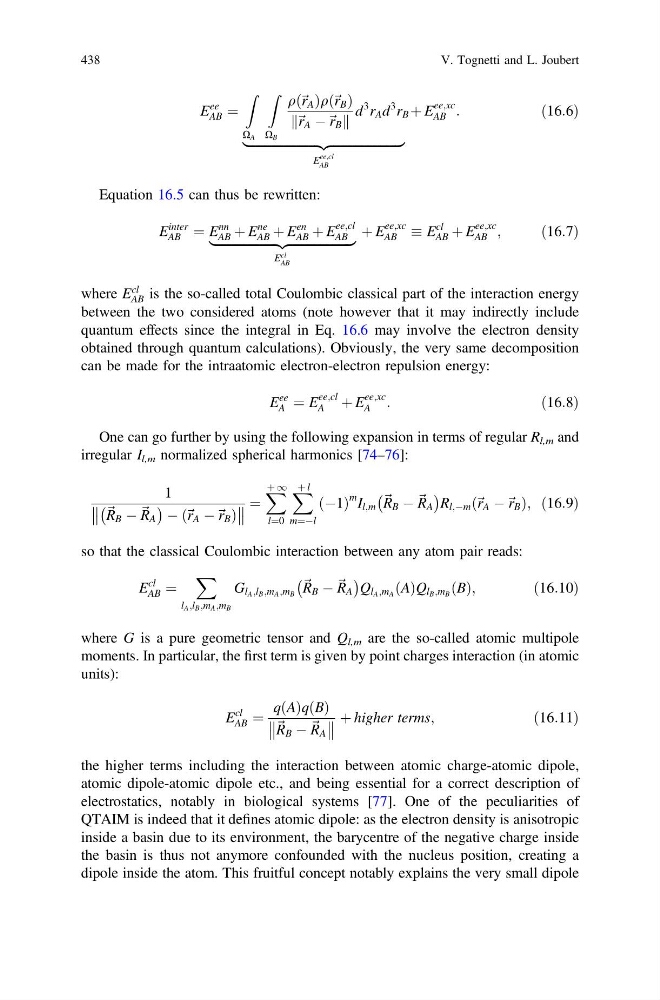
E
ee
AB ¼
Z
X A
Z
X B
q ~ r A
ð Þq ~ r B
ð Þ
~ r A À~ r B
k
k
d
3 r A d
3 r B
|fflfflfflfflfflfflfflfflfflfflfflfflfflfflfflfflfflfflfflfflfflffl{zfflfflfflfflfflfflfflfflfflfflfflfflfflfflfflfflfflfflfflfflfflffl}
E
ee;cl
AB
þ E
ee;xc
AB :
ð16:6Þ
Equation 16.5 can thus be rewritten:
E
inter
AB ¼ E
nn
AB þ E
ne
AB þ E
en
AB þ E
ee;cl
AB
|fflfflfflfflfflfflfflfflfflfflfflfflfflfflfflfflfflfflffl ffl{zfflfflfflfflfflfflfflfflfflfflfflfflfflfflfflfflfflfflffl ffl}
E cl
AB
þ E
ee;xc
AB E
cl
AB þ E
ee;xc
AB ;
ð16:7Þ
where E
cl
AB is the so-called total Coulombic classical part of the interaction energy
between the two considered atoms (note however that it may indirectly include
quantum effects since the integral in Eq. 16.6 may involve the electron density
obtained through quantum calculations). Obviously, the very same decomposition
can be made for the intraatomic electron-electron repulsion energy:
E
ee
A ¼ E
ee;cl
A
þ E
ee;xc
A
:
ð16:8Þ
One can go further by using the following expansion in terms of regular R l,m and
irregular I l,m normalized spherical harmonics [74–76]:
1
~ R B À ~ R A
À
Á À ~ r A À~ r B
ð
Þ
¼
X þ 1
l¼0
X þ l
m¼Àl
ðÀ1Þ
m I l;m ~ R B À ~ R A
À
Á
R l;Àm ~ r A À~ r B
ð
Þ; ð16:9Þ
so that the classical Coulombic interaction between any atom pair reads:
E
cl
AB ¼
X
l A ;l B ;m A ;m B
G l A ;l B ;m A ;m B ~ R B À ~ R A
À
Á
Q l A ;m A ðAÞQ l B ;m B ðBÞ;
ð16:10Þ
where G is a pure geometric tensor and Q l,m are the so-called atomic multipole
moments. In particular, the first term is given by point charges interaction (in atomic
units):
E
cl
AB ¼
qðAÞqðBÞ
~ R B À ~ R A
þ higher terms;
ð16:11Þ
the higher terms including the interaction between atomic charge-atomic dipole,
atomic dipole-atomic dipole etc., and being essential for a correct description of
electrostatics, notably in biological systems [77]. One of the peculiarities of
QTAIM is indeed that it defines atomic dipole: as the electron density is anisotropic
inside a basin due to its environment, the barycentre of the negative charge inside
the basin is thus not anymore confounded with the nucleus position, creating a
dipole inside the atom. This fruitful concept notably explains the very small dipole
438
V. Tognetti and L. Joubert
ee
AB ¼
Z
X A
Z
X B
q ~ r A
ð Þq ~ r B
ð Þ
~ r A À~ r B
k
k
d
3 r A d
3 r B
|fflfflfflfflfflfflfflfflfflfflfflfflfflfflfflfflfflfflfflfflfflffl{zfflfflfflfflfflfflfflfflfflfflfflfflfflfflfflfflfflfflfflfflfflffl}
E
ee;cl
AB
þ E
ee;xc
AB :
ð16:6Þ
Equation 16.5 can thus be rewritten:
E
inter
AB ¼ E
nn
AB þ E
ne
AB þ E
en
AB þ E
ee;cl
AB
|fflfflfflfflfflfflfflfflfflfflfflfflfflfflfflfflfflfflffl ffl{zfflfflfflfflfflfflfflfflfflfflfflfflfflfflfflfflfflfflffl ffl}
E cl
AB
þ E
ee;xc
AB E
cl
AB þ E
ee;xc
AB ;
ð16:7Þ
where E
cl
AB is the so-called total Coulombic classical part of the interaction energy
between the two considered atoms (note however that it may indirectly include
quantum effects since the integral in Eq. 16.6 may involve the electron density
obtained through quantum calculations). Obviously, the very same decomposition
can be made for the intraatomic electron-electron repulsion energy:
E
ee
A ¼ E
ee;cl
A
þ E
ee;xc
A
:
ð16:8Þ
One can go further by using the following expansion in terms of regular R l,m and
irregular I l,m normalized spherical harmonics [74–76]:
1
~ R B À ~ R A
À
Á À ~ r A À~ r B
ð
Þ
¼
X þ 1
l¼0
X þ l
m¼Àl
ðÀ1Þ
m I l;m ~ R B À ~ R A
À
Á
R l;Àm ~ r A À~ r B
ð
Þ; ð16:9Þ
so that the classical Coulombic interaction between any atom pair reads:
E
cl
AB ¼
X
l A ;l B ;m A ;m B
G l A ;l B ;m A ;m B ~ R B À ~ R A
À
Á
Q l A ;m A ðAÞQ l B ;m B ðBÞ;
ð16:10Þ
where G is a pure geometric tensor and Q l,m are the so-called atomic multipole
moments. In particular, the first term is given by point charges interaction (in atomic
units):
E
cl
AB ¼
qðAÞqðBÞ
~ R B À ~ R A
þ higher terms;
ð16:11Þ
the higher terms including the interaction between atomic charge-atomic dipole,
atomic dipole-atomic dipole etc., and being essential for a correct description of
electrostatics, notably in biological systems [77]. One of the peculiarities of
QTAIM is indeed that it defines atomic dipole: as the electron density is anisotropic
inside a basin due to its environment, the barycentre of the negative charge inside
the basin is thus not anymore confounded with the nucleus position, creating a
dipole inside the atom. This fruitful concept notably explains the very small dipole
438
V. Tognetti and L. Joubert