

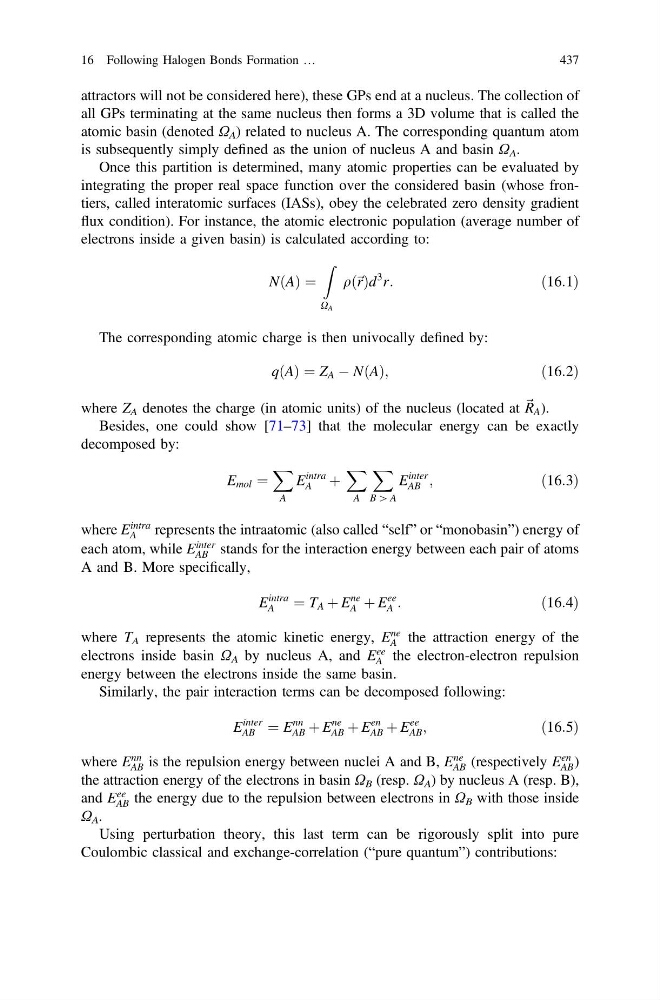
attractors will not be considered here), these GPs end at a nucleus. The collection of
all GPs terminating at the same nucleus then forms a 3D volume that is called the
atomic basin (denoted Ω A ) related to nucleus A. The corresponding quantum atom
is subsequently simply defined as the union of nucleus A and basin Ω A .
Once this partition is determined, many atomic properties can be evaluated by
integrating the proper real space function over the considered basin (whose frontiers, called interatomic surfaces (IASs), obey the celebrated zero density gradient
flux condition). For instance, the atomic electronic population (average number of
electrons inside a given basin) is calculated according to:
NðAÞ ¼
Z
X A
q ~ r
ð Þd
3 r:
ð16:1Þ
The corresponding atomic charge is then univocally defined by:
qðAÞ ¼ Z A À NðAÞ;
ð16:2Þ
where Z A denotes the charge (in atomic units) of the nucleus (located at ~ R A ).
Besides, one could show [71–73] that the molecular energy can be exactly
decomposed by:
E mol ¼
X
A
E
intra
A
þ
X
A
X
B [ A
E
inter
AB ;
ð16:3Þ
where E
intra
A
represents the intraatomic (also called “self” or “monobasin”) energy of
each atom, while E
inter
AB stands for the interaction energy between each pair of atoms
A and B. More specifically,
E
intra
A
¼ T A þ E
ne
A þ E
ee
A :
ð16:4Þ
where T A represents the atomic kinetic energy, E
ne
A the attraction energy of the
electrons inside basin Ω A by nucleus A, and E
ee
A the electron-electron repulsion
energy between the electrons inside the same basin.
Similarly, the pair interaction terms can be decomposed following:
E
inter
AB ¼ E
nn
AB þ E
ne
AB þ E
en
AB þ E
ee
AB ;
ð16:5Þ
where E
nn
AB is the repulsion energy between nuclei A and B, E
ne
AB (respectively E
en
AB )
the attraction energy of the electrons in basin Ω B (resp. Ω A ) by nucleus A (resp. B),
and E
ee
AB the energy due to the repulsion between electrons in Ω B with those inside
Ω A .
Using perturbation theory, this last term can be rigorously split into pure
Coulombic classical and exchange-correlation (“pure quantum”) contributions:
16 Following Halogen Bonds Formation …
437
all GPs terminating at the same nucleus then forms a 3D volume that is called the
atomic basin (denoted Ω A ) related to nucleus A. The corresponding quantum atom
is subsequently simply defined as the union of nucleus A and basin Ω A .
Once this partition is determined, many atomic properties can be evaluated by
integrating the proper real space function over the considered basin (whose frontiers, called interatomic surfaces (IASs), obey the celebrated zero density gradient
flux condition). For instance, the atomic electronic population (average number of
electrons inside a given basin) is calculated according to:
NðAÞ ¼
Z
X A
q ~ r
ð Þd
3 r:
ð16:1Þ
The corresponding atomic charge is then univocally defined by:
qðAÞ ¼ Z A À NðAÞ;
ð16:2Þ
where Z A denotes the charge (in atomic units) of the nucleus (located at ~ R A ).
Besides, one could show [71–73] that the molecular energy can be exactly
decomposed by:
E mol ¼
X
A
E
intra
A
þ
X
A
X
B [ A
E
inter
AB ;
ð16:3Þ
where E
intra
A
represents the intraatomic (also called “self” or “monobasin”) energy of
each atom, while E
inter
AB stands for the interaction energy between each pair of atoms
A and B. More specifically,
E
intra
A
¼ T A þ E
ne
A þ E
ee
A :
ð16:4Þ
where T A represents the atomic kinetic energy, E
ne
A the attraction energy of the
electrons inside basin Ω A by nucleus A, and E
ee
A the electron-electron repulsion
energy between the electrons inside the same basin.
Similarly, the pair interaction terms can be decomposed following:
E
inter
AB ¼ E
nn
AB þ E
ne
AB þ E
en
AB þ E
ee
AB ;
ð16:5Þ
where E
nn
AB is the repulsion energy between nuclei A and B, E
ne
AB (respectively E
en
AB )
the attraction energy of the electrons in basin Ω B (resp. Ω A ) by nucleus A (resp. B),
and E
ee
AB the energy due to the repulsion between electrons in Ω B with those inside
Ω A .
Using perturbation theory, this last term can be rigorously split into pure
Coulombic classical and exchange-correlation (“pure quantum”) contributions:
16 Following Halogen Bonds Formation …
437