

increases. For example, for the CH 3 F, SiH 3 F and GeH 3 F series the maximum EP at
tetrel atom, in the elongation of fluorine—tetrel center bond, is equal to +0.033,
+0.062 and +0.068 au, respectively [45]. Hence the S N 2 reaction mentioned earlier
here and preceded by the tetrel bond is more probable for the tin species than for the
germanium one. There is also the influence of the size effect. It was claimed that the
methyl groups are more important to block the tetrel center if the latter one is
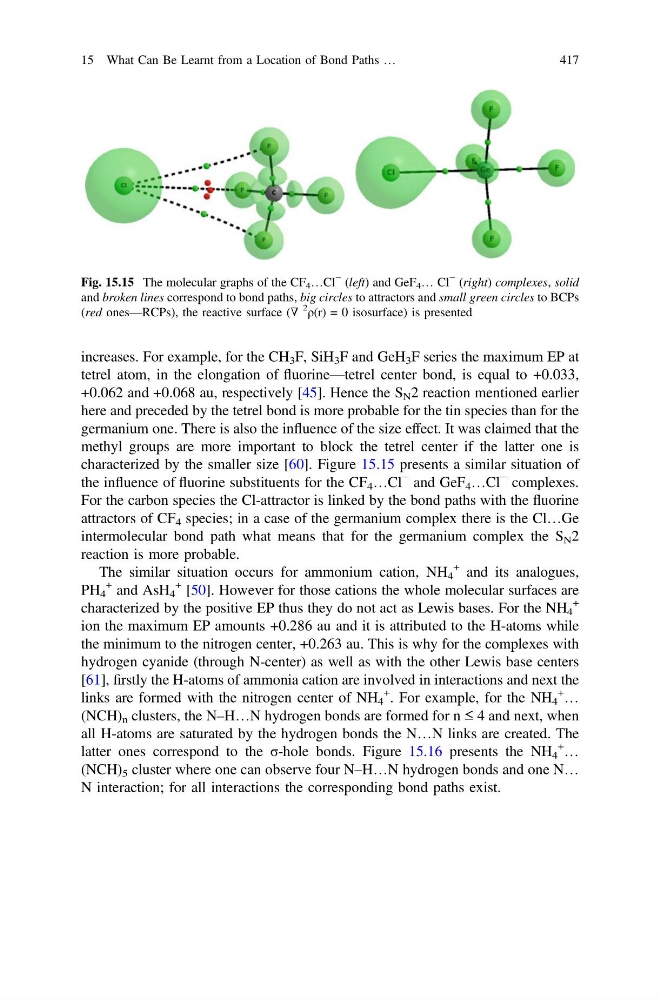
characterized by the smaller size [60]. Figure 15.15 presents a similar situation of
the influence of fluorine substituents for the CF 4 …Cl
− and GeF 4 …Cl
− complexes.
For the carbon species the Cl-attractor is linked by the bond paths with the fluorine
attractors of CF 4 species; in a case of the germanium complex there is the Cl…Ge
intermolecular bond path what means that for the germanium complex the S N 2
reaction is more probable.
The similar situation occurs for ammonium cation, NH 4
+ and its analogues,
PH 4
+ and AsH 4
+ [50]. However for those cations the whole molecular surfaces are
characterized by the positive EP thus they do not act as Lewis bases. For the NH 4
+
ion the maximum EP amounts +0.286 au and it is attributed to the H-atoms while
the minimum to the nitrogen center, +0.263 au. This is why for the complexes with
hydrogen cyanide (through N-center) as well as with the other Lewis base centers
[61], firstly the H-atoms of ammonia cation are involved in interactions and next the
links are formed with the nitrogen center of NH 4
+
. For example, for the NH 4
+
…
(NCH) n clusters, the N–H…N hydrogen bonds are formed for n ≤ 4 and next, when
all H-atoms are saturated by the hydrogen bonds the N…N links are created. The
latter ones correspond to the σ-hole bonds. Figure 15.16 presents the NH 4
+
…
(NCH) 5 cluster where one can observe four N–H…N hydrogen bonds and one N…
N interaction; for all interactions the corresponding bond paths exist.
Fig. 15.15 The molecular graphs of the CF 4 …Cl
− (left) and GeF 4 … Cl
− (right) complexes, solid
and broken lines correspond to bond paths, big circles to attractors and small green circles to BCPs
(red ones—RCPs), the reactive surface (∇
2
ρ(r) = 0 isosurface) is presented
15 What Can Be Learnt from a Location of Bond Paths …
417
tetrel atom, in the elongation of fluorine—tetrel center bond, is equal to +0.033,
+0.062 and +0.068 au, respectively [45]. Hence the S N 2 reaction mentioned earlier
here and preceded by the tetrel bond is more probable for the tin species than for the
germanium one. There is also the influence of the size effect. It was claimed that the
methyl groups are more important to block the tetrel center if the latter one is
characterized by the smaller size [60]. Figure 15.15 presents a similar situation of
the influence of fluorine substituents for the CF 4 …Cl
− and GeF 4 …Cl
− complexes.
For the carbon species the Cl-attractor is linked by the bond paths with the fluorine
attractors of CF 4 species; in a case of the germanium complex there is the Cl…Ge
intermolecular bond path what means that for the germanium complex the S N 2
reaction is more probable.
The similar situation occurs for ammonium cation, NH 4
+ and its analogues,
PH 4
+ and AsH 4
+ [50]. However for those cations the whole molecular surfaces are
characterized by the positive EP thus they do not act as Lewis bases. For the NH 4
+
ion the maximum EP amounts +0.286 au and it is attributed to the H-atoms while
the minimum to the nitrogen center, +0.263 au. This is why for the complexes with
hydrogen cyanide (through N-center) as well as with the other Lewis base centers
[61], firstly the H-atoms of ammonia cation are involved in interactions and next the
links are formed with the nitrogen center of NH 4
+
. For example, for the NH 4
+
…
(NCH) n clusters, the N–H…N hydrogen bonds are formed for n ≤ 4 and next, when
all H-atoms are saturated by the hydrogen bonds the N…N links are created. The
latter ones correspond to the σ-hole bonds. Figure 15.16 presents the NH 4
+
…
(NCH) 5 cluster where one can observe four N–H…N hydrogen bonds and one N…
N interaction; for all interactions the corresponding bond paths exist.
Fig. 15.15 The molecular graphs of the CF 4 …Cl
− (left) and GeF 4 … Cl
− (right) complexes, solid
and broken lines correspond to bond paths, big circles to attractors and small green circles to BCPs
(red ones—RCPs), the reactive surface (∇
2
ρ(r) = 0 isosurface) is presented
15 What Can Be Learnt from a Location of Bond Paths …
417