

the positive EP (+0.032 au) at the C-center in the elongation of the Cl–C bond, this
is the σ-hole which plays the role of the Lewis acid in interactions with electron rich
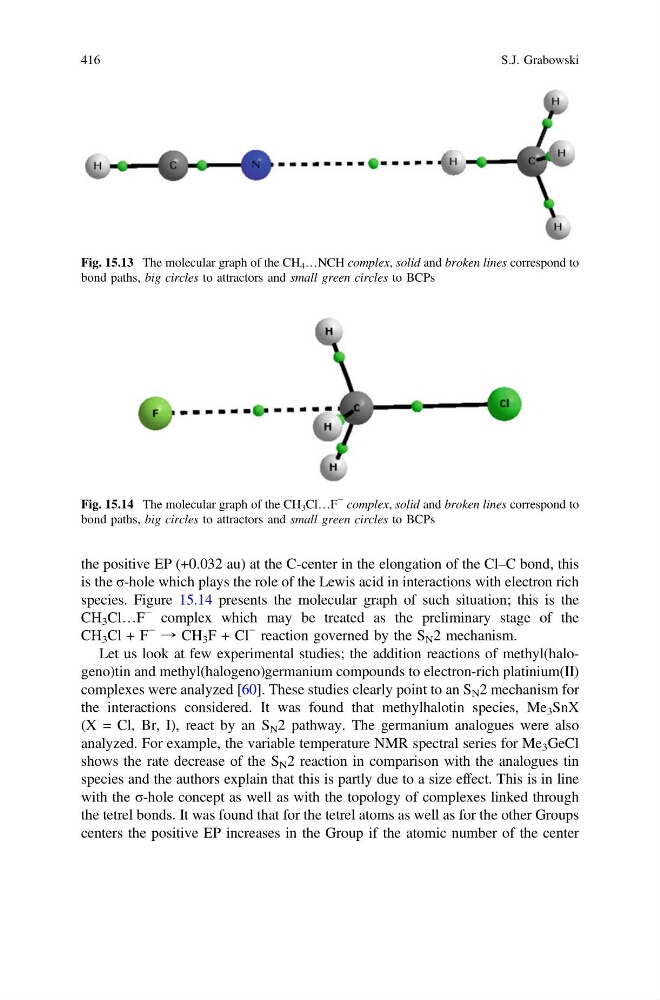
species. Figure 15.14 presents the molecular graph of such situation; this is the
CH 3 Cl…F
− complex which may be treated as the preliminary stage of the
CH 3 Cl + F
−
→ CH 3 F + Cl
− reaction governed by the S N 2 mechanism.
Let us look at few experimental studies; the addition reactions of methyl(halogeno)tin and methyl(halogeno)germanium compounds to electron-rich platinium(II)
complexes were analyzed [60]. These studies clearly point to an S N 2 mechanism for
the interactions considered. It was found that methylhalotin species, Me 3 SnX
(X = Cl, Br, I), react by an S N 2 pathway. The germanium analogues were also
analyzed. For example, the variable temperature NMR spectral series for Me 3 GeCl
shows the rate decrease of the S N 2 reaction in comparison with the analogues tin
species and the authors explain that this is partly due to a size effect. This is in line
with the σ-hole concept as well as with the topology of complexes linked through
the tetrel bonds. It was found that for the tetrel atoms as well as for the other Groups
centers the positive EP increases in the Group if the atomic number of the center
Fig. 15.13 The molecular graph of the CH 4 …NCH complex, solid and broken lines correspond to
bond paths, big circles to attractors and small green circles to BCPs
Fig. 15.14 The molecular graph of the CH 3 Cl…F
− complex, solid and broken lines correspond to
bond paths, big circles to attractors and small green circles to BCPs
416
S.J. Grabowski
is the σ-hole which plays the role of the Lewis acid in interactions with electron rich
species. Figure 15.14 presents the molecular graph of such situation; this is the
CH 3 Cl…F
− complex which may be treated as the preliminary stage of the
CH 3 Cl + F
−
→ CH 3 F + Cl
− reaction governed by the S N 2 mechanism.
Let us look at few experimental studies; the addition reactions of methyl(halogeno)tin and methyl(halogeno)germanium compounds to electron-rich platinium(II)
complexes were analyzed [60]. These studies clearly point to an S N 2 mechanism for
the interactions considered. It was found that methylhalotin species, Me 3 SnX
(X = Cl, Br, I), react by an S N 2 pathway. The germanium analogues were also
analyzed. For example, the variable temperature NMR spectral series for Me 3 GeCl
shows the rate decrease of the S N 2 reaction in comparison with the analogues tin
species and the authors explain that this is partly due to a size effect. This is in line
with the σ-hole concept as well as with the topology of complexes linked through
the tetrel bonds. It was found that for the tetrel atoms as well as for the other Groups
centers the positive EP increases in the Group if the atomic number of the center
Fig. 15.13 The molecular graph of the CH 4 …NCH complex, solid and broken lines correspond to
bond paths, big circles to attractors and small green circles to BCPs
Fig. 15.14 The molecular graph of the CH 3 Cl…F
− complex, solid and broken lines correspond to
bond paths, big circles to attractors and small green circles to BCPs
416
S.J. Grabowski