

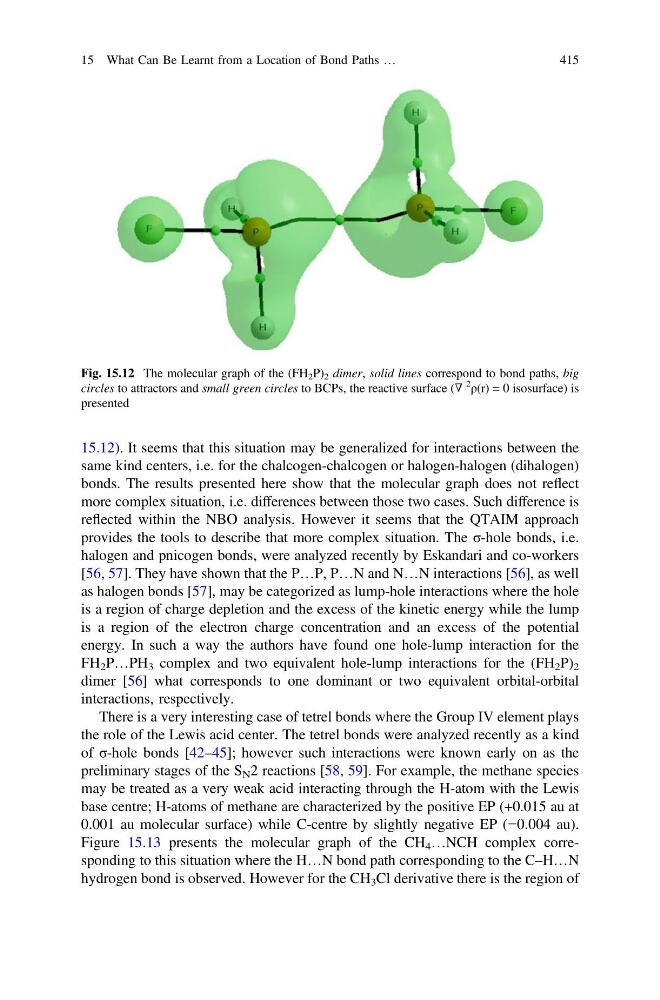
15.12). It seems that this situation may be generalized for interactions between the
same kind centers, i.e. for the chalcogen-chalcogen or halogen-halogen (dihalogen)
bonds. The results presented here show that the molecular graph does not reflect
more complex situation, i.e. differences between those two cases. Such difference is
reflected within the NBO analysis. However it seems that the QTAIM approach
provides the tools to describe that more complex situation. The σ-hole bonds, i.e.
halogen and pnicogen bonds, were analyzed recently by Eskandari and co-workers
[56, 57]. They have shown that the P…P, P…N and N…N interactions [56], as well
as halogen bonds [57], may be categorized as lump-hole interactions where the hole
is a region of charge depletion and the excess of the kinetic energy while the lump
is a region of the electron charge concentration and an excess of the potential
energy. In such a way the authors have found one hole-lump interaction for the
FH 2 P…PH 3 complex and two equivalent hole-lump interactions for the (FH 2 P) 2
dimer [56] what corresponds to one dominant or two equivalent orbital-orbital
interactions, respectively.
There is a very interesting case of tetrel bonds where the Group IV element plays
the role of the Lewis acid center. The tetrel bonds were analyzed recently as a kind
of σ-hole bonds [42–45]; however such interactions were known early on as the
preliminary stages of the S N 2 reactions [58, 59]. For example, the methane species
may be treated as a very weak acid interacting through the H-atom with the Lewis
base centre; H-atoms of methane are characterized by the positive EP (+0.015 au at
0.001 au molecular surface) while C-centre by slightly negative EP (−0.004 au).
Figure 15.13 presents the molecular graph of the CH 4 …NCH complex corresponding to this situation where the H…N bond path corresponding to the C–H…N
hydrogen bond is observed. However for the CH 3 Cl derivative there is the region of
Fig. 15.12 The molecular graph of the (FH 2 P) 2 dimer, solid lines correspond to bond paths, big
circles to attractors and small green circles to BCPs, the reactive surface (∇
2
ρ(r) = 0 isosurface) is
presented
15 What Can Be Learnt from a Location of Bond Paths …
415
same kind centers, i.e. for the chalcogen-chalcogen or halogen-halogen (dihalogen)
bonds. The results presented here show that the molecular graph does not reflect
more complex situation, i.e. differences between those two cases. Such difference is
reflected within the NBO analysis. However it seems that the QTAIM approach
provides the tools to describe that more complex situation. The σ-hole bonds, i.e.
halogen and pnicogen bonds, were analyzed recently by Eskandari and co-workers
[56, 57]. They have shown that the P…P, P…N and N…N interactions [56], as well
as halogen bonds [57], may be categorized as lump-hole interactions where the hole
is a region of charge depletion and the excess of the kinetic energy while the lump
is a region of the electron charge concentration and an excess of the potential
energy. In such a way the authors have found one hole-lump interaction for the
FH 2 P…PH 3 complex and two equivalent hole-lump interactions for the (FH 2 P) 2
dimer [56] what corresponds to one dominant or two equivalent orbital-orbital
interactions, respectively.
There is a very interesting case of tetrel bonds where the Group IV element plays
the role of the Lewis acid center. The tetrel bonds were analyzed recently as a kind
of σ-hole bonds [42–45]; however such interactions were known early on as the
preliminary stages of the S N 2 reactions [58, 59]. For example, the methane species
may be treated as a very weak acid interacting through the H-atom with the Lewis
base centre; H-atoms of methane are characterized by the positive EP (+0.015 au at
0.001 au molecular surface) while C-centre by slightly negative EP (−0.004 au).
Figure 15.13 presents the molecular graph of the CH 4 …NCH complex corresponding to this situation where the H…N bond path corresponding to the C–H…N
hydrogen bond is observed. However for the CH 3 Cl derivative there is the region of
Fig. 15.12 The molecular graph of the (FH 2 P) 2 dimer, solid lines correspond to bond paths, big
circles to attractors and small green circles to BCPs, the reactive surface (∇
2
ρ(r) = 0 isosurface) is
presented
15 What Can Be Learnt from a Location of Bond Paths …
415