

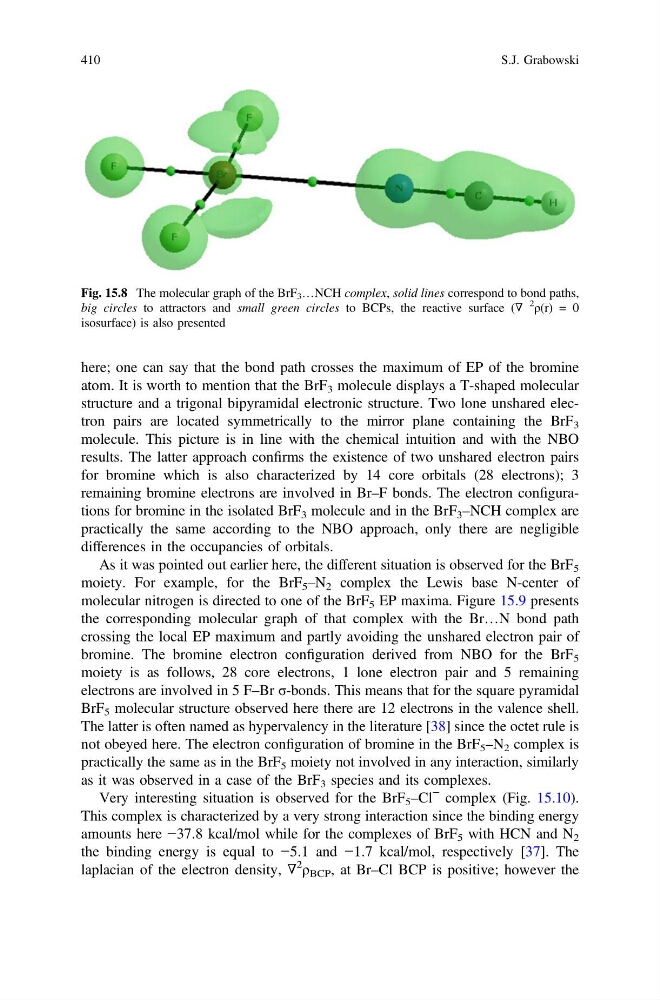
here; one can say that the bond path crosses the maximum of EP of the bromine
atom. It is worth to mention that the BrF 3 molecule displays a T-shaped molecular
structure and a trigonal bipyramidal electronic structure. Two lone unshared electron pairs are located symmetrically to the mirror plane containing the BrF 3
molecule. This picture is in line with the chemical intuition and with the NBO
results. The latter approach confirms the existence of two unshared electron pairs
for bromine which is also characterized by 14 core orbitals (28 electrons); 3
remaining bromine electrons are involved in Br–F bonds. The electron configurations for bromine in the isolated BrF 3 molecule and in the BrF 3 –NCH complex are
practically the same according to the NBO approach, only there are negligible
differences in the occupancies of orbitals.
As it was pointed out earlier here, the different situation is observed for the BrF 5
moiety. For example, for the BrF 5 –N 2 complex the Lewis base N-center of
molecular nitrogen is directed to one of the BrF 5 EP maxima. Figure 15.9 presents
the corresponding molecular graph of that complex with the Br…N bond path
crossing the local EP maximum and partly avoiding the unshared electron pair of
bromine. The bromine electron configuration derived from NBO for the BrF 5
moiety is as follows, 28 core electrons, 1 lone electron pair and 5 remaining
electrons are involved in 5 F–Br σ-bonds. This means that for the square pyramidal
BrF 5 molecular structure observed here there are 12 electrons in the valence shell.
The latter is often named as hypervalency in the literature [38] since the octet rule is
not obeyed here. The electron configuration of bromine in the BrF 5 –N 2 complex is
practically the same as in the BrF 5 moiety not involved in any interaction, similarly
as it was observed in a case of the BrF 3 species and its complexes.
Very interesting situation is observed for the BrF 5 –Cl
− complex (Fig. 15.10).
This complex is characterized by a very strong interaction since the binding energy
amounts here −37.8 kcal/mol while for the complexes of BrF 5 with HCN and N 2
the binding energy is equal to −5.1 and −1.7 kcal/mol, respectively [37]. The
laplacian of the electron density, ∇
2
ρ BCP , at Br–Cl BCP is positive; however the
Fig. 15.8 The molecular graph of the BrF 3 …NCH complex, solid lines correspond to bond paths,
big circles to attractors and small green circles to BCPs, the reactive surface (∇
2
ρ(r) = 0
isosurface) is also presented
410
S.J. Grabowski
atom. It is worth to mention that the BrF 3 molecule displays a T-shaped molecular
structure and a trigonal bipyramidal electronic structure. Two lone unshared electron pairs are located symmetrically to the mirror plane containing the BrF 3
molecule. This picture is in line with the chemical intuition and with the NBO
results. The latter approach confirms the existence of two unshared electron pairs
for bromine which is also characterized by 14 core orbitals (28 electrons); 3
remaining bromine electrons are involved in Br–F bonds. The electron configurations for bromine in the isolated BrF 3 molecule and in the BrF 3 –NCH complex are
practically the same according to the NBO approach, only there are negligible
differences in the occupancies of orbitals.
As it was pointed out earlier here, the different situation is observed for the BrF 5
moiety. For example, for the BrF 5 –N 2 complex the Lewis base N-center of
molecular nitrogen is directed to one of the BrF 5 EP maxima. Figure 15.9 presents
the corresponding molecular graph of that complex with the Br…N bond path
crossing the local EP maximum and partly avoiding the unshared electron pair of
bromine. The bromine electron configuration derived from NBO for the BrF 5
moiety is as follows, 28 core electrons, 1 lone electron pair and 5 remaining
electrons are involved in 5 F–Br σ-bonds. This means that for the square pyramidal
BrF 5 molecular structure observed here there are 12 electrons in the valence shell.
The latter is often named as hypervalency in the literature [38] since the octet rule is
not obeyed here. The electron configuration of bromine in the BrF 5 –N 2 complex is
practically the same as in the BrF 5 moiety not involved in any interaction, similarly
as it was observed in a case of the BrF 3 species and its complexes.
Very interesting situation is observed for the BrF 5 –Cl
− complex (Fig. 15.10).
This complex is characterized by a very strong interaction since the binding energy
amounts here −37.8 kcal/mol while for the complexes of BrF 5 with HCN and N 2
the binding energy is equal to −5.1 and −1.7 kcal/mol, respectively [37]. The
laplacian of the electron density, ∇
2
ρ BCP , at Br–Cl BCP is positive; however the
Fig. 15.8 The molecular graph of the BrF 3 …NCH complex, solid lines correspond to bond paths,
big circles to attractors and small green circles to BCPs, the reactive surface (∇
2
ρ(r) = 0
isosurface) is also presented
410
S.J. Grabowski