

well as less negative region of EP around the Cl-atom (orange color in Fig. 15.3)
being the consequence of the existence of unshared electron pairs. The positive
region of EP in the elongation of the C–Cl bond is observed (blue color). This is
interesting that there are also regions of the positive EP in the elongation of F–C
and Cl–C bonds, attributed to the carbon which may also act as the Lewis acid sites.
Such regions are also nicely explained in terms of the σ-hole concept.
In general the σ-hole concept explains satisfactory why the halogen centers
possess the dual character; they may act as the Lewis acid and as the Lewis base. In
the former case the corresponding interaction is named as the halogen bond and it is
usually linear or nearly so due to the location of the restricted area of the positive
EP in the elongation of C–X bond.
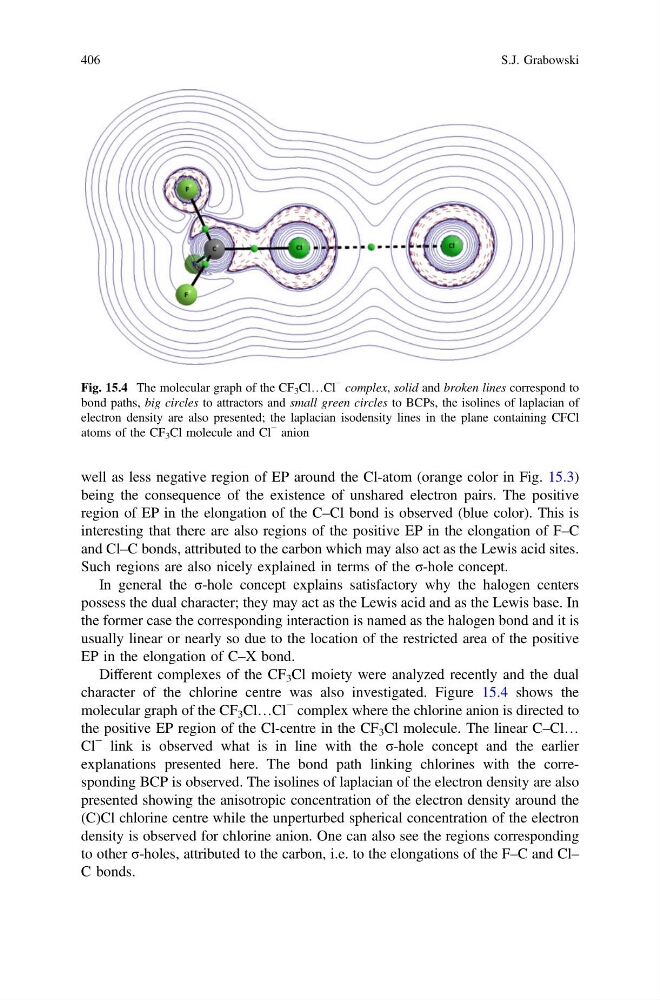
Different complexes of the CF 3 Cl moiety were analyzed recently and the dual
character of the chlorine centre was also investigated. Figure 15.4 shows the
molecular graph of the CF 3 Cl…Cl
− complex where the chlorine anion is directed to
the positive EP region of the Cl-centre in the CF 3 Cl molecule. The linear C–Cl…
Cl
− link is observed what is in line with the σ-hole concept and the earlier
explanations presented here. The bond path linking chlorines with the corresponding BCP is observed. The isolines of laplacian of the electron density are also
presented showing the anisotropic concentration of the electron density around the
(C)Cl chlorine centre while the unperturbed spherical concentration of the electron
density is observed for chlorine anion. One can also see the regions corresponding
to other σ-holes, attributed to the carbon, i.e. to the elongations of the F–C and Cl–
C bonds.
Fig. 15.4 The molecular graph of the CF 3 Cl…Cl
− complex, solid and broken lines correspond to
bond paths, big circles to attractors and small green circles to BCPs, the isolines of laplacian of
electron density are also presented; the laplacian isodensity lines in the plane containing CFCl
atoms of the CF 3 Cl molecule and Cl
− anion
406
S.J. Grabowski
being the consequence of the existence of unshared electron pairs. The positive
region of EP in the elongation of the C–Cl bond is observed (blue color). This is
interesting that there are also regions of the positive EP in the elongation of F–C
and Cl–C bonds, attributed to the carbon which may also act as the Lewis acid sites.
Such regions are also nicely explained in terms of the σ-hole concept.
In general the σ-hole concept explains satisfactory why the halogen centers
possess the dual character; they may act as the Lewis acid and as the Lewis base. In
the former case the corresponding interaction is named as the halogen bond and it is
usually linear or nearly so due to the location of the restricted area of the positive
EP in the elongation of C–X bond.
Different complexes of the CF 3 Cl moiety were analyzed recently and the dual
character of the chlorine centre was also investigated. Figure 15.4 shows the
molecular graph of the CF 3 Cl…Cl
− complex where the chlorine anion is directed to
the positive EP region of the Cl-centre in the CF 3 Cl molecule. The linear C–Cl…
Cl
− link is observed what is in line with the σ-hole concept and the earlier
explanations presented here. The bond path linking chlorines with the corresponding BCP is observed. The isolines of laplacian of the electron density are also
presented showing the anisotropic concentration of the electron density around the
(C)Cl chlorine centre while the unperturbed spherical concentration of the electron
density is observed for chlorine anion. One can also see the regions corresponding
to other σ-holes, attributed to the carbon, i.e. to the elongations of the F–C and Cl–
C bonds.
Fig. 15.4 The molecular graph of the CF 3 Cl…Cl
− complex, solid and broken lines correspond to
bond paths, big circles to attractors and small green circles to BCPs, the isolines of laplacian of
electron density are also presented; the laplacian isodensity lines in the plane containing CFCl
atoms of the CF 3 Cl molecule and Cl
− anion
406
S.J. Grabowski