

indicated where the laplacian value is negative or positive. The latter indication is
useful to describe different characteristics of the system analyzed such as the Lewis
acid and Lewis base sites, the nature of interatomic contacts (bonds or intermolecular contacts), the regions of the concentration and depletion of electron
charge density—the latter often leads to the location of unshared electron pairs, to
the identification if the bond is ionic or covalent in nature, etc. [13–15]. For
numerous molecular graphs analyzed hereafter these laplacian isolines or the
reactive surfaces (∇ρ
2 (r) = 0 isosurfaces) are also presented to deepen the understanding of the nature of interactions.
There is no difference if, from classical point of view, the intermolecular
interaction or the chemical bond is considered. For both cases the bond path is
created what means that two atoms are bonded (but it does not mean that necessarily there is the bond between them). Sometimes the characteristics of the bond
critical point (BCP) related to the bond path considered are analyzed, the negative
value of the laplacian of the electron density at BCP, ∇
2
ρ BCP , indicates the concentration of the electron charge density in the inter-atomic region what is typical
for covalent bonds. If the positive value of ∇
2
ρ BCP is observed thus there is the
closed-shell interaction like in a case of an ionic bond, a van der Waals interaction
or a hydrogen bond. However the above classification is not always a rule.
Sometimes for strong hydrogen bonds the total electron energy density at BCP,
H BCP , is negative or even for very strong hydrogen bonds the ∇
2
ρ BCP value is
negative like for the typical covalent bonds [16, 17]. It was stated that the interaction is covalent in nature or at least it is characterized by the partial covalency if
H BCP for the analyzed interatomic contact is negative, there is no requirement of the
negative value of ∇
2
ρ BCP [18, 19]. One can mention here well known relationships
between energetic topological parameters and the laplacian of the electron density
at BCP (expressed in atomic units, see Eq. 15.1) [5, 6].
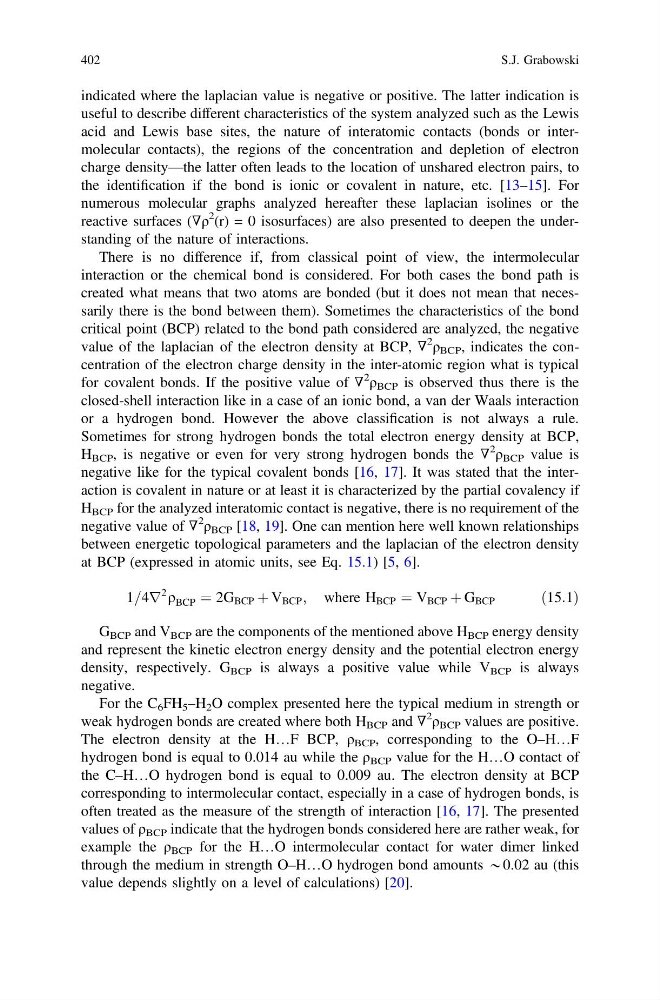
1=4r
2
q BCP ¼ 2G BCP þ V BCP ; where H BCP ¼ V BCP þ G BCP
ð15:1Þ
G BCP and V BCP are the components of the mentioned above H BCP energy density
and represent the kinetic electron energy density and the potential electron energy
density, respectively. G BCP is always a positive value while V BCP is always
negative.
For the C 6 FH 5 –H 2 O complex presented here the typical medium in strength or
weak hydrogen bonds are created where both H BCP and ∇
2
ρ BCP values are positive.
The electron density at the H…F BCP, ρ BCP , corresponding to the O–H…F
hydrogen bond is equal to 0.014 au while the ρ BCP value for the H…O contact of
the C–H…O hydrogen bond is equal to 0.009 au. The electron density at BCP
corresponding to intermolecular contact, especially in a case of hydrogen bonds, is
often treated as the measure of the strength of interaction [16, 17]. The presented
values of ρ BCP indicate that the hydrogen bonds considered here are rather weak, for
example the ρ BCP for the H…O intermolecular contact for water dimer linked
through the medium in strength O–H…O hydrogen bond amounts *0.02 au (this
value depends slightly on a level of calculations) [20].
402
S.J. Grabowski
useful to describe different characteristics of the system analyzed such as the Lewis
acid and Lewis base sites, the nature of interatomic contacts (bonds or intermolecular contacts), the regions of the concentration and depletion of electron
charge density—the latter often leads to the location of unshared electron pairs, to
the identification if the bond is ionic or covalent in nature, etc. [13–15]. For
numerous molecular graphs analyzed hereafter these laplacian isolines or the
reactive surfaces (∇ρ
2 (r) = 0 isosurfaces) are also presented to deepen the understanding of the nature of interactions.
There is no difference if, from classical point of view, the intermolecular
interaction or the chemical bond is considered. For both cases the bond path is
created what means that two atoms are bonded (but it does not mean that necessarily there is the bond between them). Sometimes the characteristics of the bond
critical point (BCP) related to the bond path considered are analyzed, the negative
value of the laplacian of the electron density at BCP, ∇
2
ρ BCP , indicates the concentration of the electron charge density in the inter-atomic region what is typical
for covalent bonds. If the positive value of ∇
2
ρ BCP is observed thus there is the
closed-shell interaction like in a case of an ionic bond, a van der Waals interaction
or a hydrogen bond. However the above classification is not always a rule.
Sometimes for strong hydrogen bonds the total electron energy density at BCP,
H BCP , is negative or even for very strong hydrogen bonds the ∇
2
ρ BCP value is
negative like for the typical covalent bonds [16, 17]. It was stated that the interaction is covalent in nature or at least it is characterized by the partial covalency if
H BCP for the analyzed interatomic contact is negative, there is no requirement of the
negative value of ∇
2
ρ BCP [18, 19]. One can mention here well known relationships
between energetic topological parameters and the laplacian of the electron density
at BCP (expressed in atomic units, see Eq. 15.1) [5, 6].
1=4r
2
q BCP ¼ 2G BCP þ V BCP ; where H BCP ¼ V BCP þ G BCP
ð15:1Þ
G BCP and V BCP are the components of the mentioned above H BCP energy density
and represent the kinetic electron energy density and the potential electron energy
density, respectively. G BCP is always a positive value while V BCP is always
negative.
For the C 6 FH 5 –H 2 O complex presented here the typical medium in strength or
weak hydrogen bonds are created where both H BCP and ∇
2
ρ BCP values are positive.
The electron density at the H…F BCP, ρ BCP , corresponding to the O–H…F
hydrogen bond is equal to 0.014 au while the ρ BCP value for the H…O contact of
the C–H…O hydrogen bond is equal to 0.009 au. The electron density at BCP
corresponding to intermolecular contact, especially in a case of hydrogen bonds, is
often treated as the measure of the strength of interaction [16, 17]. The presented
values of ρ BCP indicate that the hydrogen bonds considered here are rather weak, for
example the ρ BCP for the H…O intermolecular contact for water dimer linked
through the medium in strength O–H…O hydrogen bond amounts *0.02 au (this
value depends slightly on a level of calculations) [20].
402
S.J. Grabowski