

It was pointed out that the n(B) → σ AH
* orbital-orbital interaction may be treated
as a signature of the A–H…B hydrogen bond since it corresponds to the H…B
contact [21–24]. For the hydrogen bonds the latter orbital-orbital interaction energy
is the most important contribution to the charge transfer energy term. For two O–
H…F and C–H…O hydrogen bonds presented in Fig. 15.1 there are the n
(F) → σ OH
*
and n(O) → σ CH
*
orbital-orbital interactions, respectively, with the
corresponding energies amounting 1.7 and 0.8 kcal/mol (HF/aug-cc-pVTZ//
MP2/aug-cc-pVTZ level). The corresponding n(O) → σ OH
*
orbital-orbital interaction for the mentioned above water dimer is equal to *6 kcal/mol (depending on
the level of calculation).
One can see two ring critical points (RCPs, red small circles in Fig. 15.1)
attributed to the benzene ring and to the ring created by covalent bonds and two
H…F and H…O contacts; i.e. the latter RCP corresponds to the O–H…F–C–C–
H…O ring. Figure 15.1 shows also the isolines of the laplacian of electron density
with the regions of the concentration of the electron density at O and F proton
acceptor centers. Those regions correspond to the lone electron pairs which are
responsible for the existence of the negative electrostatic potentials (EPs) at the
oxygen and fluorine atoms. The hydrogen atoms of the (C)H…O and (O)H…F
contacts are characterized by the positive EPs due to the significant outflow of the
electron density from the hydrogen atoms to the carbon and oxygen atoms and to
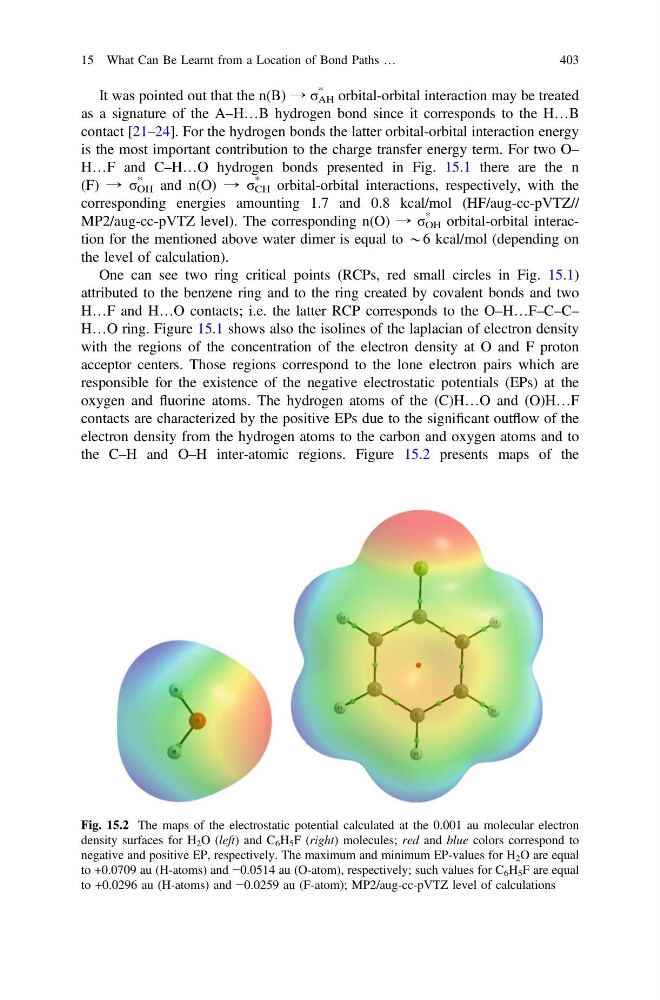
the C–H and O–H inter-atomic regions. Figure 15.2 presents maps of the
Fig. 15.2 The maps of the electrostatic potential calculated at the 0.001 au molecular electron
density surfaces for H 2 O (left) and C 6 H 5 F (right) molecules; red and blue colors correspond to
negative and positive EP, respectively. The maximum and minimum EP-values for H 2 O are equal
to +0.0709 au (H-atoms) and −0.0514 au (O-atom), respectively; such values for C 6 H 5 F are equal
to +0.0296 au (H-atoms) and −0.0259 au (F-atom); MP2/aug-cc-pVTZ level of calculations
15 What Can Be Learnt from a Location of Bond Paths …
403
* orbital-orbital interaction may be treated
as a signature of the A–H…B hydrogen bond since it corresponds to the H…B
contact [21–24]. For the hydrogen bonds the latter orbital-orbital interaction energy
is the most important contribution to the charge transfer energy term. For two O–
H…F and C–H…O hydrogen bonds presented in Fig. 15.1 there are the n
(F) → σ OH
*
and n(O) → σ CH
*
orbital-orbital interactions, respectively, with the
corresponding energies amounting 1.7 and 0.8 kcal/mol (HF/aug-cc-pVTZ//
MP2/aug-cc-pVTZ level). The corresponding n(O) → σ OH
*
orbital-orbital interaction for the mentioned above water dimer is equal to *6 kcal/mol (depending on
the level of calculation).
One can see two ring critical points (RCPs, red small circles in Fig. 15.1)
attributed to the benzene ring and to the ring created by covalent bonds and two
H…F and H…O contacts; i.e. the latter RCP corresponds to the O–H…F–C–C–
H…O ring. Figure 15.1 shows also the isolines of the laplacian of electron density
with the regions of the concentration of the electron density at O and F proton
acceptor centers. Those regions correspond to the lone electron pairs which are
responsible for the existence of the negative electrostatic potentials (EPs) at the
oxygen and fluorine atoms. The hydrogen atoms of the (C)H…O and (O)H…F
contacts are characterized by the positive EPs due to the significant outflow of the
electron density from the hydrogen atoms to the carbon and oxygen atoms and to
the C–H and O–H inter-atomic regions. Figure 15.2 presents maps of the
Fig. 15.2 The maps of the electrostatic potential calculated at the 0.001 au molecular electron
density surfaces for H 2 O (left) and C 6 H 5 F (right) molecules; red and blue colors correspond to
negative and positive EP, respectively. The maximum and minimum EP-values for H 2 O are equal
to +0.0709 au (H-atoms) and −0.0514 au (O-atom), respectively; such values for C 6 H 5 F are equal
to +0.0296 au (H-atoms) and −0.0259 au (F-atom); MP2/aug-cc-pVTZ level of calculations
15 What Can Be Learnt from a Location of Bond Paths …
403