

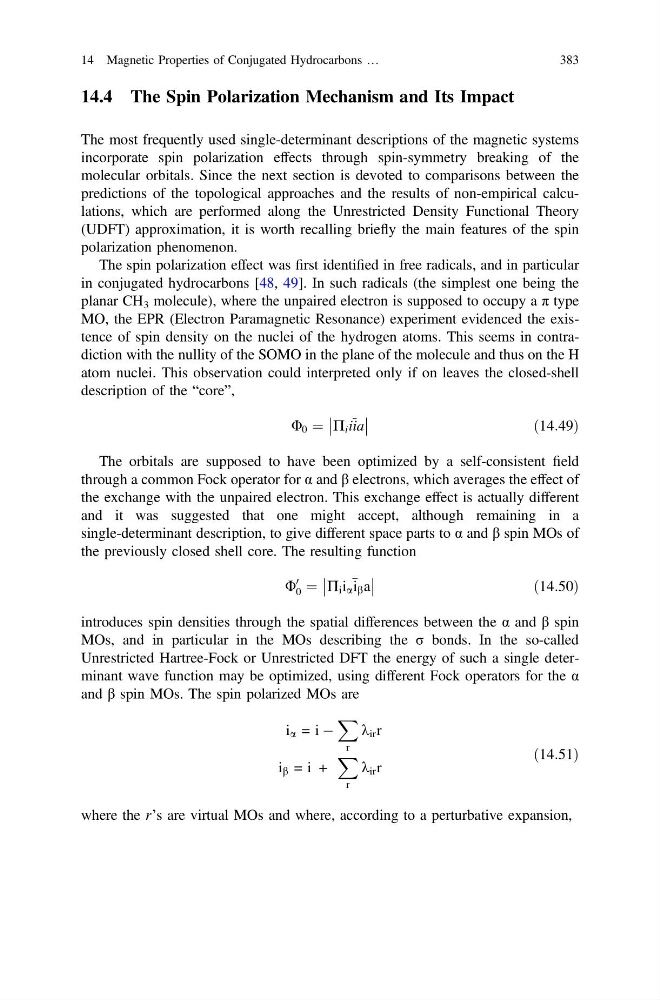
14.4 The Spin Polarization Mechanism and Its Impact
The most frequently used single-determinant descriptions of the magnetic systems
incorporate spin polarization effects through spin-symmetry breaking of the
molecular orbitals. Since the next section is devoted to comparisons between the
predictions of the topological approaches and the results of non-empirical calculations, which are performed along the Unrestricted Density Functional Theory
(UDFT) approximation, it is worth recalling briefly the main features of the spin
polarization phenomenon.
The spin polarization effect was first identified in free radicals, and in particular
in conjugated hydrocarbons [48, 49]. In such radicals (the simplest one being the
planar CH 3 molecule), where the unpaired electron is supposed to occupy a π type
MO, the EPR (Electron Paramagnetic Resonance) experiment evidenced the existence of spin density on the nuclei of the hydrogen atoms. This seems in contradiction with the nullity of the SOMO in the plane of the molecule and thus on the H
atom nuclei. This observation could interpreted only if on leaves the closed-shell
description of the “core”,
U 0 ¼ P i iia
ð14:49Þ
The orbitals are supposed to have been optimized by a self-consistent field
through a common Fock operator for α and β electrons, which averages the effect of
the exchange with the unpaired electron. This exchange effect is actually different
and it was suggested that one might accept, although remaining in a
single-determinant description, to give different space parts to α and β spin MOs of
the previously closed shell core. The resulting function
U
0
0 ¼ P i i a i b a
ð14:50Þ
introduces spin densities through the spatial differences between the α and β spin
MOs, and in particular in the MOs describing the σ bonds. In the so-called
Unrestricted Hartree-Fock or Unrestricted DFT the energy of such a single determinant wave function may be optimized, using different Fock operators for the α
and β spin MOs. The spin polarized MOs are
i a = i À
X
r
k ir r
i b = i +
X
r
k ir r
ð14:51Þ
where the r’s are virtual MOs and where, according to a perturbative expansion,
14 Magnetic Properties of Conjugated Hydrocarbons …
383
The most frequently used single-determinant descriptions of the magnetic systems
incorporate spin polarization effects through spin-symmetry breaking of the
molecular orbitals. Since the next section is devoted to comparisons between the
predictions of the topological approaches and the results of non-empirical calculations, which are performed along the Unrestricted Density Functional Theory
(UDFT) approximation, it is worth recalling briefly the main features of the spin
polarization phenomenon.
The spin polarization effect was first identified in free radicals, and in particular
in conjugated hydrocarbons [48, 49]. In such radicals (the simplest one being the
planar CH 3 molecule), where the unpaired electron is supposed to occupy a π type
MO, the EPR (Electron Paramagnetic Resonance) experiment evidenced the existence of spin density on the nuclei of the hydrogen atoms. This seems in contradiction with the nullity of the SOMO in the plane of the molecule and thus on the H
atom nuclei. This observation could interpreted only if on leaves the closed-shell
description of the “core”,
U 0 ¼ P i iia
ð14:49Þ
The orbitals are supposed to have been optimized by a self-consistent field
through a common Fock operator for α and β electrons, which averages the effect of
the exchange with the unpaired electron. This exchange effect is actually different
and it was suggested that one might accept, although remaining in a
single-determinant description, to give different space parts to α and β spin MOs of
the previously closed shell core. The resulting function
U
0
0 ¼ P i i a i b a
ð14:50Þ
introduces spin densities through the spatial differences between the α and β spin
MOs, and in particular in the MOs describing the σ bonds. In the so-called
Unrestricted Hartree-Fock or Unrestricted DFT the energy of such a single determinant wave function may be optimized, using different Fock operators for the α
and β spin MOs. The spin polarized MOs are
i a = i À
X
r
k ir r
i b = i +
X
r
k ir r
ð14:51Þ
where the r’s are virtual MOs and where, according to a perturbative expansion,
14 Magnetic Properties of Conjugated Hydrocarbons …
383