

k ir ¼ À
i
h jK a r
j i
2DE 3 ði!r)
:
ð14:52Þ
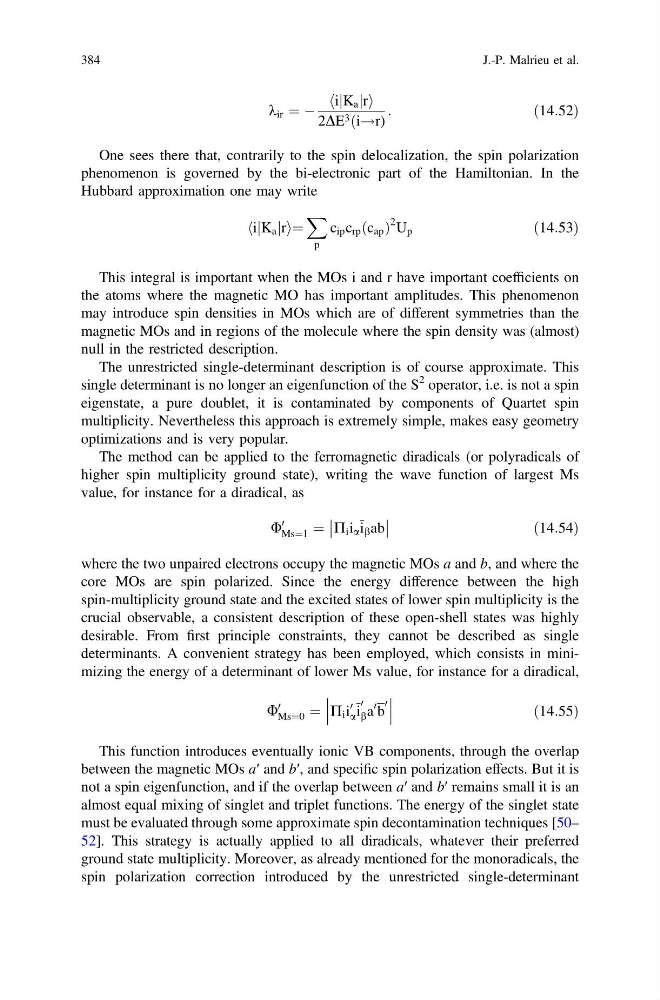
One sees there that, contrarily to the spin delocalization, the spin polarization
phenomenon is governed by the bi-electronic part of the Hamiltonian. In the
Hubbard approximation one may write
i
h jK a r
j i¼
X
p
c ip c rp ðc ap Þ
2 U p
ð14:53Þ
This integral is important when the MOs i and r have important coefficients on
the atoms where the magnetic MO has important amplitudes. This phenomenon
may introduce spin densities in MOs which are of different symmetries than the
magnetic MOs and in regions of the molecule where the spin density was (almost)
null in the restricted description.
The unrestricted single-determinant description is of course approximate. This
single determinant is no longer an eigenfunction of the S
2 operator, i.e. is not a spin
eigenstate, a pure doublet, it is contaminated by components of Quartet spin
multiplicity. Nevertheless this approach is extremely simple, makes easy geometry
optimizations and is very popular.
The method can be applied to the ferromagnetic diradicals (or polyradicals of
higher spin multiplicity ground state), writing the wave function of largest Ms
value, for instance for a diradical, as
U
0
Ms¼1 ¼ P i i a i b ab
ð14:54Þ
where the two unpaired electrons occupy the magnetic MOs a and b, and where the
core MOs are spin polarized. Since the energy difference between the high
spin-multiplicity ground state and the excited states of lower spin multiplicity is the
crucial observable, a consistent description of these open-shell states was highly
desirable. From first principle constraints, they cannot be described as single
determinants. A convenient strategy has been employed, which consists in minimizing the energy of a determinant of lower Ms value, for instance for a diradical,
U
0
Ms¼0 ¼ P i i
0
a i
0
b a
0 b
0
ð14:55Þ
This function introduces eventually ionic VB components, through the overlap
between the magnetic MOs a′ and b′, and specific spin polarization effects. But it is
not a spin eigenfunction, and if the overlap between a′ and b′ remains small it is an
almost equal mixing of singlet and triplet functions. The energy of the singlet state
must be evaluated through some approximate spin decontamination techniques [50–
52]. This strategy is actually applied to all diradicals, whatever their preferred
ground state multiplicity. Moreover, as already mentioned for the monoradicals, the
spin polarization correction introduced by the unrestricted single-determinant
384
J.-P. Malrieu et al.
i
h jK a r
j i
2DE 3 ði!r)
:
ð14:52Þ
One sees there that, contrarily to the spin delocalization, the spin polarization
phenomenon is governed by the bi-electronic part of the Hamiltonian. In the
Hubbard approximation one may write
i
h jK a r
j i¼
X
p
c ip c rp ðc ap Þ
2 U p
ð14:53Þ
This integral is important when the MOs i and r have important coefficients on
the atoms where the magnetic MO has important amplitudes. This phenomenon
may introduce spin densities in MOs which are of different symmetries than the
magnetic MOs and in regions of the molecule where the spin density was (almost)
null in the restricted description.
The unrestricted single-determinant description is of course approximate. This
single determinant is no longer an eigenfunction of the S
2 operator, i.e. is not a spin
eigenstate, a pure doublet, it is contaminated by components of Quartet spin
multiplicity. Nevertheless this approach is extremely simple, makes easy geometry
optimizations and is very popular.
The method can be applied to the ferromagnetic diradicals (or polyradicals of
higher spin multiplicity ground state), writing the wave function of largest Ms
value, for instance for a diradical, as
U
0
Ms¼1 ¼ P i i a i b ab
ð14:54Þ
where the two unpaired electrons occupy the magnetic MOs a and b, and where the
core MOs are spin polarized. Since the energy difference between the high
spin-multiplicity ground state and the excited states of lower spin multiplicity is the
crucial observable, a consistent description of these open-shell states was highly
desirable. From first principle constraints, they cannot be described as single
determinants. A convenient strategy has been employed, which consists in minimizing the energy of a determinant of lower Ms value, for instance for a diradical,
U
0
Ms¼0 ¼ P i i
0
a i
0
b a
0 b
0
ð14:55Þ
This function introduces eventually ionic VB components, through the overlap
between the magnetic MOs a′ and b′, and specific spin polarization effects. But it is
not a spin eigenfunction, and if the overlap between a′ and b′ remains small it is an
almost equal mixing of singlet and triplet functions. The energy of the singlet state
must be evaluated through some approximate spin decontamination techniques [50–
52]. This strategy is actually applied to all diradicals, whatever their preferred
ground state multiplicity. Moreover, as already mentioned for the monoradicals, the
spin polarization correction introduced by the unrestricted single-determinant
384
J.-P. Malrieu et al.