

(d) “Undecidable” spin multiplicity
It is worth mentioning a family of graphs for which the ground state multiplicity
cannot be assessed without accurate calculations, despite the fact that they are
alternant with equal numbers of sites of both colors. These graphs are such that they
may be seen as resulting from the interaction between two disjoint free radicals
connected by one or several atoms which are nodal positions of the SOMOs of
these radicals [44]. Consider a molecular graph with 2n sites, n red and n blue sites.
If the graph may be divided into a fragment A with 2p + 1 sites, p + 1 of red color, p
of blue color, and a fragment B with 2q − 1 sites, q − 1 of red color, and q of blue
color (p + q = n), and if the atoms connecting the fragments A and B are the minor
color atoms of both fragments, i.e. blue color atoms of fragment A and red color
atoms of fragment B, then one may define a non-bonding SOMO m A on A and a
non-bonding SOMO m B on B, and the hopping integral between them, according to
Eq. (14.4) is zero, t m A m B ¼ 0.
As the two MOs are defined in disjoint fragments the exchange integral K mAmB
is also null or very weak and one cannot decide about the ground state multiplicity
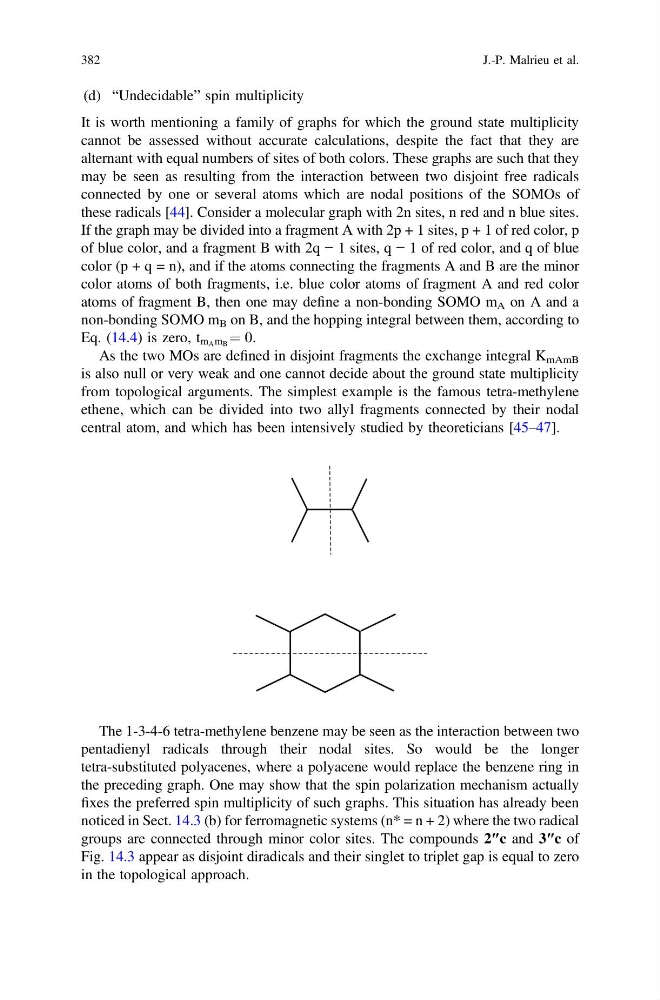
from topological arguments. The simplest example is the famous tetra-methylene
ethene, which can be divided into two allyl fragments connected by their nodal
central atom, and which has been intensively studied by theoreticians [45–47].
The 1-3-4-6 tetra-methylene benzene may be seen as the interaction between two
pentadienyl radicals through their nodal sites. So would be the longer
tetra-substituted polyacenes, where a polyacene would replace the benzene ring in
the preceding graph. One may show that the spin polarization mechanism actually
fixes the preferred spin multiplicity of such graphs. This situation has already been
noticed in Sect. 14.3 (b) for ferromagnetic systems (n* = n + 2) where the two radical
groups are connected through minor color sites. The compounds 2″c and 3″c of
Fig. 14.3 appear as disjoint diradicals and their singlet to triplet gap is equal to zero
in the topological approach.
382
J.-P. Malrieu et al.
It is worth mentioning a family of graphs for which the ground state multiplicity
cannot be assessed without accurate calculations, despite the fact that they are
alternant with equal numbers of sites of both colors. These graphs are such that they
may be seen as resulting from the interaction between two disjoint free radicals
connected by one or several atoms which are nodal positions of the SOMOs of
these radicals [44]. Consider a molecular graph with 2n sites, n red and n blue sites.
If the graph may be divided into a fragment A with 2p + 1 sites, p + 1 of red color, p
of blue color, and a fragment B with 2q − 1 sites, q − 1 of red color, and q of blue
color (p + q = n), and if the atoms connecting the fragments A and B are the minor
color atoms of both fragments, i.e. blue color atoms of fragment A and red color
atoms of fragment B, then one may define a non-bonding SOMO m A on A and a
non-bonding SOMO m B on B, and the hopping integral between them, according to
Eq. (14.4) is zero, t m A m B ¼ 0.
As the two MOs are defined in disjoint fragments the exchange integral K mAmB
is also null or very weak and one cannot decide about the ground state multiplicity
from topological arguments. The simplest example is the famous tetra-methylene
ethene, which can be divided into two allyl fragments connected by their nodal
central atom, and which has been intensively studied by theoreticians [45–47].
The 1-3-4-6 tetra-methylene benzene may be seen as the interaction between two
pentadienyl radicals through their nodal sites. So would be the longer
tetra-substituted polyacenes, where a polyacene would replace the benzene ring in
the preceding graph. One may show that the spin polarization mechanism actually
fixes the preferred spin multiplicity of such graphs. This situation has already been
noticed in Sect. 14.3 (b) for ferromagnetic systems (n* = n + 2) where the two radical
groups are connected through minor color sites. The compounds 2″c and 3″c of
Fig. 14.3 appear as disjoint diradicals and their singlet to triplet gap is equal to zero
in the topological approach.
382
J.-P. Malrieu et al.