

symmetry broken, while the geometry optimization of the Ms = 0 solution converges to a closed shell. The spin-decontaminated optimized geometry exhibits a
moderate symmetry breaking. The topological model gives t″ = 0.129t (to be
compared with the HOMO energy, 0.135 t) and U″ = 0.319U, which leads to a spin
symmetry breaking. The singlet to triplet energy gap is calculated to be 0.40 eV for
the accepted values of t and U. The Ms = 0 solutions of longer analogs have an S
2
value close to 1, i.e. are half-and-half mixtures of singlet and triplet sates. For the
larger analogs the diradical view get closer and closer to the exact
Hückel + Hubbard approach, the difference between t″ and the HOMO energy tends
to zero and so does the two evaluations of U″. For 3″b t″ = 0.063t (exact energy of
the HOMO = 0.64t) while U″ = 0.305 U. The singlet to triplet gap is evaluated to be
0.118 eV.
The dimethylene naphthalene molecule 2″a is the first member of a series of
branched polyacenes which are expected to be singlet and which accept a unique
Kékulé bond pairing. Suppressing successively one of the two extra methylene
groups one generates two free radical SOMOs a and b, the shape of which was
given in Sect. 14.2. For 2″a the hopping integral between the a and b SOMOs is
easily calculated to be equal to t″ = 3t/17 = 0.176t, close to the Hückel HOMO
energy (0.188t). The quantity U″ is also easily calculated to be equal to 101 U/289.
In this case, according to Eq. (14.38), the singlet to triplet excitation energy is found
to be 0.63 eV.
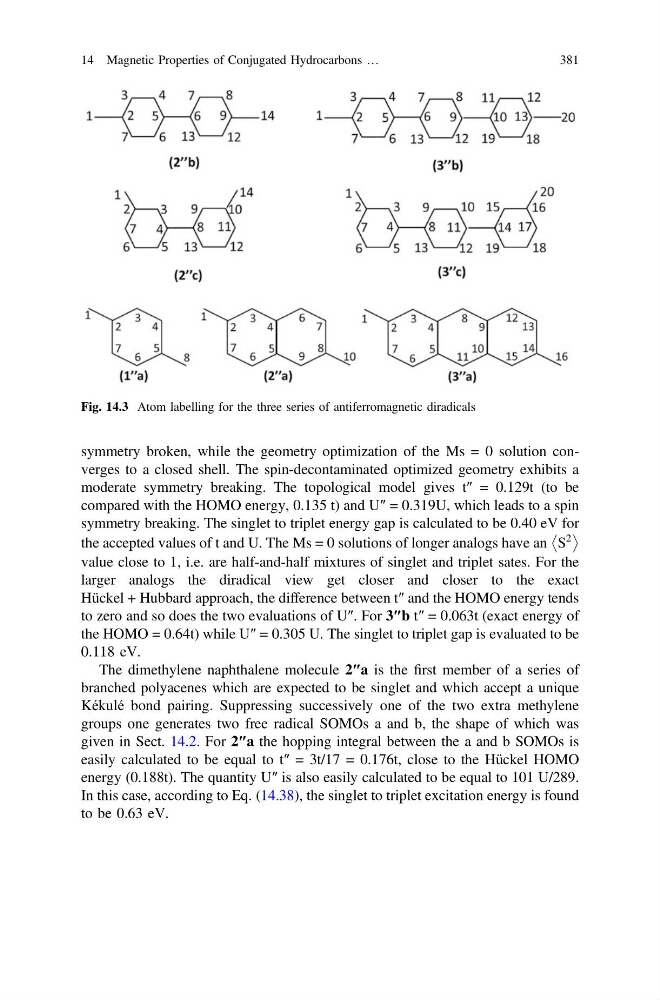
Fig. 14.3 Atom labelling for the three series of antiferromagnetic diradicals
14 Magnetic Properties of Conjugated Hydrocarbons …
381
moderate symmetry breaking. The topological model gives t″ = 0.129t (to be
compared with the HOMO energy, 0.135 t) and U″ = 0.319U, which leads to a spin
symmetry breaking. The singlet to triplet energy gap is calculated to be 0.40 eV for
the accepted values of t and U. The Ms = 0 solutions of longer analogs have an S
2
value close to 1, i.e. are half-and-half mixtures of singlet and triplet sates. For the
larger analogs the diradical view get closer and closer to the exact
Hückel + Hubbard approach, the difference between t″ and the HOMO energy tends
to zero and so does the two evaluations of U″. For 3″b t″ = 0.063t (exact energy of
the HOMO = 0.64t) while U″ = 0.305 U. The singlet to triplet gap is evaluated to be
0.118 eV.
The dimethylene naphthalene molecule 2″a is the first member of a series of
branched polyacenes which are expected to be singlet and which accept a unique
Kékulé bond pairing. Suppressing successively one of the two extra methylene
groups one generates two free radical SOMOs a and b, the shape of which was
given in Sect. 14.2. For 2″a the hopping integral between the a and b SOMOs is
easily calculated to be equal to t″ = 3t/17 = 0.176t, close to the Hückel HOMO
energy (0.188t). The quantity U″ is also easily calculated to be equal to 101 U/289.
In this case, according to Eq. (14.38), the singlet to triplet excitation energy is found
to be 0.63 eV.
Fig. 14.3 Atom labelling for the three series of antiferromagnetic diradicals
14 Magnetic Properties of Conjugated Hydrocarbons …
381