

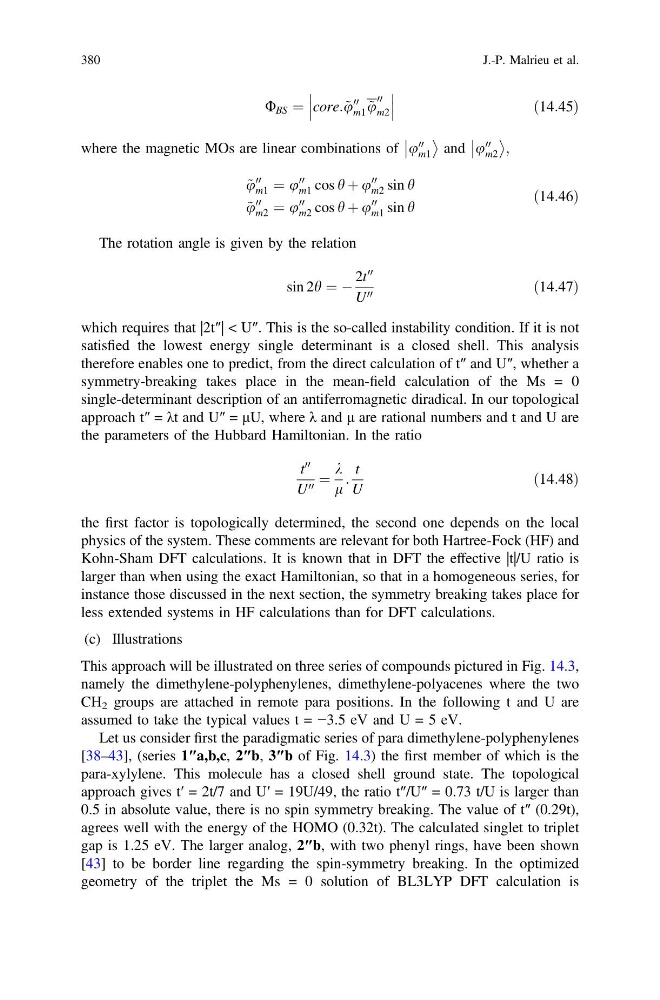
U BS ¼ core:~ u
00
m1 ~
u
00
m2
ð14:45Þ
where the magnetic MOs are linear combinations of u
00
m1
and u
00
m2
;
~
u
00
m1 ¼ u
00
m1 cos h þ u
00
m2 sin h
~
u
00
m2 ¼ u
00
m2 cos h þ u
00
m1 sin h
ð14:46Þ
The rotation angle is given by the relation
sin 2h ¼ À
2t
00
U 00
ð14:47Þ
which requires that |2t″| < U″. This is the so-called instability condition. If it is not
satisfied the lowest energy single determinant is a closed shell. This analysis
therefore enables one to predict, from the direct calculation of t″ and U″, whether a
symmetry-breaking takes place in the mean-field calculation of the Ms = 0
single-determinant description of an antiferromagnetic diradical. In our topological
approach t″ = λt and U″ = μU, where λ and μ are rational numbers and t and U are
the parameters of the Hubbard Hamiltonian. In the ratio
t
00
U 00 ¼
k
l
:
t
U
ð14:48Þ
the first factor is topologically determined, the second one depends on the local
physics of the system. These comments are relevant for both Hartree-Fock (HF) and
Kohn-Sham DFT calculations. It is known that in DFT the effective |t|/U ratio is
larger than when using the exact Hamiltonian, so that in a homogeneous series, for
instance those discussed in the next section, the symmetry breaking takes place for
less extended systems in HF calculations than for DFT calculations.
(c) Illustrations
This approach will be illustrated on three series of compounds pictured in Fig. 14.3,
namely the dimethylene-polyphenylenes, dimethylene-polyacenes where the two
CH 2 groups are attached in remote para positions. In the following t and U are
assumed to take the typical values t = −3.5 eV and U = 5 eV.
Let us consider first the paradigmatic series of para dimethylene-polyphenylenes
[38–43], (series 1″a,b,c, 2″b, 3″b of Fig. 14.3) the first member of which is the
para-xylylene. This molecule has a closed shell ground state. The topological
approach gives t′ = 2t/7 and U′ = 19U/49, the ratio t″/U″ = 0.73 t/U is larger than
0.5 in absolute value, there is no spin symmetry breaking. The value of t″ (0.29t),
agrees well with the energy of the HOMO (0.32t). The calculated singlet to triplet
gap is 1.25 eV. The larger analog, 2″b, with two phenyl rings, have been shown
[43] to be border line regarding the spin-symmetry breaking. In the optimized
geometry of the triplet the Ms = 0 solution of BL3LYP DFT calculation is
380
J.-P. Malrieu et al.
00
m1 ~
u
00
m2
ð14:45Þ
where the magnetic MOs are linear combinations of u
00
m1
and u
00
m2
;
~
u
00
m1 ¼ u
00
m1 cos h þ u
00
m2 sin h
~
u
00
m2 ¼ u
00
m2 cos h þ u
00
m1 sin h
ð14:46Þ
The rotation angle is given by the relation
sin 2h ¼ À
2t
00
U 00
ð14:47Þ
which requires that |2t″| < U″. This is the so-called instability condition. If it is not
satisfied the lowest energy single determinant is a closed shell. This analysis
therefore enables one to predict, from the direct calculation of t″ and U″, whether a
symmetry-breaking takes place in the mean-field calculation of the Ms = 0
single-determinant description of an antiferromagnetic diradical. In our topological
approach t″ = λt and U″ = μU, where λ and μ are rational numbers and t and U are
the parameters of the Hubbard Hamiltonian. In the ratio
t
00
U 00 ¼
k
l
:
t
U
ð14:48Þ
the first factor is topologically determined, the second one depends on the local
physics of the system. These comments are relevant for both Hartree-Fock (HF) and
Kohn-Sham DFT calculations. It is known that in DFT the effective |t|/U ratio is
larger than when using the exact Hamiltonian, so that in a homogeneous series, for
instance those discussed in the next section, the symmetry breaking takes place for
less extended systems in HF calculations than for DFT calculations.
(c) Illustrations
This approach will be illustrated on three series of compounds pictured in Fig. 14.3,
namely the dimethylene-polyphenylenes, dimethylene-polyacenes where the two
CH 2 groups are attached in remote para positions. In the following t and U are
assumed to take the typical values t = −3.5 eV and U = 5 eV.
Let us consider first the paradigmatic series of para dimethylene-polyphenylenes
[38–43], (series 1″a,b,c, 2″b, 3″b of Fig. 14.3) the first member of which is the
para-xylylene. This molecule has a closed shell ground state. The topological
approach gives t′ = 2t/7 and U′ = 19U/49, the ratio t″/U″ = 0.73 t/U is larger than
0.5 in absolute value, there is no spin symmetry breaking. The value of t″ (0.29t),
agrees well with the energy of the HOMO (0.32t). The calculated singlet to triplet
gap is 1.25 eV. The larger analog, 2″b, with two phenyl rings, have been shown
[43] to be border line regarding the spin-symmetry breaking. In the optimized
geometry of the triplet the Ms = 0 solution of BL3LYP DFT calculation is
380
J.-P. Malrieu et al.