

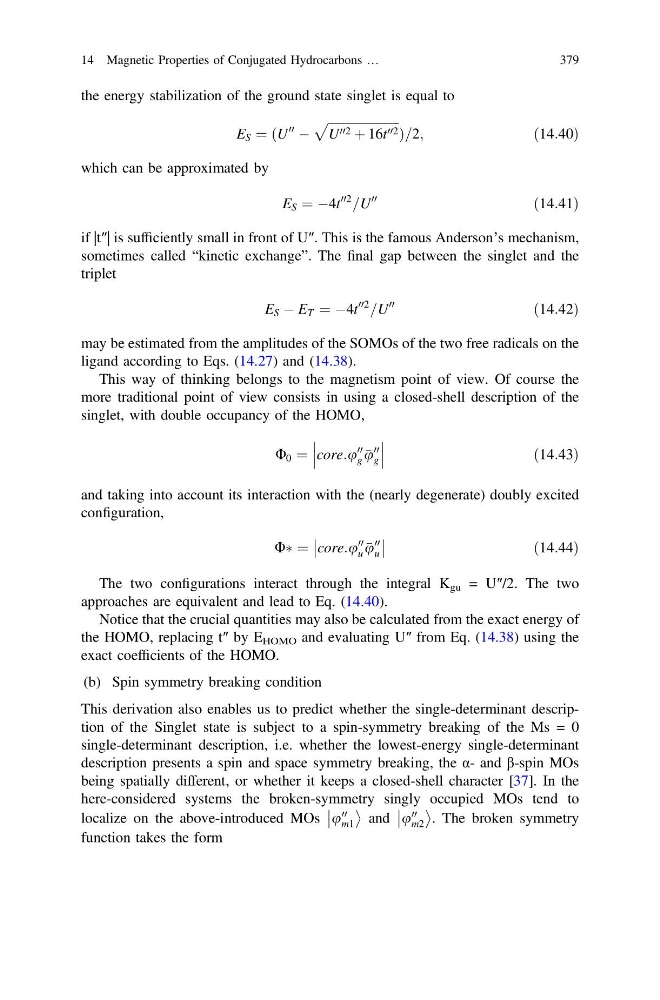
the energy stabilization of the ground state singlet is equal to
E S ¼ ðU
00
À
ffiffiffiffiffiffiffiffiffiffiffiffiffiffiffiffiffiffiffiffiffiffiffi
U 002 þ 16t 002
p
Þ=2;
ð14:40Þ
which can be approximated by
E S ¼ À4t
002
=U
00
ð14:41Þ
if |t″| is sufficiently small in front of U″. This is the famous Anderson’s mechanism,
sometimes called “kinetic exchange”. The final gap between the singlet and the
triplet
E S À E T ¼ À4t
002
=U
00
ð14:42Þ
may be estimated from the amplitudes of the SOMOs of the two free radicals on the
ligand according to Eqs. (14.27) and (14.38).
This way of thinking belongs to the magnetism point of view. Of course the
more traditional point of view consists in using a closed-shell description of the
singlet, with double occupancy of the HOMO,
U 0 ¼ core:u
00
g
u
00
g
ð14:43Þ
and taking into account its interaction with the (nearly degenerate) doubly excited
configuration,
UÃ ¼ core:u
00
u
u
00
u
ð14:44Þ
The two configurations interact through the integral K gu = U″/2. The two
approaches are equivalent and lead to Eq. (14.40).
Notice that the crucial quantities may also be calculated from the exact energy of
the HOMO, replacing t″ by E HOMO and evaluating U″ from Eq. (14.38) using the
exact coefficients of the HOMO.
(b) Spin symmetry breaking condition
This derivation also enables us to predict whether the single-determinant description of the Singlet state is subject to a spin-symmetry breaking of the Ms = 0
single-determinant description, i.e. whether the lowest-energy single-determinant
description presents a spin and space symmetry breaking, the α- and β-spin MOs
being spatially different, or whether it keeps a closed-shell character [37]. In the
here-considered systems the broken-symmetry singly occupied MOs tend to
localize on the above-introduced MOs u
00
m1
and u
00
m2
. The broken symmetry
function takes the form
14 Magnetic Properties of Conjugated Hydrocarbons …
379
E S ¼ ðU
00
À
ffiffiffiffiffiffiffiffiffiffiffiffiffiffiffiffiffiffiffiffiffiffiffi
U 002 þ 16t 002
p
Þ=2;
ð14:40Þ
which can be approximated by
E S ¼ À4t
002
=U
00
ð14:41Þ
if |t″| is sufficiently small in front of U″. This is the famous Anderson’s mechanism,
sometimes called “kinetic exchange”. The final gap between the singlet and the
triplet
E S À E T ¼ À4t
002
=U
00
ð14:42Þ
may be estimated from the amplitudes of the SOMOs of the two free radicals on the
ligand according to Eqs. (14.27) and (14.38).
This way of thinking belongs to the magnetism point of view. Of course the
more traditional point of view consists in using a closed-shell description of the
singlet, with double occupancy of the HOMO,
U 0 ¼ core:u
00
g
u
00
g
ð14:43Þ
and taking into account its interaction with the (nearly degenerate) doubly excited
configuration,
UÃ ¼ core:u
00
u
u
00
u
ð14:44Þ
The two configurations interact through the integral K gu = U″/2. The two
approaches are equivalent and lead to Eq. (14.40).
Notice that the crucial quantities may also be calculated from the exact energy of
the HOMO, replacing t″ by E HOMO and evaluating U″ from Eq. (14.38) using the
exact coefficients of the HOMO.
(b) Spin symmetry breaking condition
This derivation also enables us to predict whether the single-determinant description of the Singlet state is subject to a spin-symmetry breaking of the Ms = 0
single-determinant description, i.e. whether the lowest-energy single-determinant
description presents a spin and space symmetry breaking, the α- and β-spin MOs
being spatially different, or whether it keeps a closed-shell character [37]. In the
here-considered systems the broken-symmetry singly occupied MOs tend to
localize on the above-introduced MOs u
00
m1
and u
00
m2
. The broken symmetry
function takes the form
14 Magnetic Properties of Conjugated Hydrocarbons …
379