

sites but have tails on the ligand, or from the delocalized orbitals u
00
g
E
and u
00
u
,
which are the in-phase and out-of-phase combinations of u
00
m1
and u
00
m2
. Let us
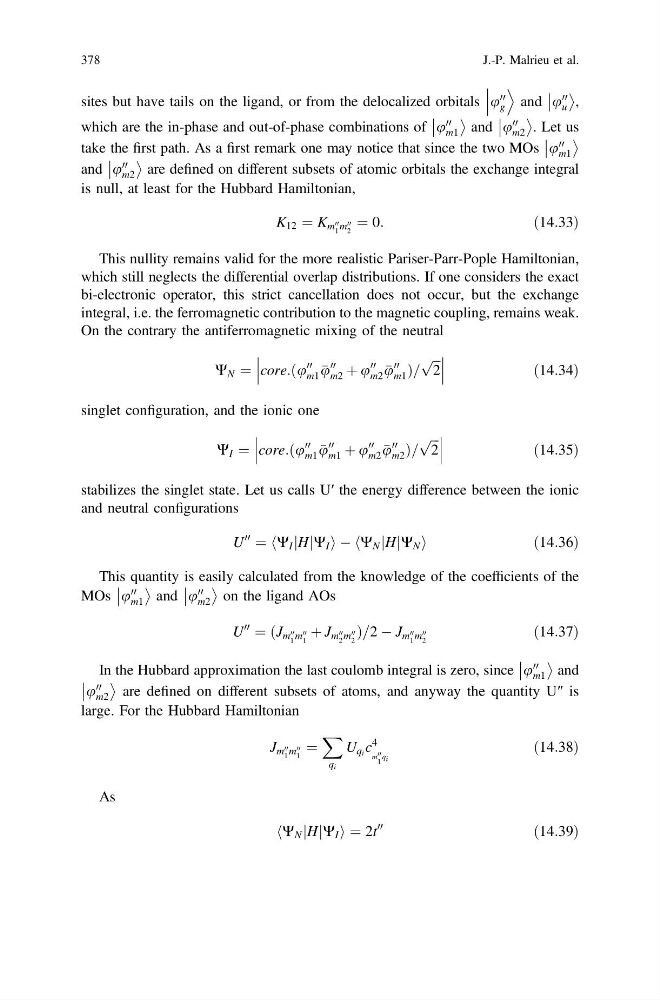
take the first path. As a first remark one may notice that since the two MOs u
00
m1
and u
00
m2
are defined on different subsets of atomic orbitals the exchange integral
is null, at least for the Hubbard Hamiltonian,
K 12 ¼ K m 00
1
m 00
2
¼ 0:
ð14:33Þ
This nullity remains valid for the more realistic Pariser-Parr-Pople Hamiltonian,
which still neglects the differential overlap distributions. If one considers the exact
bi-electronic operator, this strict cancellation does not occur, but the exchange
integral, i.e. the ferromagnetic contribution to the magnetic coupling, remains weak.
On the contrary the antiferromagnetic mixing of the neutral
W N ¼ core:ðu
00
m1
u
00
m2 þ u
00
m2
u
00
m1 Þ=
ffiffi ffi
2
p
ð14:34Þ
singlet configuration, and the ionic one
W I ¼ core:ðu
00
m1
u
00
m1 þ u
00
m2
u
00
m2 Þ=
ffiffi ffi
2
p
ð14:35Þ
stabilizes the singlet state. Let us calls U′ the energy difference between the ionic
and neutral configurations
U
00
¼ W I
h jH W I
j i À W N
h jH W N
j i
ð14:36Þ
This quantity is easily calculated from the knowledge of the coefficients of the
MOs u
00
m1
and u
00
m2
on the ligand AOs
U
00
¼ ðJ m 00
1
m 00
1
þ J m 00
2
m 00
2
Þ=2 À J m 00
1
m 00
2
ð14:37Þ
In the Hubbard approximation the last coulomb integral is zero, since u
00
m1
and
u
00
m2
are defined on different subsets of atoms, and anyway the quantity U″ is
large. For the Hubbard Hamiltonian
J m 00
1
m 00
1
¼
X
q i
U q i c
4
m 00
1
q i
ð14:38Þ
As
W N
h jH W I
j i ¼ 2t
00
ð14:39Þ
378
J.-P. Malrieu et al.
00
g
E
and u
00
u
,
which are the in-phase and out-of-phase combinations of u
00
m1
and u
00
m2
. Let us
take the first path. As a first remark one may notice that since the two MOs u
00
m1
and u
00
m2
are defined on different subsets of atomic orbitals the exchange integral
is null, at least for the Hubbard Hamiltonian,
K 12 ¼ K m 00
1
m 00
2
¼ 0:
ð14:33Þ
This nullity remains valid for the more realistic Pariser-Parr-Pople Hamiltonian,
which still neglects the differential overlap distributions. If one considers the exact
bi-electronic operator, this strict cancellation does not occur, but the exchange
integral, i.e. the ferromagnetic contribution to the magnetic coupling, remains weak.
On the contrary the antiferromagnetic mixing of the neutral
W N ¼ core:ðu
00
m1
u
00
m2 þ u
00
m2
u
00
m1 Þ=
ffiffi ffi
2
p
ð14:34Þ
singlet configuration, and the ionic one
W I ¼ core:ðu
00
m1
u
00
m1 þ u
00
m2
u
00
m2 Þ=
ffiffi ffi
2
p
ð14:35Þ
stabilizes the singlet state. Let us calls U′ the energy difference between the ionic
and neutral configurations
U
00
¼ W I
h jH W I
j i À W N
h jH W N
j i
ð14:36Þ
This quantity is easily calculated from the knowledge of the coefficients of the
MOs u
00
m1
and u
00
m2
on the ligand AOs
U
00
¼ ðJ m 00
1
m 00
1
þ J m 00
2
m 00
2
Þ=2 À J m 00
1
m 00
2
ð14:37Þ
In the Hubbard approximation the last coulomb integral is zero, since u
00
m1
and
u
00
m2
are defined on different subsets of atoms, and anyway the quantity U″ is
large. For the Hubbard Hamiltonian
J m 00
1
m 00
1
¼
X
q i
U q i c
4
m 00
1
q i
ð14:38Þ
As
W N
h jH W I
j i ¼ 2t
00
ð14:39Þ
378
J.-P. Malrieu et al.