

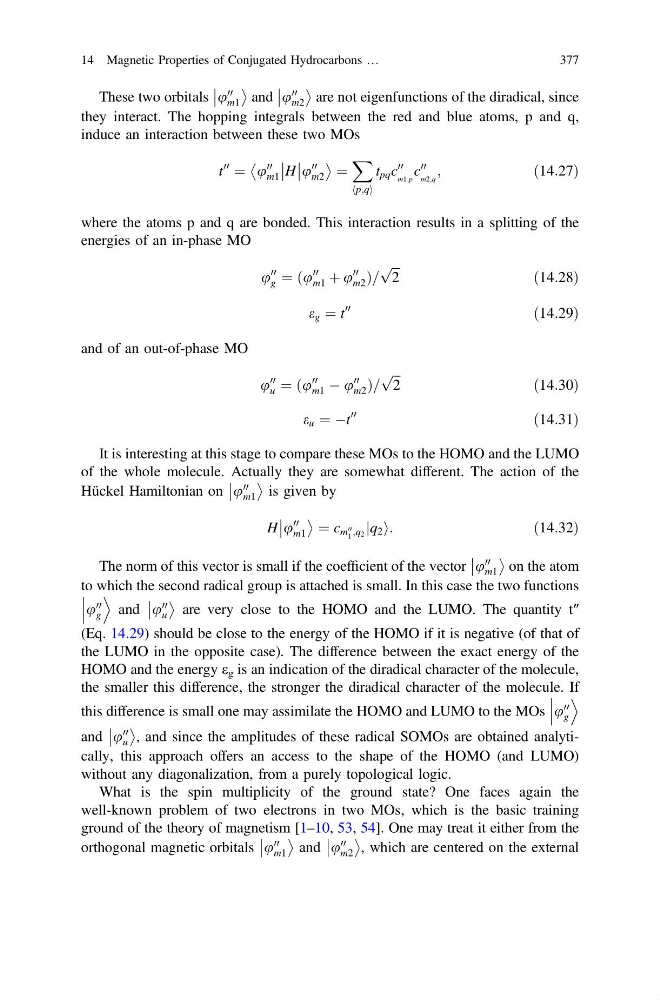
These two orbitals u
00
m1
and u
00
m2
are not eigenfunctions of the diradical, since
they interact. The hopping integrals between the red and blue atoms, p and q,
induce an interaction between these two MOs
t
00
¼ u
00
m1
H u
00
m2
¼
X
p;q
h i
t pq c
00
m1;p
c
00
m2;q
;
ð14:27Þ
where the atoms p and q are bonded. This interaction results in a splitting of the
energies of an in-phase MO
u
00
g ¼ ðu
00
m1 þ u
00
m2 Þ=
ffiffi ffi
2
p
ð14:28Þ
e g ¼ t
00
ð14:29Þ
and of an out-of-phase MO
u
00
u ¼ ðu
00
m1 À u
00
m2 Þ=
ffiffi ffi
2
p
ð14:30Þ
e u ¼ Àt
00
ð14:31Þ
It is interesting at this stage to compare these MOs to the HOMO and the LUMO
of the whole molecule. Actually they are somewhat different. The action of the
Hückel Hamiltonian on u
00
m1
is given by
H u
00
m1
¼ c m 00
1
;q 2 q 2
j i:
ð14:32Þ
The norm of this vector is small if the coefficient of the vector u
00
m1
on the atom
to which the second radical group is attached is small. In this case the two functions
u
00
g
E
and u
00
u
are very close to the HOMO and the LUMO. The quantity t″
(Eq. 14.29) should be close to the energy of the HOMO if it is negative (of that of
the LUMO in the opposite case). The difference between the exact energy of the
HOMO and the energy ε g is an indication of the diradical character of the molecule,
the smaller this difference, the stronger the diradical character of the molecule. If
this difference is small one may assimilate the HOMO and LUMO to the MOs u
00
g
E
and u
00
u
, and since the amplitudes of these radical SOMOs are obtained analytically, this approach offers an access to the shape of the HOMO (and LUMO)
without any diagonalization, from a purely topological logic.
What is the spin multiplicity of the ground state? One faces again the
well-known problem of two electrons in two MOs, which is the basic training
ground of the theory of magnetism [1–10, 53, 54]. One may treat it either from the
orthogonal magnetic orbitals u
00
m1
and u
00
m2
, which are centered on the external
14 Magnetic Properties of Conjugated Hydrocarbons …
377
00
m1
and u
00
m2
are not eigenfunctions of the diradical, since
they interact. The hopping integrals between the red and blue atoms, p and q,
induce an interaction between these two MOs
t
00
¼ u
00
m1
H u
00
m2
¼
X
p;q
h i
t pq c
00
m1;p
c
00
m2;q
;
ð14:27Þ
where the atoms p and q are bonded. This interaction results in a splitting of the
energies of an in-phase MO
u
00
g ¼ ðu
00
m1 þ u
00
m2 Þ=
ffiffi ffi
2
p
ð14:28Þ
e g ¼ t
00
ð14:29Þ
and of an out-of-phase MO
u
00
u ¼ ðu
00
m1 À u
00
m2 Þ=
ffiffi ffi
2
p
ð14:30Þ
e u ¼ Àt
00
ð14:31Þ
It is interesting at this stage to compare these MOs to the HOMO and the LUMO
of the whole molecule. Actually they are somewhat different. The action of the
Hückel Hamiltonian on u
00
m1
is given by
H u
00
m1
¼ c m 00
1
;q 2 q 2
j i:
ð14:32Þ
The norm of this vector is small if the coefficient of the vector u
00
m1
on the atom
to which the second radical group is attached is small. In this case the two functions
u
00
g
E
and u
00
u
are very close to the HOMO and the LUMO. The quantity t″
(Eq. 14.29) should be close to the energy of the HOMO if it is negative (of that of
the LUMO in the opposite case). The difference between the exact energy of the
HOMO and the energy ε g is an indication of the diradical character of the molecule,
the smaller this difference, the stronger the diradical character of the molecule. If
this difference is small one may assimilate the HOMO and LUMO to the MOs u
00
g
E
and u
00
u
, and since the amplitudes of these radical SOMOs are obtained analytically, this approach offers an access to the shape of the HOMO (and LUMO)
without any diagonalization, from a purely topological logic.
What is the spin multiplicity of the ground state? One faces again the
well-known problem of two electrons in two MOs, which is the basic training
ground of the theory of magnetism [1–10, 53, 54]. One may treat it either from the
orthogonal magnetic orbitals u
00
m1
and u
00
m2
, which are centered on the external
14 Magnetic Properties of Conjugated Hydrocarbons …
377