

• introducing the inter-electronic repulsion in its simplest form, through the
Hubbard Hamiltonian, this approach also gives access to a straightforward
evaluation of the energy gap between the lowest eigenstate and the other states
of the same spatial configuration.
14.3.2 Antiferromagnetic Coupling in Singlet Diradicals
(a) Analytic derivation
Let us now consider the alternant graphs having the same number of atoms of both
colors. Most of them are in principle closed-shell systems since they do not have
degenerate non-bonding MOs. The 4n-membered rings represent an exception to
this statement but a Jahn-Teller distortion removes this degeneracy and stabilizes a
closed-shell ground state. However it is worth considering first some systems where
two radical centers are weakly coupled, in an antiferromagnetic manner, through a
conjugated ligand of 2n sites, with n sites of each color. Many complexes in coordination chemistry belong to this category, i.e. they may be written M 1
. —L—M 2
. .
M 1
p 1
q 2
M 2
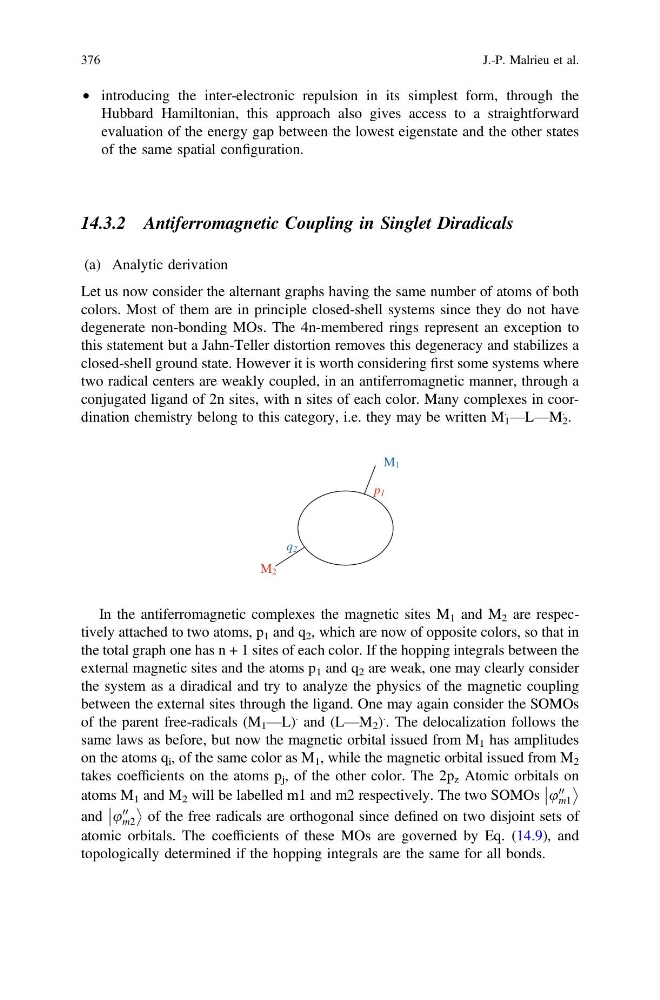
In the antiferromagnetic complexes the magnetic sites M 1 and M 2 are respectively attached to two atoms, p 1 and q 2 , which are now of opposite colors, so that in
the total graph one has n + 1 sites of each color. If the hopping integrals between the
external magnetic sites and the atoms p 1 and q 2 are weak, one may clearly consider
the system as a diradical and try to analyze the physics of the magnetic coupling
between the external sites through the ligand. One may again consider the SOMOs
of the parent free-radicals (M 1 —L)
. and (L—M 2 )
. . The delocalization follows the
same laws as before, but now the magnetic orbital issued from M 1 has amplitudes
on the atoms q i , of the same color as M 1 , while the magnetic orbital issued from M 2
takes coefficients on the atoms p j , of the other color. The 2p z Atomic orbitals on
atoms M 1 and M 2 will be labelled m1 and m2 respectively. The two SOMOs u
00
m1
and u
00
m2
of the free radicals are orthogonal since defined on two disjoint sets of
atomic orbitals. The coefficients of these MOs are governed by Eq. (14.9), and
topologically determined if the hopping integrals are the same for all bonds.
376
J.-P. Malrieu et al.
Hubbard Hamiltonian, this approach also gives access to a straightforward
evaluation of the energy gap between the lowest eigenstate and the other states
of the same spatial configuration.
14.3.2 Antiferromagnetic Coupling in Singlet Diradicals
(a) Analytic derivation
Let us now consider the alternant graphs having the same number of atoms of both
colors. Most of them are in principle closed-shell systems since they do not have
degenerate non-bonding MOs. The 4n-membered rings represent an exception to
this statement but a Jahn-Teller distortion removes this degeneracy and stabilizes a
closed-shell ground state. However it is worth considering first some systems where
two radical centers are weakly coupled, in an antiferromagnetic manner, through a
conjugated ligand of 2n sites, with n sites of each color. Many complexes in coordination chemistry belong to this category, i.e. they may be written M 1
. —L—M 2
. .
M 1
p 1
q 2
M 2
In the antiferromagnetic complexes the magnetic sites M 1 and M 2 are respectively attached to two atoms, p 1 and q 2 , which are now of opposite colors, so that in
the total graph one has n + 1 sites of each color. If the hopping integrals between the
external magnetic sites and the atoms p 1 and q 2 are weak, one may clearly consider
the system as a diradical and try to analyze the physics of the magnetic coupling
between the external sites through the ligand. One may again consider the SOMOs
of the parent free-radicals (M 1 —L)
. and (L—M 2 )
. . The delocalization follows the
same laws as before, but now the magnetic orbital issued from M 1 has amplitudes
on the atoms q i , of the same color as M 1 , while the magnetic orbital issued from M 2
takes coefficients on the atoms p j , of the other color. The 2p z Atomic orbitals on
atoms M 1 and M 2 will be labelled m1 and m2 respectively. The two SOMOs u
00
m1
and u
00
m2
of the free radicals are orthogonal since defined on two disjoint sets of
atomic orbitals. The coefficients of these MOs are governed by Eq. (14.9), and
topologically determined if the hopping integrals are the same for all bonds.
376
J.-P. Malrieu et al.