

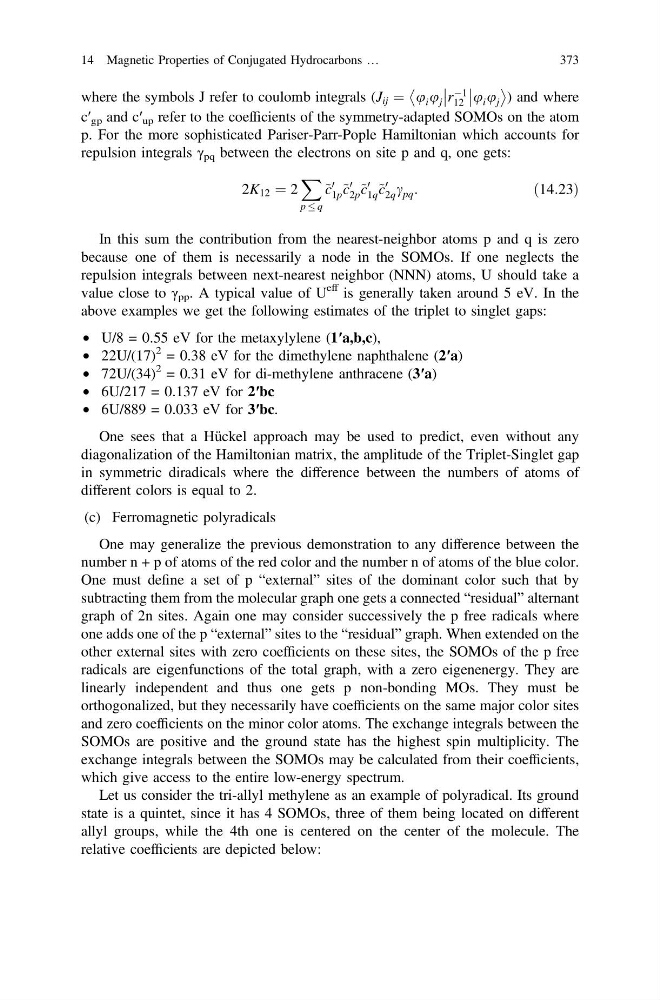
where the symbols J refer to coulomb integrals (J ij ¼ u i u j
r
À1
12 u i u j
) and where
c′ gp and c′ up refer to the coefficients of the symmetry-adapted SOMOs on the atom
p. For the more sophisticated Pariser-Parr-Pople Hamiltonian which accounts for
repulsion integrals γ pq between the electrons on site p and q, one gets:
2K 12 ¼ 2
X
p q
~ c
0
1p ~ c
0
2p ~ c
0
1q ~ c
0
2q c pq :
ð14:23Þ
In this sum the contribution from the nearest-neighbor atoms p and q is zero
because one of them is necessarily a node in the SOMOs. If one neglects the
repulsion integrals between next-nearest neighbor (NNN) atoms, U should take a
value close to γ pp . A typical value of U
eff is generally taken around 5 eV. In the
above examples we get the following estimates of the triplet to singlet gaps:
• U/8 = 0.55 eV for the metaxylylene (1′a,b,c),
• 22U/(17)
2 = 0.38 eV for the dimethylene naphthalene (2′a)
• 72U/(34)
2 = 0.31 eV for di-methylene anthracene (3′a)
• 6U/217 = 0.137 eV for 2′bc
• 6U/889 = 0.033 eV for 3′bc.
One sees that a Hückel approach may be used to predict, even without any
diagonalization of the Hamiltonian matrix, the amplitude of the Triplet-Singlet gap
in symmetric diradicals where the difference between the numbers of atoms of
different colors is equal to 2.
(c) Ferromagnetic polyradicals
One may generalize the previous demonstration to any difference between the
number n + p of atoms of the red color and the number n of atoms of the blue color.
One must define a set of p “external” sites of the dominant color such that by
subtracting them from the molecular graph one gets a connected “residual” alternant
graph of 2n sites. Again one may consider successively the p free radicals where
one adds one of the p “external” sites to the “residual” graph. When extended on the
other external sites with zero coefficients on these sites, the SOMOs of the p free
radicals are eigenfunctions of the total graph, with a zero eigenenergy. They are
linearly independent and thus one gets p non-bonding MOs. They must be
orthogonalized, but they necessarily have coefficients on the same major color sites
and zero coefficients on the minor color atoms. The exchange integrals between the
SOMOs are positive and the ground state has the highest spin multiplicity. The
exchange integrals between the SOMOs may be calculated from their coefficients,
which give access to the entire low-energy spectrum.
Let us consider the tri-allyl methylene as an example of polyradical. Its ground
state is a quintet, since it has 4 SOMOs, three of them being located on different
allyl groups, while the 4th one is centered on the center of the molecule. The
relative coefficients are depicted below:
14 Magnetic Properties of Conjugated Hydrocarbons …
373
r
À1
12 u i u j
) and where
c′ gp and c′ up refer to the coefficients of the symmetry-adapted SOMOs on the atom
p. For the more sophisticated Pariser-Parr-Pople Hamiltonian which accounts for
repulsion integrals γ pq between the electrons on site p and q, one gets:
2K 12 ¼ 2
X
p q
~ c
0
1p ~ c
0
2p ~ c
0
1q ~ c
0
2q c pq :
ð14:23Þ
In this sum the contribution from the nearest-neighbor atoms p and q is zero
because one of them is necessarily a node in the SOMOs. If one neglects the
repulsion integrals between next-nearest neighbor (NNN) atoms, U should take a
value close to γ pp . A typical value of U
eff is generally taken around 5 eV. In the
above examples we get the following estimates of the triplet to singlet gaps:
• U/8 = 0.55 eV for the metaxylylene (1′a,b,c),
• 22U/(17)
2 = 0.38 eV for the dimethylene naphthalene (2′a)
• 72U/(34)
2 = 0.31 eV for di-methylene anthracene (3′a)
• 6U/217 = 0.137 eV for 2′bc
• 6U/889 = 0.033 eV for 3′bc.
One sees that a Hückel approach may be used to predict, even without any
diagonalization of the Hamiltonian matrix, the amplitude of the Triplet-Singlet gap
in symmetric diradicals where the difference between the numbers of atoms of
different colors is equal to 2.
(c) Ferromagnetic polyradicals
One may generalize the previous demonstration to any difference between the
number n + p of atoms of the red color and the number n of atoms of the blue color.
One must define a set of p “external” sites of the dominant color such that by
subtracting them from the molecular graph one gets a connected “residual” alternant
graph of 2n sites. Again one may consider successively the p free radicals where
one adds one of the p “external” sites to the “residual” graph. When extended on the
other external sites with zero coefficients on these sites, the SOMOs of the p free
radicals are eigenfunctions of the total graph, with a zero eigenenergy. They are
linearly independent and thus one gets p non-bonding MOs. They must be
orthogonalized, but they necessarily have coefficients on the same major color sites
and zero coefficients on the minor color atoms. The exchange integrals between the
SOMOs are positive and the ground state has the highest spin multiplicity. The
exchange integrals between the SOMOs may be calculated from their coefficients,
which give access to the entire low-energy spectrum.
Let us consider the tri-allyl methylene as an example of polyradical. Its ground
state is a quintet, since it has 4 SOMOs, three of them being located on different
allyl groups, while the 4th one is centered on the center of the molecule. The
relative coefficients are depicted below:
14 Magnetic Properties of Conjugated Hydrocarbons …
373