

~
u
0
1
¼ ð u
0
g
E
þ u
0
u
Þ=
ffiffi ffi
2
p ;
~
u
0
2
¼ ð u
0
g
E
À u
0
u
Þ=
ffiffi ffi
2
p ;
~
u
0
g
E
¼ ð u
0
ðÀp1Þ
E
þ u
0
ðÀp2Þ
E
Þ=
ffiffiffiffiffiffiffiffiffiffiffiffiffiffiffiffiffiffi
2ð1 þ S 12
p
Þ
~
u
0
u
¼ ðu
0
ðÀp1Þ À u
0
ðÀp2Þ
E
Þ=
ffiffiffiffiffiffiffiffiffiffiffiffiffiffiffiffiffiffiffi
2ð1 À S 12
p
Þ:
ð14:16Þ
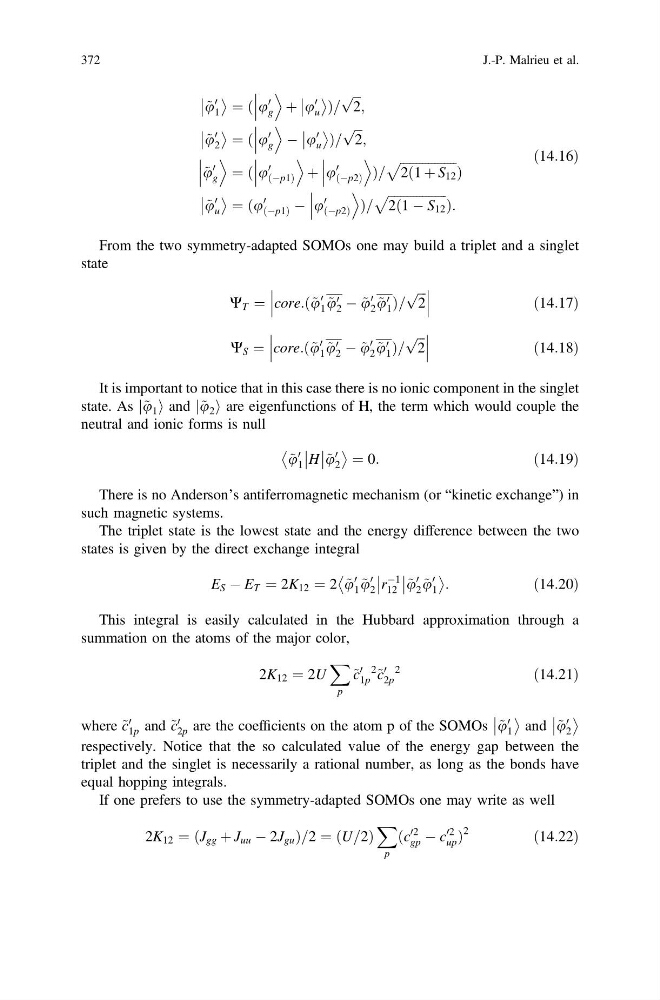
From the two symmetry-adapted SOMOs one may build a triplet and a singlet
state
W T ¼ core:ð~ u
0
1 ~
u 0
2 À ~
u
0
2 ~
u 0
1 Þ=
ffiffi ffi
2
p
ð14:17Þ
W S ¼ core:ð~ u
0
1 ~
u 0
2 À ~
u
0
2 ~
u 0
1 Þ=
ffiffi ffi
2
p
ð14:18Þ
It is important to notice that in this case there is no ionic component in the singlet
state. As ~
u 1
j i and ~
u 2
j i are eigenfunctions of H, the term which would couple the
neutral and ionic forms is null
~
u
0
1
H ~
u
0
2
¼ 0:
ð14:19Þ
There is no Anderson’s antiferromagnetic mechanism (or “kinetic exchange”) in
such magnetic systems.
The triplet state is the lowest state and the energy difference between the two
states is given by the direct exchange integral
E S À E T ¼ 2K 12 ¼ 2 ~
u
0
1 ~
u
0
2
r
À1
12 ~
u
0
2 ~
u
0
1
:
ð14:20Þ
This integral is easily calculated in the Hubbard approximation through a
summation on the atoms of the major color,
2K 12 ¼ 2U
X
p
~ c
0
1p
2
~ c
0
2p
2
ð14:21Þ
where ~ c
0
1p and ~ c
0
2p are the coefficients on the atom p of the SOMOs ~
u
0
1
and ~
u
0
2
respectively. Notice that the so calculated value of the energy gap between the
triplet and the singlet is necessarily a rational number, as long as the bonds have
equal hopping integrals.
If one prefers to use the symmetry-adapted SOMOs one may write as well
2K 12 ¼ ðJ gg þ J uu À 2J gu Þ=2 ¼ ðU=2Þ
X
p
ðc
02
gp À c
02
up Þ
2
ð14:22Þ
372
J.-P. Malrieu et al.
u
0
1
¼ ð u
0
g
E
þ u
0
u
Þ=
ffiffi ffi
2
p ;
~
u
0
2
¼ ð u
0
g
E
À u
0
u
Þ=
ffiffi ffi
2
p ;
~
u
0
g
E
¼ ð u
0
ðÀp1Þ
E
þ u
0
ðÀp2Þ
E
Þ=
ffiffiffiffiffiffiffiffiffiffiffiffiffiffiffiffiffiffi
2ð1 þ S 12
p
Þ
~
u
0
u
¼ ðu
0
ðÀp1Þ À u
0
ðÀp2Þ
E
Þ=
ffiffiffiffiffiffiffiffiffiffiffiffiffiffiffiffiffiffiffi
2ð1 À S 12
p
Þ:
ð14:16Þ
From the two symmetry-adapted SOMOs one may build a triplet and a singlet
state
W T ¼ core:ð~ u
0
1 ~
u 0
2 À ~
u
0
2 ~
u 0
1 Þ=
ffiffi ffi
2
p
ð14:17Þ
W S ¼ core:ð~ u
0
1 ~
u 0
2 À ~
u
0
2 ~
u 0
1 Þ=
ffiffi ffi
2
p
ð14:18Þ
It is important to notice that in this case there is no ionic component in the singlet
state. As ~
u 1
j i and ~
u 2
j i are eigenfunctions of H, the term which would couple the
neutral and ionic forms is null
~
u
0
1
H ~
u
0
2
¼ 0:
ð14:19Þ
There is no Anderson’s antiferromagnetic mechanism (or “kinetic exchange”) in
such magnetic systems.
The triplet state is the lowest state and the energy difference between the two
states is given by the direct exchange integral
E S À E T ¼ 2K 12 ¼ 2 ~
u
0
1 ~
u
0
2
r
À1
12 ~
u
0
2 ~
u
0
1
:
ð14:20Þ
This integral is easily calculated in the Hubbard approximation through a
summation on the atoms of the major color,
2K 12 ¼ 2U
X
p
~ c
0
1p
2
~ c
0
2p
2
ð14:21Þ
where ~ c
0
1p and ~ c
0
2p are the coefficients on the atom p of the SOMOs ~
u
0
1
and ~
u
0
2
respectively. Notice that the so calculated value of the energy gap between the
triplet and the singlet is necessarily a rational number, as long as the bonds have
equal hopping integrals.
If one prefers to use the symmetry-adapted SOMOs one may write as well
2K 12 ¼ ðJ gg þ J uu À 2J gu Þ=2 ¼ ðU=2Þ
X
p
ðc
02
gp À c
02
up Þ
2
ð14:22Þ
372
J.-P. Malrieu et al.