

-1
1
-1
-1
-1
-1
-1
-1
2
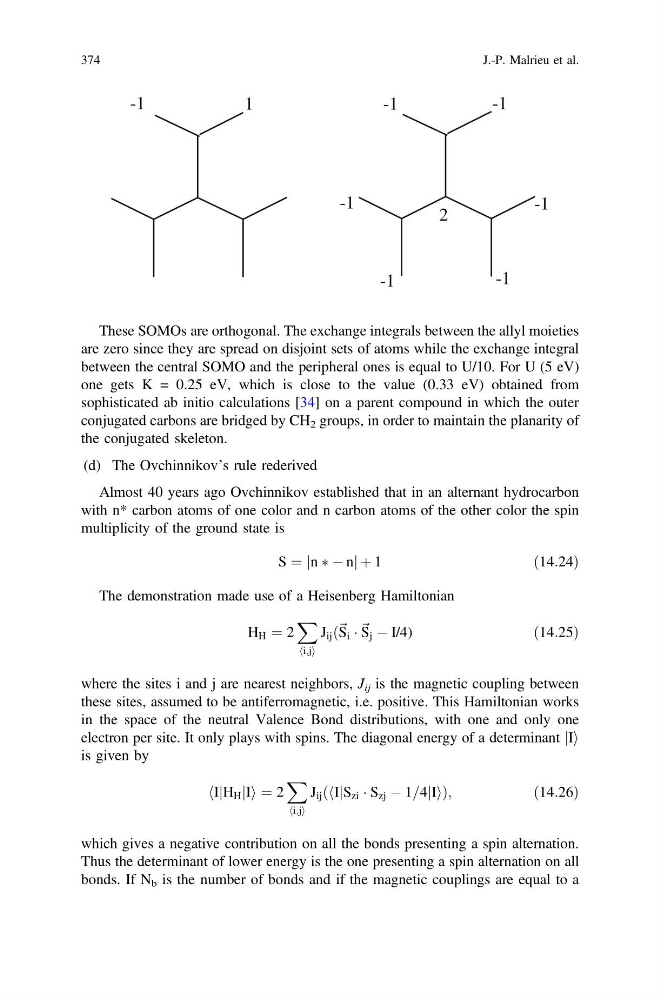
These SOMOs are orthogonal. The exchange integrals between the allyl moieties
are zero since they are spread on disjoint sets of atoms while the exchange integral
between the central SOMO and the peripheral ones is equal to U/10. For U (5 eV)
one gets K = 0.25 eV, which is close to the value (0.33 eV) obtained from
sophisticated ab initio calculations [34] on a parent compound in which the outer
conjugated carbons are bridged by CH 2 groups, in order to maintain the planarity of
the conjugated skeleton.
(d) The Ovchinnikov’s rule rederived
Almost 40 years ago Ovchinnikov established that in an alternant hydrocarbon
with n* carbon atoms of one color and n carbon atoms of the other color the spin
multiplicity of the ground state is
S ¼ n à À n
j
jþ 1
ð14:24Þ
The demonstration made use of a Heisenberg Hamiltonian
H H ¼ 2
X
i;j
h i
J ij ð ~ S i Á ~ S j À I/4)
ð14:25Þ
where the sites i and j are nearest neighbors, J ij is the magnetic coupling between
these sites, assumed to be antiferromagnetic, i.e. positive. This Hamiltonian works
in the space of the neutral Valence Bond distributions, with one and only one
electron per site. It only plays with spins. The diagonal energy of a determinant I
j i
is given by
I
h jH H I
j i ¼ 2
X
i;j
h i
J ij ð I
h jS zi Á S zj À 1=4 I
j iÞ;
ð14:26Þ
which gives a negative contribution on all the bonds presenting a spin alternation.
Thus the determinant of lower energy is the one presenting a spin alternation on all
bonds. If N b is the number of bonds and if the magnetic couplings are equal to a
374
J.-P. Malrieu et al.
1
-1
-1
-1
-1
-1
-1
2
These SOMOs are orthogonal. The exchange integrals between the allyl moieties
are zero since they are spread on disjoint sets of atoms while the exchange integral
between the central SOMO and the peripheral ones is equal to U/10. For U (5 eV)
one gets K = 0.25 eV, which is close to the value (0.33 eV) obtained from
sophisticated ab initio calculations [34] on a parent compound in which the outer
conjugated carbons are bridged by CH 2 groups, in order to maintain the planarity of
the conjugated skeleton.
(d) The Ovchinnikov’s rule rederived
Almost 40 years ago Ovchinnikov established that in an alternant hydrocarbon
with n* carbon atoms of one color and n carbon atoms of the other color the spin
multiplicity of the ground state is
S ¼ n à À n
j
jþ 1
ð14:24Þ
The demonstration made use of a Heisenberg Hamiltonian
H H ¼ 2
X
i;j
h i
J ij ð ~ S i Á ~ S j À I/4)
ð14:25Þ
where the sites i and j are nearest neighbors, J ij is the magnetic coupling between
these sites, assumed to be antiferromagnetic, i.e. positive. This Hamiltonian works
in the space of the neutral Valence Bond distributions, with one and only one
electron per site. It only plays with spins. The diagonal energy of a determinant I
j i
is given by
I
h jH H I
j i ¼ 2
X
i;j
h i
J ij ð I
h jS zi Á S zj À 1=4 I
j iÞ;
ð14:26Þ
which gives a negative contribution on all the bonds presenting a spin alternation.
Thus the determinant of lower energy is the one presenting a spin alternation on all
bonds. If N b is the number of bonds and if the magnetic couplings are equal to a
374
J.-P. Malrieu et al.