

14.3 Diradicals and Polyradicals and Their Preferred Spin
Multiplicity
This section shows how the SOMOs of diradicals can be generated from the
SOMOs of two single radicals. Then the energy difference between the lowest
triplet and singlet states may be analytically estimated from the values of the
coefficients of the SOMOs of the diradical.
14.3.1 Ferromagnetic Di- and Poly-radicals
Organic diradicals have been intensively studied by ab initio treatments [26–33].
We concentrate here on a simple and deductive approach.
(a) From radicals to diradicals: analytic derivation
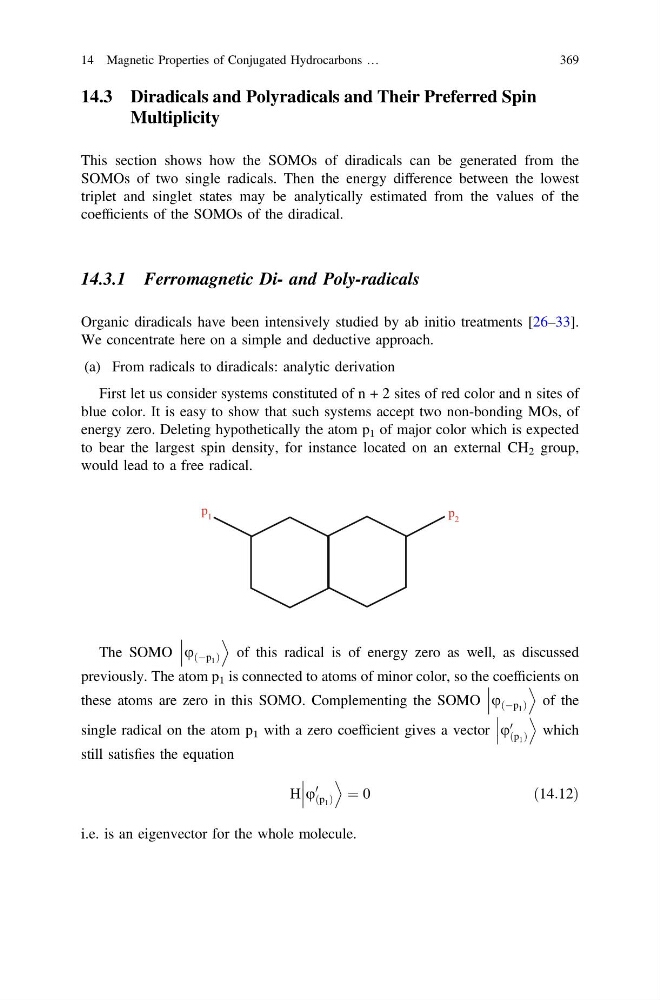
First let us consider systems constituted of n + 2 sites of red color and n sites of
blue color. It is easy to show that such systems accept two non-bonding MOs, of
energy zero. Deleting hypothetically the atom p 1 of major color which is expected
to bear the largest spin density, for instance located on an external CH 2 group,
would lead to a free radical.
p 1
p 2
The SOMO u ðÀp 1 Þ
E
of this radical is of energy zero as well, as discussed
previously. The atom p 1 is connected to atoms of minor color, so the coefficients on
these atoms are zero in this SOMO. Complementing the SOMO u ðÀp 1 Þ
E
of the
single radical on the atom p 1 with a zero coefficient gives a vector u
0
ðp 1 Þ
E
which
still satisfies the equation
H u
0
ðp 1 Þ
E
¼ 0
ð14:12Þ
i.e. is an eigenvector for the whole molecule.
14 Magnetic Properties of Conjugated Hydrocarbons …
369
Multiplicity
This section shows how the SOMOs of diradicals can be generated from the
SOMOs of two single radicals. Then the energy difference between the lowest
triplet and singlet states may be analytically estimated from the values of the
coefficients of the SOMOs of the diradical.
14.3.1 Ferromagnetic Di- and Poly-radicals
Organic diradicals have been intensively studied by ab initio treatments [26–33].
We concentrate here on a simple and deductive approach.
(a) From radicals to diradicals: analytic derivation
First let us consider systems constituted of n + 2 sites of red color and n sites of
blue color. It is easy to show that such systems accept two non-bonding MOs, of
energy zero. Deleting hypothetically the atom p 1 of major color which is expected
to bear the largest spin density, for instance located on an external CH 2 group,
would lead to a free radical.
p 1
p 2
The SOMO u ðÀp 1 Þ
E
of this radical is of energy zero as well, as discussed
previously. The atom p 1 is connected to atoms of minor color, so the coefficients on
these atoms are zero in this SOMO. Complementing the SOMO u ðÀp 1 Þ
E
of the
single radical on the atom p 1 with a zero coefficient gives a vector u
0
ðp 1 Þ
E
which
still satisfies the equation
H u
0
ðp 1 Þ
E
¼ 0
ð14:12Þ
i.e. is an eigenvector for the whole molecule.
14 Magnetic Properties of Conjugated Hydrocarbons …
369