

Let us now consider radicals obtained by adding an extra site on a polyacene or
fused polycyclic hydrocarbons.
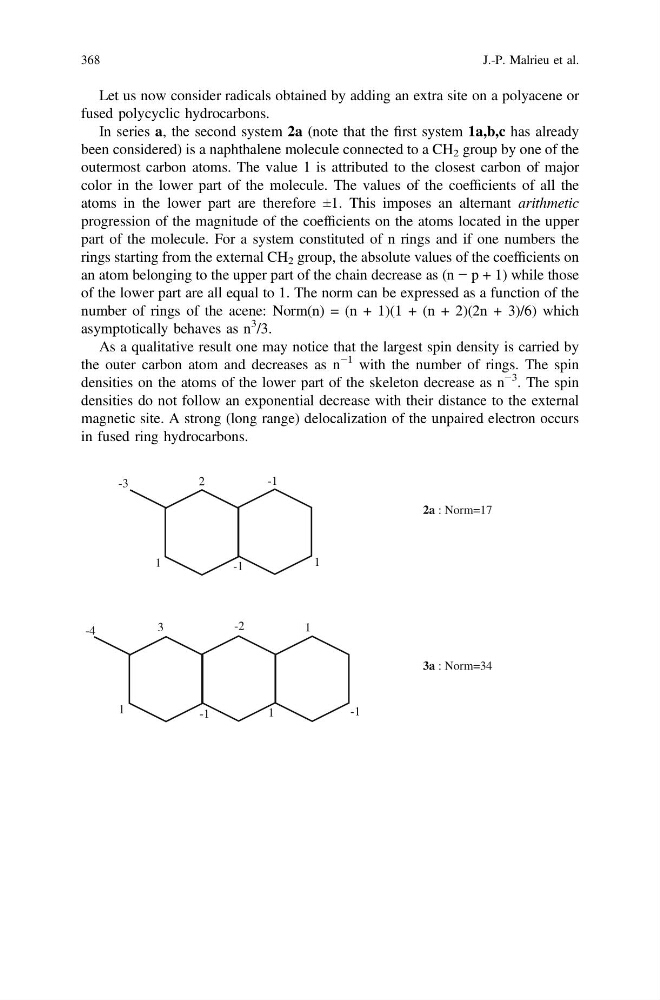
In series a, the second system 2a (note that the first system 1a,b,c has already
been considered) is a naphthalene molecule connected to a CH 2 group by one of the
outermost carbon atoms. The value 1 is attributed to the closest carbon of major
color in the lower part of the molecule. The values of the coefficients of all the
atoms in the lower part are therefore ±1. This imposes an alternant arithmetic
progression of the magnitude of the coefficients on the atoms located in the upper
part of the molecule. For a system constituted of n rings and if one numbers the
rings starting from the external CH 2 group, the absolute values of the coefficients on
an atom belonging to the upper part of the chain decrease as (n − p + 1) while those
of the lower part are all equal to 1. The norm can be expressed as a function of the
number of rings of the acene: Norm(n) = (n + 1)(1 + (n + 2)(2n + 3)/6) which
asymptotically behaves as n
3 /3.
As a qualitative result one may notice that the largest spin density is carried by
the outer carbon atom and decreases as n
−1 with the number of rings. The spin
densities on the atoms of the lower part of the skeleton decrease as n
−3 . The spin
densities do not follow an exponential decrease with their distance to the external
magnetic site. A strong (long range) delocalization of the unpaired electron occurs
in fused ring hydrocarbons.
2a : Norm=17
3a : Norm=34
-3
2
1
-1
-1
1
-4
3
1
-1
-2
1
1
-1
368
J.-P. Malrieu et al.
fused polycyclic hydrocarbons.
In series a, the second system 2a (note that the first system 1a,b,c has already
been considered) is a naphthalene molecule connected to a CH 2 group by one of the
outermost carbon atoms. The value 1 is attributed to the closest carbon of major
color in the lower part of the molecule. The values of the coefficients of all the
atoms in the lower part are therefore ±1. This imposes an alternant arithmetic
progression of the magnitude of the coefficients on the atoms located in the upper
part of the molecule. For a system constituted of n rings and if one numbers the
rings starting from the external CH 2 group, the absolute values of the coefficients on
an atom belonging to the upper part of the chain decrease as (n − p + 1) while those
of the lower part are all equal to 1. The norm can be expressed as a function of the
number of rings of the acene: Norm(n) = (n + 1)(1 + (n + 2)(2n + 3)/6) which
asymptotically behaves as n
3 /3.
As a qualitative result one may notice that the largest spin density is carried by
the outer carbon atom and decreases as n
−1 with the number of rings. The spin
densities on the atoms of the lower part of the skeleton decrease as n
−3 . The spin
densities do not follow an exponential decrease with their distance to the external
magnetic site. A strong (long range) delocalization of the unpaired electron occurs
in fused ring hydrocarbons.
2a : Norm=17
3a : Norm=34
-3
2
1
-1
-1
1
-4
3
1
-1
-2
1
1
-1
368
J.-P. Malrieu et al.