

One may repeat the same procedure for the atom p 2 on which one may also
expect a large spin density and get a second SOMO of the diradical,
H u
0
ðp 2 Þ
E
¼ 0:
ð14:13Þ
These two eigenvectors are linearly independent as the first one has amplitude on
the p 2 atom while the second one has not. They both have non-zero coefficients on
the same red atoms and zero coefficients on the blue ones. One may note that they
are not orthogonal. Using their overlap
u
0
ðp 1 Þ
D
u
0
ðp 2 Þ
E
¼ u ðÀp 1 Þ
D
u ðÀp 2 Þ
E
= S 12
ð14:14Þ
they may be orthogonalized through the S
−1/2 procedure.
(b) Illustrations
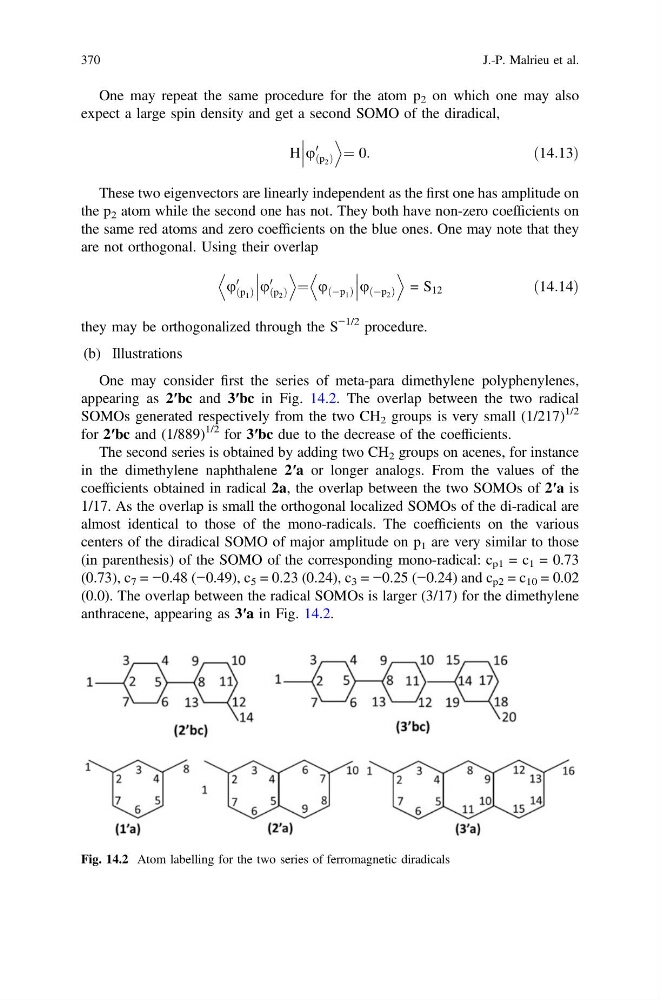
One may consider first the series of meta-para dimethylene polyphenylenes,
appearing as 2′bc and 3′bc in Fig. 14.2. The overlap between the two radical
SOMOs generated respectively from the two CH 2 groups is very small (1/217)
1/2
for 2′bc and (1/889)
1/2 for 3′bc due to the decrease of the coefficients.
The second series is obtained by adding two CH 2 groups on acenes, for instance
in the dimethylene naphthalene 2′a or longer analogs. From the values of the
coefficients obtained in radical 2a, the overlap between the two SOMOs of 2′a is
1/17. As the overlap is small the orthogonal localized SOMOs of the di-radical are
almost identical to those of the mono-radicals. The coefficients on the various
centers of the diradical SOMO of major amplitude on p 1 are very similar to those
(in parenthesis) of the SOMO of the corresponding mono-radical: c p1 = c 1 = 0.73
(0.73), c 7 = −0.48 (−0.49), c 5 = 0.23 (0.24), c 3 = −0.25 (−0.24) and c p2 = c 10 = 0.02
(0.0). The overlap between the radical SOMOs is larger (3/17) for the dimethylene
anthracene, appearing as 3′a in Fig. 14.2.
Fig. 14.2 Atom labelling for the two series of ferromagnetic diradicals
370
J.-P. Malrieu et al.
expect a large spin density and get a second SOMO of the diradical,
H u
0
ðp 2 Þ
E
¼ 0:
ð14:13Þ
These two eigenvectors are linearly independent as the first one has amplitude on
the p 2 atom while the second one has not. They both have non-zero coefficients on
the same red atoms and zero coefficients on the blue ones. One may note that they
are not orthogonal. Using their overlap
u
0
ðp 1 Þ
D
u
0
ðp 2 Þ
E
¼ u ðÀp 1 Þ
D
u ðÀp 2 Þ
E
= S 12
ð14:14Þ
they may be orthogonalized through the S
−1/2 procedure.
(b) Illustrations
One may consider first the series of meta-para dimethylene polyphenylenes,
appearing as 2′bc and 3′bc in Fig. 14.2. The overlap between the two radical
SOMOs generated respectively from the two CH 2 groups is very small (1/217)
1/2
for 2′bc and (1/889)
1/2 for 3′bc due to the decrease of the coefficients.
The second series is obtained by adding two CH 2 groups on acenes, for instance
in the dimethylene naphthalene 2′a or longer analogs. From the values of the
coefficients obtained in radical 2a, the overlap between the two SOMOs of 2′a is
1/17. As the overlap is small the orthogonal localized SOMOs of the di-radical are
almost identical to those of the mono-radicals. The coefficients on the various
centers of the diradical SOMO of major amplitude on p 1 are very similar to those
(in parenthesis) of the SOMO of the corresponding mono-radical: c p1 = c 1 = 0.73
(0.73), c 7 = −0.48 (−0.49), c 5 = 0.23 (0.24), c 3 = −0.25 (−0.24) and c p2 = c 10 = 0.02
(0.0). The overlap between the radical SOMOs is larger (3/17) for the dimethylene
anthracene, appearing as 3′a in Fig. 14.2.
Fig. 14.2 Atom labelling for the two series of ferromagnetic diradicals
370
J.-P. Malrieu et al.