

separations is by default set to one, i.e. one positive charge and one negative charge
on two different atoms. We believe it is a wise choice as it could be hard to give a
chemical meaning to structures with more charge separation.
13.4.3 Topological Resonance Energy
The Topological Resonance Energy (TRE) is a measurement of the resonance
energy based on the topology of the molecule [34–36]. It is defined as the difference
between the energy of the considered molecule and its acyclic counterpart. The later
is a fictitious yet well defined system in which aromaticity is lost. A way to suppress
aromaticity is to consider the mixture with an anti-aromatic system. It was recently
shown that the characteristic polynomial (13.15) of the acyclic system is the
average of the characteristic polynomial of the real molecule and its anti-aromatic
Möbius counterpart [37]. In the framework of cyclic species with p electrons, the
fictitious Möbius molecule is obtained by rotating along the n-fold cycle the p
orbital of the i
th vertex by
ðiÀ1Þp
n . This leads to an out-of-phase interaction between
the p orbitals of the first and the nth vertices. In other words, the p axis rotates by p
radians along the cycle, like the Möbius ribbon. This rotation is equivalent to setting
all interactions equal between adjacent centers except for the last one which is
multiplied by −1.
-1.4
-1.2
-1
-0.8
-0.6
-0.4
-0.2
0
0.2
0.4
-0.6
-0.4
-0.2
0
0.2
0.4
0.6
0.8
1
1.2
Topological resonance energy
Breslow resonance energy
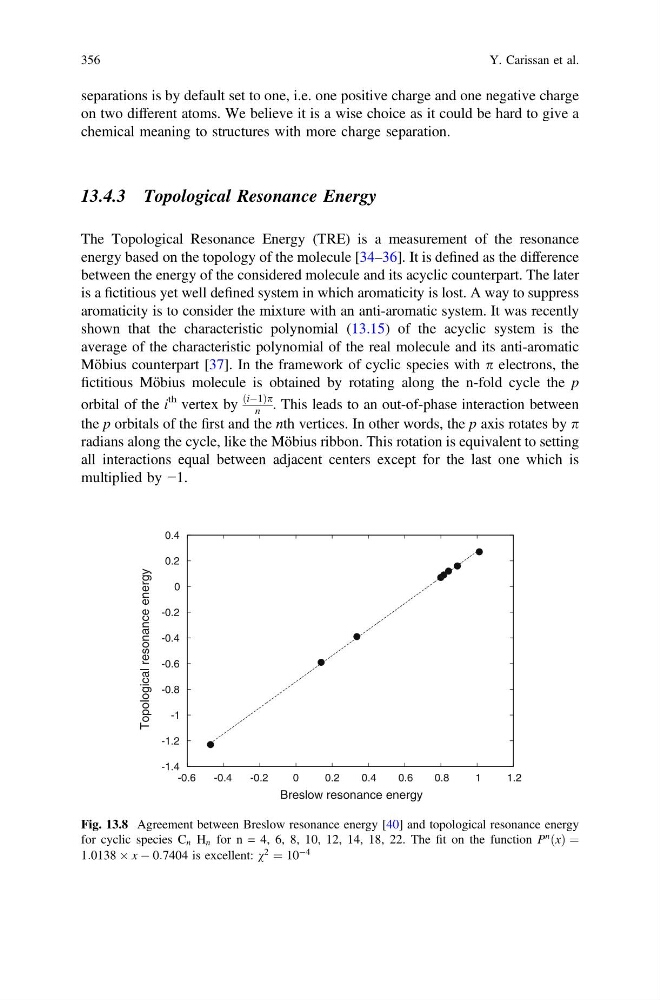
Fig. 13.8 Agreement between Breslow resonance energy [40] and topological resonance energy
for cyclic species C n H n for n = 4, 6, 8, 10, 12, 14, 18, 22. The fit on the function P
n ðxÞ ¼
1:0138 Â x À 0:7404 is excellent: v
2 ¼ 10
À4
356
Y. Carissan et al.
on two different atoms. We believe it is a wise choice as it could be hard to give a
chemical meaning to structures with more charge separation.
13.4.3 Topological Resonance Energy
The Topological Resonance Energy (TRE) is a measurement of the resonance
energy based on the topology of the molecule [34–36]. It is defined as the difference
between the energy of the considered molecule and its acyclic counterpart. The later
is a fictitious yet well defined system in which aromaticity is lost. A way to suppress
aromaticity is to consider the mixture with an anti-aromatic system. It was recently
shown that the characteristic polynomial (13.15) of the acyclic system is the
average of the characteristic polynomial of the real molecule and its anti-aromatic
Möbius counterpart [37]. In the framework of cyclic species with p electrons, the
fictitious Möbius molecule is obtained by rotating along the n-fold cycle the p
orbital of the i
th vertex by
ðiÀ1Þp
n . This leads to an out-of-phase interaction between
the p orbitals of the first and the nth vertices. In other words, the p axis rotates by p
radians along the cycle, like the Möbius ribbon. This rotation is equivalent to setting
all interactions equal between adjacent centers except for the last one which is
multiplied by −1.
-1.4
-1.2
-1
-0.8
-0.6
-0.4
-0.2
0
0.2
0.4
-0.6
-0.4
-0.2
0
0.2
0.4
0.6
0.8
1
1.2
Topological resonance energy
Breslow resonance energy
Fig. 13.8 Agreement between Breslow resonance energy [40] and topological resonance energy
for cyclic species C n H n for n = 4, 6, 8, 10, 12, 14, 18, 22. The fit on the function P
n ðxÞ ¼
1:0138 Â x À 0:7404 is excellent: v
2 ¼ 10
À4
356
Y. Carissan et al.