

13.4.2 Automatic Generation of Localized Structures
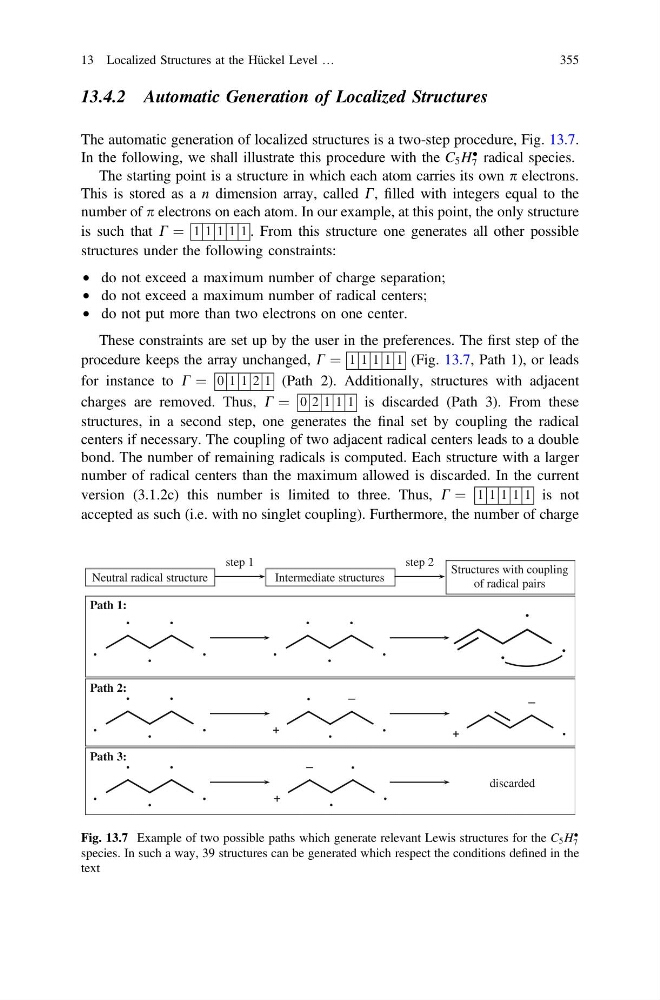
The automatic generation of localized structures is a two-step procedure, Fig. 13.7.
In the following, we shall illustrate this procedure with the C 5 H
7 radical species.
The starting point is a structure in which each atom carries its own p electrons.
This is stored as a n dimension array, called C, filled with integers equal to the
number of p electrons on each atom. In our example, at this point, the only structure
is such that C ¼ 1 1 1 1 1 . From this structure one generates all other possible
structures under the following constraints:
• do not exceed a maximum number of charge separation;
• do not exceed a maximum number of radical centers;
• do not put more than two electrons on one center.
These constraints are set up by the user in the preferences. The first step of the
procedure keeps the array unchanged, C ¼ 1 1 1 1 1 (Fig. 13.7, Path 1), or leads
for instance to C ¼ 0 1 1 2 1 (Path 2). Additionally, structures with adjacent
charges are removed. Thus, C ¼ 0 2 1 1 1 is discarded (Path 3). From these
structures, in a second step, one generates the final set by coupling the radical
centers if necessary. The coupling of two adjacent radical centers leads to a double
bond. The number of remaining radicals is computed. Each structure with a larger
number of radical centers than the maximum allowed is discarded. In the current
version (3.1.2c) this number is limited to three. Thus, C ¼ 1 1 1 1 1 is not
accepted as such (i.e. with no singlet coupling). Furthermore, the number of charge
Fig. 13.7 Example of two possible paths which generate relevant Lewis structures for the C 5 H
7
species. In such a way, 39 structures can be generated which respect the conditions defined in the
text
13 Localized Structures at the Hückel Level …
355
The automatic generation of localized structures is a two-step procedure, Fig. 13.7.
In the following, we shall illustrate this procedure with the C 5 H
7 radical species.
The starting point is a structure in which each atom carries its own p electrons.
This is stored as a n dimension array, called C, filled with integers equal to the
number of p electrons on each atom. In our example, at this point, the only structure
is such that C ¼ 1 1 1 1 1 . From this structure one generates all other possible
structures under the following constraints:
• do not exceed a maximum number of charge separation;
• do not exceed a maximum number of radical centers;
• do not put more than two electrons on one center.
These constraints are set up by the user in the preferences. The first step of the
procedure keeps the array unchanged, C ¼ 1 1 1 1 1 (Fig. 13.7, Path 1), or leads
for instance to C ¼ 0 1 1 2 1 (Path 2). Additionally, structures with adjacent
charges are removed. Thus, C ¼ 0 2 1 1 1 is discarded (Path 3). From these
structures, in a second step, one generates the final set by coupling the radical
centers if necessary. The coupling of two adjacent radical centers leads to a double
bond. The number of remaining radicals is computed. Each structure with a larger
number of radical centers than the maximum allowed is discarded. In the current
version (3.1.2c) this number is limited to three. Thus, C ¼ 1 1 1 1 1 is not
accepted as such (i.e. with no singlet coupling). Furthermore, the number of charge
Fig. 13.7 Example of two possible paths which generate relevant Lewis structures for the C 5 H
7
species. In such a way, 39 structures can be generated which respect the conditions defined in the
text
13 Localized Structures at the Hückel Level …
355