

13.3.2.1 The Butadiene Case
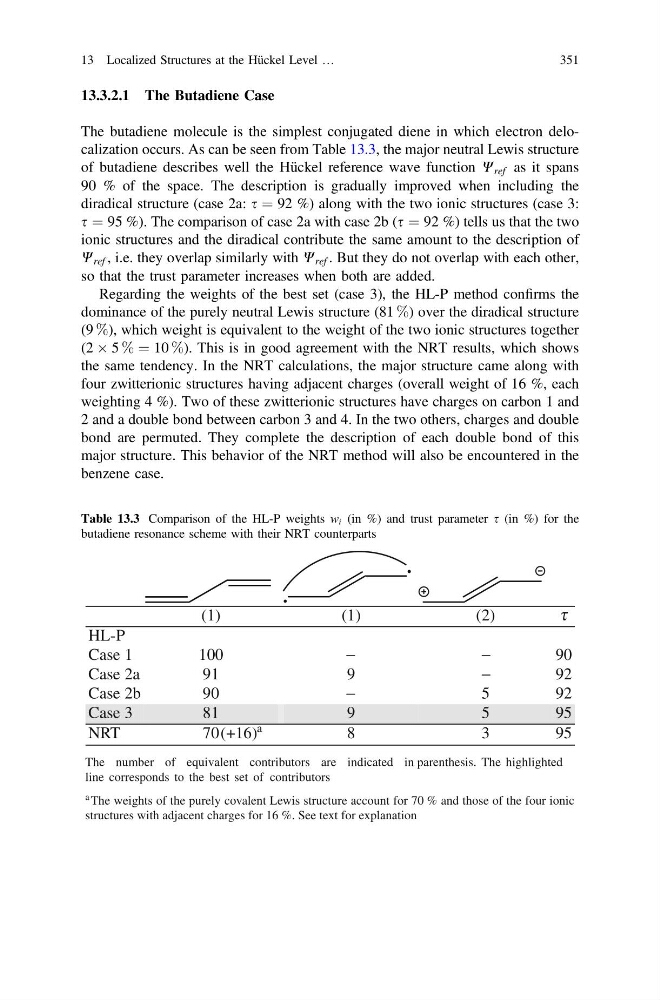
The butadiene molecule is the simplest conjugated diene in which electron delocalization occurs. As can be seen from Table 13.3, the major neutral Lewis structure
of butadiene describes well the Hückel reference wave function W ref as it spans
90 % of the space. The description is gradually improved when including the
diradical structure (case 2a: s ¼ 92 %) along with the two ionic structures (case 3:
s ¼ 95 %). The comparison of case 2a with case 2b (s ¼ 92 %) tells us that the two
ionic structures and the diradical contribute the same amount to the description of
W ref , i.e. they overlap similarly with W ref . But they do not overlap with each other,
so that the trust parameter increases when both are added.
Regarding the weights of the best set (case 3), the HL-P method confirms the
dominance of the purely neutral Lewis structure (81 %) over the diradical structure
(9 %), which weight is equivalent to the weight of the two ionic structures together
(2 Â 5 % ¼ 10 %). This is in good agreement with the NRT results, which shows
the same tendency. In the NRT calculations, the major structure came along with
four zwitterionic structures having adjacent charges (overall weight of 16 %, each
weighting 4 %). Two of these zwitterionic structures have charges on carbon 1 and
2 and a double bond between carbon 3 and 4. In the two others, charges and double
bond are permuted. They complete the description of each double bond of this
major structure. This behavior of the NRT method will also be encountered in the
benzene case.
Table 13.3 Comparison of the HL-P weights w i (in %) and trust parameter s (in %) for the
butadiene resonance scheme with their NRT counterparts
(1)
(1)
(2)
τ
HL-P
Case 1
100
−
−
90
Case 2a
91
9
−
92
Case 2b
90
−
5
9 2
Case 3
81
9
5
95
NRT
70(+16) a
8
3
9 5
a The weights of the purely covalent Lewis structure account for 70 % and those of the four ionic
structures with adjacent charges for 16 %. See text for explanation
The number of equivalent contributors are indicated in parenthesis. The highlighted
line corresponds to the best set of contributors
13 Localized Structures at the Hückel Level …
351
The butadiene molecule is the simplest conjugated diene in which electron delocalization occurs. As can be seen from Table 13.3, the major neutral Lewis structure
of butadiene describes well the Hückel reference wave function W ref as it spans
90 % of the space. The description is gradually improved when including the
diradical structure (case 2a: s ¼ 92 %) along with the two ionic structures (case 3:
s ¼ 95 %). The comparison of case 2a with case 2b (s ¼ 92 %) tells us that the two
ionic structures and the diradical contribute the same amount to the description of
W ref , i.e. they overlap similarly with W ref . But they do not overlap with each other,
so that the trust parameter increases when both are added.
Regarding the weights of the best set (case 3), the HL-P method confirms the
dominance of the purely neutral Lewis structure (81 %) over the diradical structure
(9 %), which weight is equivalent to the weight of the two ionic structures together
(2 Â 5 % ¼ 10 %). This is in good agreement with the NRT results, which shows
the same tendency. In the NRT calculations, the major structure came along with
four zwitterionic structures having adjacent charges (overall weight of 16 %, each
weighting 4 %). Two of these zwitterionic structures have charges on carbon 1 and
2 and a double bond between carbon 3 and 4. In the two others, charges and double
bond are permuted. They complete the description of each double bond of this
major structure. This behavior of the NRT method will also be encountered in the
benzene case.
Table 13.3 Comparison of the HL-P weights w i (in %) and trust parameter s (in %) for the
butadiene resonance scheme with their NRT counterparts
(1)
(1)
(2)
τ
HL-P
Case 1
100
−
−
90
Case 2a
91
9
−
92
Case 2b
90
−
5
9 2
Case 3
81
9
5
95
NRT
70(+16) a
8
3
9 5
a The weights of the purely covalent Lewis structure account for 70 % and those of the four ionic
structures with adjacent charges for 16 %. See text for explanation
The number of equivalent contributors are indicated in parenthesis. The highlighted
line corresponds to the best set of contributors
13 Localized Structures at the Hückel Level …
351