

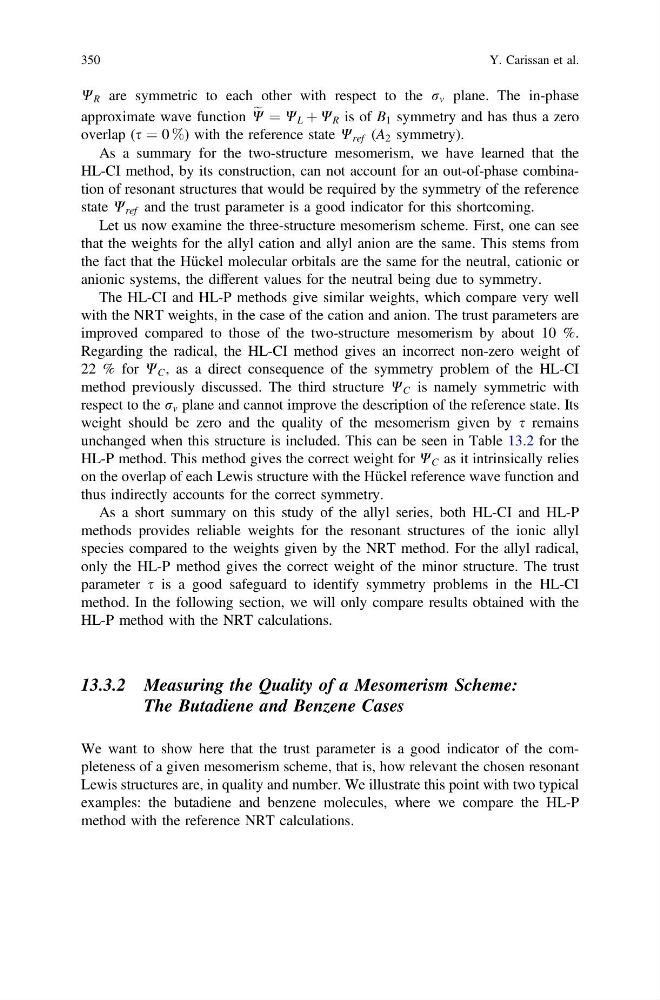
W R are symmetric to each other with respect to the r v plane. The in-phase
approximate wave function e
W ¼ W L þ W R is of B 1 symmetry and has thus a zero
overlap (s ¼ 0 %) with the reference state W ref (A 2 symmetry).
As a summary for the two-structure mesomerism, we have learned that the
HL-CI method, by its construction, can not account for an out-of-phase combination of resonant structures that would be required by the symmetry of the reference
state W ref and the trust parameter is a good indicator for this shortcoming.
Let us now examine the three-structure mesomerism scheme. First, one can see
that the weights for the allyl cation and allyl anion are the same. This stems from
the fact that the Hückel molecular orbitals are the same for the neutral, cationic or
anionic systems, the different values for the neutral being due to symmetry.
The HL-CI and HL-P methods give similar weights, which compare very well
with the NRT weights, in the case of the cation and anion. The trust parameters are
improved compared to those of the two-structure mesomerism by about 10 %.
Regarding the radical, the HL-CI method gives an incorrect non-zero weight of
22 % for W C , as a direct consequence of the symmetry problem of the HL-CI
method previously discussed. The third structure W C is namely symmetric with
respect to the r v plane and cannot improve the description of the reference state. Its
weight should be zero and the quality of the mesomerism given by s remains
unchanged when this structure is included. This can be seen in Table 13.2 for the
HL-P method. This method gives the correct weight for W C as it intrinsically relies
on the overlap of each Lewis structure with the Hückel reference wave function and
thus indirectly accounts for the correct symmetry.
As a short summary on this study of the allyl series, both HL-CI and HL-P
methods provides reliable weights for the resonant structures of the ionic allyl
species compared to the weights given by the NRT method. For the allyl radical,
only the HL-P method gives the correct weight of the minor structure. The trust
parameter s is a good safeguard to identify symmetry problems in the HL-CI
method. In the following section, we will only compare results obtained with the
HL-P method with the NRT calculations.
13.3.2 Measuring the Quality of a Mesomerism Scheme:
The Butadiene and Benzene Cases
We want to show here that the trust parameter is a good indicator of the completeness of a given mesomerism scheme, that is, how relevant the chosen resonant
Lewis structures are, in quality and number. We illustrate this point with two typical
examples: the butadiene and benzene molecules, where we compare the HL-P
method with the reference NRT calculations.
350
Y. Carissan et al.
approximate wave function e
W ¼ W L þ W R is of B 1 symmetry and has thus a zero
overlap (s ¼ 0 %) with the reference state W ref (A 2 symmetry).
As a summary for the two-structure mesomerism, we have learned that the
HL-CI method, by its construction, can not account for an out-of-phase combination of resonant structures that would be required by the symmetry of the reference
state W ref and the trust parameter is a good indicator for this shortcoming.
Let us now examine the three-structure mesomerism scheme. First, one can see
that the weights for the allyl cation and allyl anion are the same. This stems from
the fact that the Hückel molecular orbitals are the same for the neutral, cationic or
anionic systems, the different values for the neutral being due to symmetry.
The HL-CI and HL-P methods give similar weights, which compare very well
with the NRT weights, in the case of the cation and anion. The trust parameters are
improved compared to those of the two-structure mesomerism by about 10 %.
Regarding the radical, the HL-CI method gives an incorrect non-zero weight of
22 % for W C , as a direct consequence of the symmetry problem of the HL-CI
method previously discussed. The third structure W C is namely symmetric with
respect to the r v plane and cannot improve the description of the reference state. Its
weight should be zero and the quality of the mesomerism given by s remains
unchanged when this structure is included. This can be seen in Table 13.2 for the
HL-P method. This method gives the correct weight for W C as it intrinsically relies
on the overlap of each Lewis structure with the Hückel reference wave function and
thus indirectly accounts for the correct symmetry.
As a short summary on this study of the allyl series, both HL-CI and HL-P
methods provides reliable weights for the resonant structures of the ionic allyl
species compared to the weights given by the NRT method. For the allyl radical,
only the HL-P method gives the correct weight of the minor structure. The trust
parameter s is a good safeguard to identify symmetry problems in the HL-CI
method. In the following section, we will only compare results obtained with the
HL-P method with the NRT calculations.
13.3.2 Measuring the Quality of a Mesomerism Scheme:
The Butadiene and Benzene Cases
We want to show here that the trust parameter is a good indicator of the completeness of a given mesomerism scheme, that is, how relevant the chosen resonant
Lewis structures are, in quality and number. We illustrate this point with two typical
examples: the butadiene and benzene molecules, where we compare the HL-P
method with the reference NRT calculations.
350
Y. Carissan et al.