

13.3.2.2 The Benzene Case
The benzene molecule is an archetype for the study of p delocalization and aromaticity (see e.g. the reviews [30, 31] and references therein). In standard chemistry
textbooks, the resonance in the benzene molecule involves only the two major
Kekule structures (see Table 13.4). However this two-structure scheme is by far
incomplete to describe the p delocalization of benzene. It is well recognized in the
VB community that about 175 VB structures are needed in order to grasp the
resonance in the benzene molecule [32].
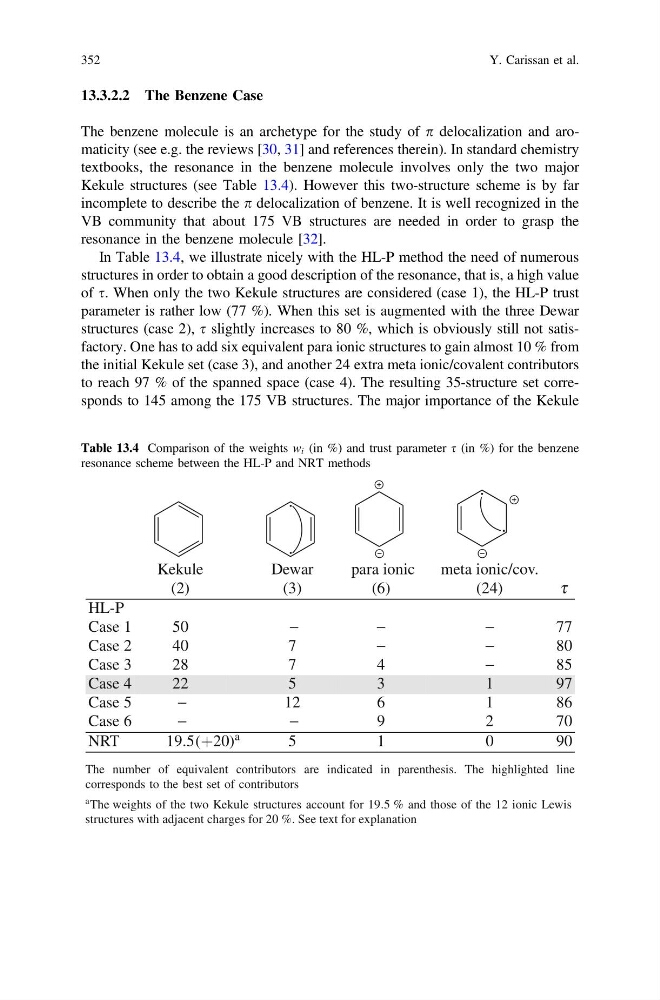
In Table 13.4, we illustrate nicely with the HL-P method the need of numerous
structures in order to obtain a good description of the resonance, that is, a high value
of s. When only the two Kekule structures are considered (case 1), the HL-P trust
parameter is rather low (77 %). When this set is augmented with the three Dewar
structures (case 2), s slightly increases to 80 %, which is obviously still not satisfactory. One has to add six equivalent para ionic structures to gain almost 10 % from
the initial Kekule set (case 3), and another 24 extra meta ionic/covalent contributors
to reach 97 % of the spanned space (case 4). The resulting 35-structure set corresponds to 145 among the 175 VB structures. The major importance of the Kekule
Table 13.4 Comparison of the weights w i (in %) and trust parameter s (in %) for the benzene
resonance scheme between the HL-P and NRT methods
Kekule
Dewar
para ionic
meta ionic/cov.
(2)
(3)
(6)
(24)
τ
HL-P
Case 1
50
−
−
−
77
Case 2
40
7
−
−
80
Case 3
28
7
4
−
85
Case 4
22
5
3
1
97
Case 5
−
12
6
1
86
Case 6
−
−
9
2
7 0
NRT
19.5(+20) a
5
1
0
9 0
a The weights of the two Kekule structures account for 19.5 % and those of the 12 ionic Lewis
structures with adjacent charges for 20 %. See text for explanation
The number of equivalent contributors are indicated in parenthesis. The highlighted line
corresponds to the best set of contributors
352
Y. Carissan et al.
The benzene molecule is an archetype for the study of p delocalization and aromaticity (see e.g. the reviews [30, 31] and references therein). In standard chemistry
textbooks, the resonance in the benzene molecule involves only the two major
Kekule structures (see Table 13.4). However this two-structure scheme is by far
incomplete to describe the p delocalization of benzene. It is well recognized in the
VB community that about 175 VB structures are needed in order to grasp the
resonance in the benzene molecule [32].
In Table 13.4, we illustrate nicely with the HL-P method the need of numerous
structures in order to obtain a good description of the resonance, that is, a high value
of s. When only the two Kekule structures are considered (case 1), the HL-P trust
parameter is rather low (77 %). When this set is augmented with the three Dewar
structures (case 2), s slightly increases to 80 %, which is obviously still not satisfactory. One has to add six equivalent para ionic structures to gain almost 10 % from
the initial Kekule set (case 3), and another 24 extra meta ionic/covalent contributors
to reach 97 % of the spanned space (case 4). The resulting 35-structure set corresponds to 145 among the 175 VB structures. The major importance of the Kekule
Table 13.4 Comparison of the weights w i (in %) and trust parameter s (in %) for the benzene
resonance scheme between the HL-P and NRT methods
Kekule
Dewar
para ionic
meta ionic/cov.
(2)
(3)
(6)
(24)
τ
HL-P
Case 1
50
−
−
−
77
Case 2
40
7
−
−
80
Case 3
28
7
4
−
85
Case 4
22
5
3
1
97
Case 5
−
12
6
1
86
Case 6
−
−
9
2
7 0
NRT
19.5(+20) a
5
1
0
9 0
a The weights of the two Kekule structures account for 19.5 % and those of the 12 ionic Lewis
structures with adjacent charges for 20 %. See text for explanation
The number of equivalent contributors are indicated in parenthesis. The highlighted line
corresponds to the best set of contributors
352
Y. Carissan et al.