

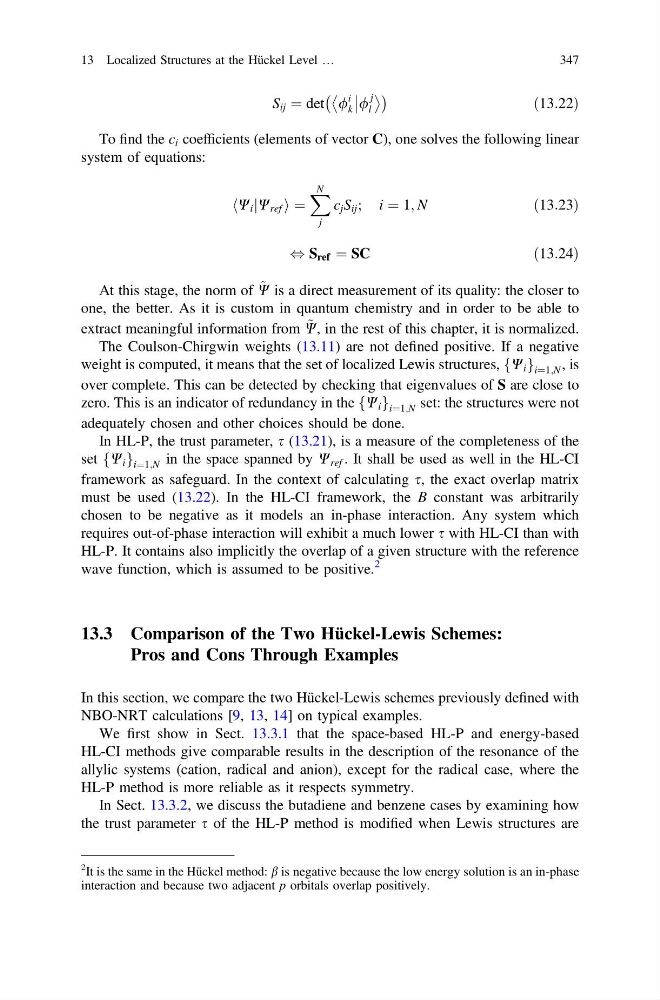
S ij ¼ det /
i
k
/
j
l
À
Á
ð13:22Þ
To find the c i coefficients (elements of vector C), one solves the following linear
system of equations:
hW i jW ref i ¼
X N
j
c j S ij ; i ¼ 1; N
ð13:23Þ
, S ref ¼ SC
ð13:24Þ
At this stage, the norm of ~
W is a direct measurement of its quality: the closer to
one, the better. As it is custom in quantum chemistry and in order to be able to
extract meaningful information from ~
W, in the rest of this chapter, it is normalized.
The Coulson-Chirgwin weights (13.11) are not defined positive. If a negative
weight is computed, it means that the set of localized Lewis structures, W i
f g i¼1;N , is
over complete. This can be detected by checking that eigenvalues of S are close to
zero. This is an indicator of redundancy in the W i
f g i¼1;N set: the structures were not
adequately chosen and other choices should be done.
In HL-P, the trust parameter, s (13.21), is a measure of the completeness of the
set W i
f g i¼1;N in the space spanned by W ref . It shall be used as well in the HL-CI
framework as safeguard. In the context of calculating s, the exact overlap matrix
must be used (13.22). In the HL-CI framework, the B constant was arbitrarily
chosen to be negative as it models an in-phase interaction. Any system which
requires out-of-phase interaction will exhibit a much lower s with HL-CI than with
HL-P. It contains also implicitly the overlap of a given structure with the reference
wave function, which is assumed to be positive.
2
13.3 Comparison of the Two Hückel-Lewis Schemes:
Pros and Cons Through Examples
In this section, we compare the two Hückel-Lewis schemes previously defined with
NBO-NRT calculations [9, 13, 14] on typical examples.
We first show in Sect. 13.3.1 that the space-based HL-P and energy-based
HL-CI methods give comparable results in the description of the resonance of the
allylic systems (cation, radical and anion), except for the radical case, where the
HL-P method is more reliable as it respects symmetry.
In Sect. 13.3.2, we discuss the butadiene and benzene cases by examining how
the trust parameter s of the HL-P method is modified when Lewis structures are
2
It is the same in the Hückel method: b is negative because the low energy solution is an in-phase
interaction and because two adjacent p orbitals overlap positively.
13 Localized Structures at the Hückel Level …
347
i
k
/
j
l
À
Á
ð13:22Þ
To find the c i coefficients (elements of vector C), one solves the following linear
system of equations:
hW i jW ref i ¼
X N
j
c j S ij ; i ¼ 1; N
ð13:23Þ
, S ref ¼ SC
ð13:24Þ
At this stage, the norm of ~
W is a direct measurement of its quality: the closer to
one, the better. As it is custom in quantum chemistry and in order to be able to
extract meaningful information from ~
W, in the rest of this chapter, it is normalized.
The Coulson-Chirgwin weights (13.11) are not defined positive. If a negative
weight is computed, it means that the set of localized Lewis structures, W i
f g i¼1;N , is
over complete. This can be detected by checking that eigenvalues of S are close to
zero. This is an indicator of redundancy in the W i
f g i¼1;N set: the structures were not
adequately chosen and other choices should be done.
In HL-P, the trust parameter, s (13.21), is a measure of the completeness of the
set W i
f g i¼1;N in the space spanned by W ref . It shall be used as well in the HL-CI
framework as safeguard. In the context of calculating s, the exact overlap matrix
must be used (13.22). In the HL-CI framework, the B constant was arbitrarily
chosen to be negative as it models an in-phase interaction. Any system which
requires out-of-phase interaction will exhibit a much lower s with HL-CI than with
HL-P. It contains also implicitly the overlap of a given structure with the reference
wave function, which is assumed to be positive.
2
13.3 Comparison of the Two Hückel-Lewis Schemes:
Pros and Cons Through Examples
In this section, we compare the two Hückel-Lewis schemes previously defined with
NBO-NRT calculations [9, 13, 14] on typical examples.
We first show in Sect. 13.3.1 that the space-based HL-P and energy-based
HL-CI methods give comparable results in the description of the resonance of the
allylic systems (cation, radical and anion), except for the radical case, where the
HL-P method is more reliable as it respects symmetry.
In Sect. 13.3.2, we discuss the butadiene and benzene cases by examining how
the trust parameter s of the HL-P method is modified when Lewis structures are
2
It is the same in the Hückel method: b is negative because the low energy solution is an in-phase
interaction and because two adjacent p orbitals overlap positively.
13 Localized Structures at the Hückel Level …
347