

added or removed in a given mesomerism scheme and how this parameter helps
choosing the important structures that best describe the resonance in these systems.
All NRT calculations have been performed using the NBO 6.0 program [23].
Unless otherwise mentioned, the geometries of the systems studied in this section
have been optimized at the B3LYP/6-31+G(d) level of calculation, using the G09
Gaussian [24] package. The values of the trust parameter s differ from previously
published work [1], the values published here corresponding to a normalized ~
W.
13.3.1 Resonance in the Allyl Series: Cation, Radical
and Anion
Let us examine in this section the mesomerism in the three allylic systems: the
cation, radical and anion. Such molecules have served as model systems in
numerous theoretical studies on p delocalization [25–29].
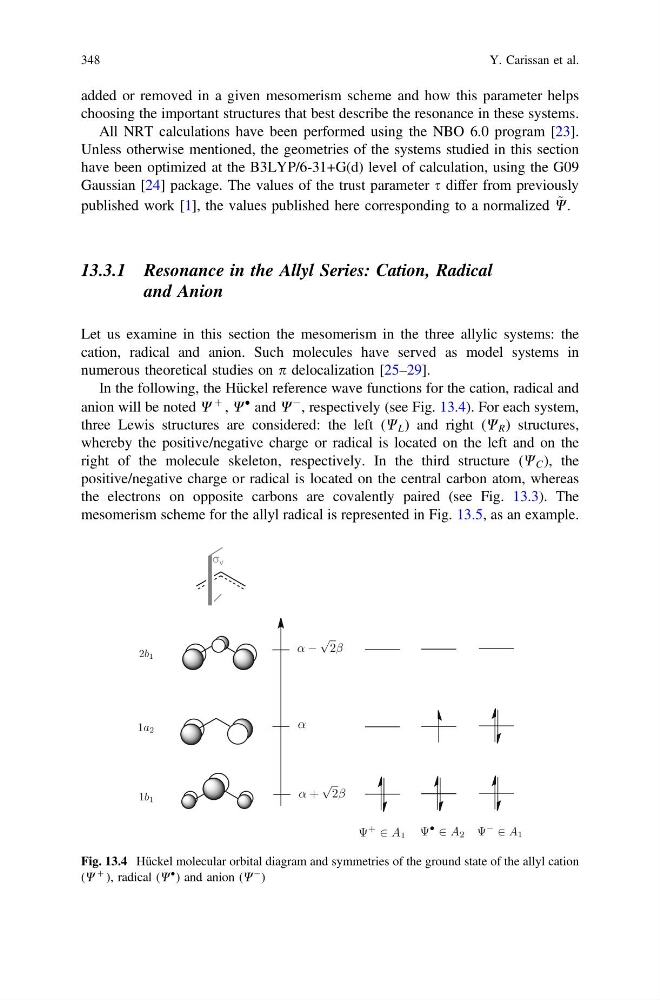
In the following, the Hückel reference wave functions for the cation, radical and
anion will be noted W
þ , W
and W
À , respectively (see Fig. 13.4). For each system,
three Lewis structures are considered: the left (W L ) and right (W R ) structures,
whereby the positive/negative charge or radical is located on the left and on the
right of the molecule skeleton, respectively. In the third structure (W C ), the
positive/negative charge or radical is located on the central carbon atom, whereas
the electrons on opposite carbons are covalently paired (see Fig. 13.3). The
mesomerism scheme for the allyl radical is represented in Fig. 13.5, as an example.
Fig. 13.4 Hückel molecular orbital diagram and symmetries of the ground state of the allyl cation
(W
þ ), radical (W
) and anion (W
À )
348
Y. Carissan et al.
choosing the important structures that best describe the resonance in these systems.
All NRT calculations have been performed using the NBO 6.0 program [23].
Unless otherwise mentioned, the geometries of the systems studied in this section
have been optimized at the B3LYP/6-31+G(d) level of calculation, using the G09
Gaussian [24] package. The values of the trust parameter s differ from previously
published work [1], the values published here corresponding to a normalized ~
W.
13.3.1 Resonance in the Allyl Series: Cation, Radical
and Anion
Let us examine in this section the mesomerism in the three allylic systems: the
cation, radical and anion. Such molecules have served as model systems in
numerous theoretical studies on p delocalization [25–29].
In the following, the Hückel reference wave functions for the cation, radical and
anion will be noted W
þ , W
and W
À , respectively (see Fig. 13.4). For each system,
three Lewis structures are considered: the left (W L ) and right (W R ) structures,
whereby the positive/negative charge or radical is located on the left and on the
right of the molecule skeleton, respectively. In the third structure (W C ), the
positive/negative charge or radical is located on the central carbon atom, whereas
the electrons on opposite carbons are covalently paired (see Fig. 13.3). The
mesomerism scheme for the allyl radical is represented in Fig. 13.5, as an example.
Fig. 13.4 Hückel molecular orbital diagram and symmetries of the ground state of the allyl cation
(W
þ ), radical (W
) and anion (W
À )
348
Y. Carissan et al.