

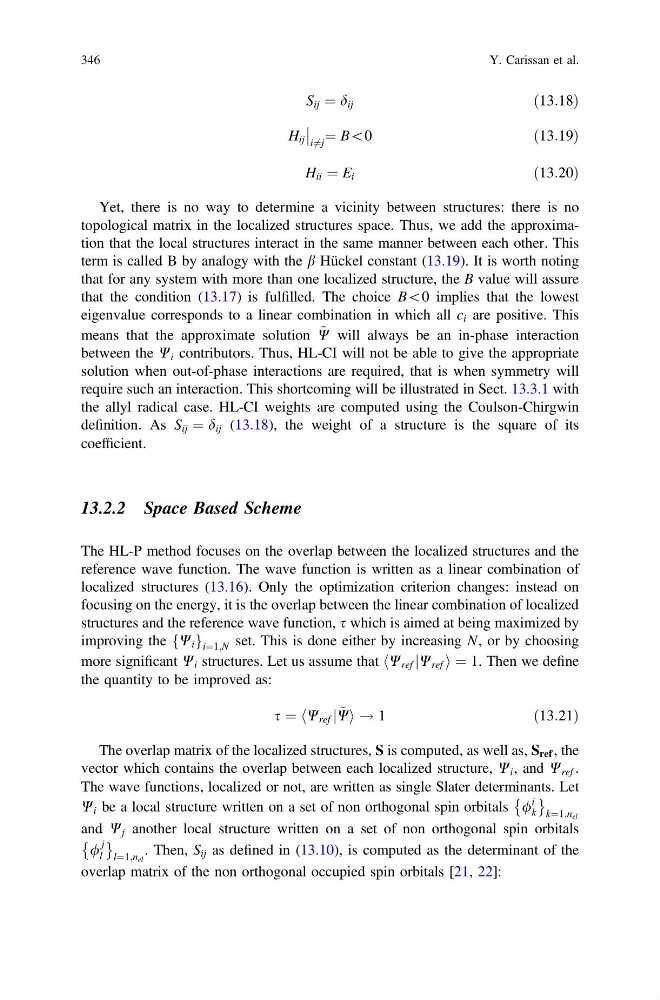
S ij ¼ d ij
ð13:18Þ
H ij
i6 ¼j
¼ B\0
ð13:19Þ
H ii ¼ E i
ð13:20Þ
Yet, there is no way to determine a vicinity between structures: there is no
topological matrix in the localized structures space. Thus, we add the approximation that the local structures interact in the same manner between each other. This
term is called B by analogy with the b Hückel constant (13.19). It is worth noting
that for any system with more than one localized structure, the B value will assure
that the condition (13.17) is fulfilled. The choice B\0 implies that the lowest
eigenvalue corresponds to a linear combination in which all c i are positive. This
means that the approximate solution ~
W will always be an in-phase interaction
between the W i contributors. Thus, HL-CI will not be able to give the appropriate
solution when out-of-phase interactions are required, that is when symmetry will
require such an interaction. This shortcoming will be illustrated in Sect. 13.3.1 with
the allyl radical case. HL-CI weights are computed using the Coulson-Chirgwin
definition. As S ij ¼ d ij (13.18), the weight of a structure is the square of its
coefficient.
13.2.2 Space Based Scheme
The HL-P method focuses on the overlap between the localized structures and the
reference wave function. The wave function is written as a linear combination of
localized structures (13.16). Only the optimization criterion changes: instead on
focusing on the energy, it is the overlap between the linear combination of localized
structures and the reference wave function, s which is aimed at being maximized by
improving the W i
f g i¼1;N set. This is done either by increasing N, or by choosing
more significant W i structures. Let us assume that hW ref jW ref i ¼ 1. Then we define
the quantity to be improved as:
s ¼ hW ref j ~
Wi ! 1
ð13:21Þ
The overlap matrix of the localized structures, S is computed, as well as, S ref , the
vector which contains the overlap between each localized structure, W i , and W ref .
The wave functions, localized or not, are written as single Slater determinants. Let
W i be a local structure written on a set of non orthogonal spin orbitals /
i
k
È É
k¼1;n el
and W j another local structure written on a set of non orthogonal spin orbitals
/
j
l
È É
l¼1;n el
. Then, S ij as defined in (13.10), is computed as the determinant of the
overlap matrix of the non orthogonal occupied spin orbitals [21, 22]:
346
Y. Carissan et al.
ð13:18Þ
H ij
i6 ¼j
¼ B\0
ð13:19Þ
H ii ¼ E i
ð13:20Þ
Yet, there is no way to determine a vicinity between structures: there is no
topological matrix in the localized structures space. Thus, we add the approximation that the local structures interact in the same manner between each other. This
term is called B by analogy with the b Hückel constant (13.19). It is worth noting
that for any system with more than one localized structure, the B value will assure
that the condition (13.17) is fulfilled. The choice B\0 implies that the lowest
eigenvalue corresponds to a linear combination in which all c i are positive. This
means that the approximate solution ~
W will always be an in-phase interaction
between the W i contributors. Thus, HL-CI will not be able to give the appropriate
solution when out-of-phase interactions are required, that is when symmetry will
require such an interaction. This shortcoming will be illustrated in Sect. 13.3.1 with
the allyl radical case. HL-CI weights are computed using the Coulson-Chirgwin
definition. As S ij ¼ d ij (13.18), the weight of a structure is the square of its
coefficient.
13.2.2 Space Based Scheme
The HL-P method focuses on the overlap between the localized structures and the
reference wave function. The wave function is written as a linear combination of
localized structures (13.16). Only the optimization criterion changes: instead on
focusing on the energy, it is the overlap between the linear combination of localized
structures and the reference wave function, s which is aimed at being maximized by
improving the W i
f g i¼1;N set. This is done either by increasing N, or by choosing
more significant W i structures. Let us assume that hW ref jW ref i ¼ 1. Then we define
the quantity to be improved as:
s ¼ hW ref j ~
Wi ! 1
ð13:21Þ
The overlap matrix of the localized structures, S is computed, as well as, S ref , the
vector which contains the overlap between each localized structure, W i , and W ref .
The wave functions, localized or not, are written as single Slater determinants. Let
W i be a local structure written on a set of non orthogonal spin orbitals /
i
k
È É
k¼1;n el
and W j another local structure written on a set of non orthogonal spin orbitals
/
j
l
È É
l¼1;n el
. Then, S ij as defined in (13.10), is computed as the determinant of the
overlap matrix of the non orthogonal occupied spin orbitals [21, 22]:
346
Y. Carissan et al.