

13.1.4 From Hückel Molecular Orbital to Lewis Structures
In the Hückel-Lewis family of methods, we use the fact that the Hückel
Hamiltonian is versatile, so electrons can be localized by simply zeroing out some
terms in a modified Hamiltonian matrix. This terms are those that correspond to
single bonds in a Lewis structure. The new Hamiltonian leads to eigenvectors that
correspond to local orbitals, and corresponding eigenvalues are also obtained. The
wave function W i , that describes the ith structure, is again a Slater determinant,
obtained by distributing the electrons in the appropriate local orbitals.
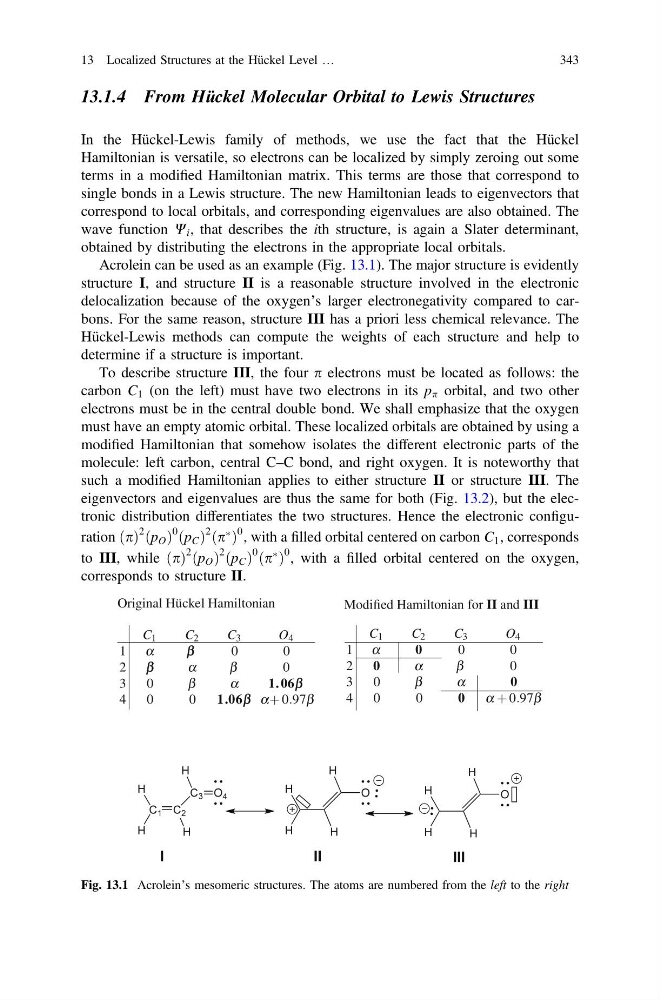
Acrolein can be used as an example (Fig. 13.1). The major structure is evidently
structure I, and structure II is a reasonable structure involved in the electronic
delocalization because of the oxygen’s larger electronegativity compared to carbons. For the same reason, structure III has a priori less chemical relevance. The
Hückel-Lewis methods can compute the weights of each structure and help to
determine if a structure is important.
To describe structure III, the four p electrons must be located as follows: the
carbon C 1 (on the left) must have two electrons in its p p orbital, and two other
electrons must be in the central double bond. We shall emphasize that the oxygen
must have an empty atomic orbital. These localized orbitals are obtained by using a
modified Hamiltonian that somehow isolates the different electronic parts of the
molecule: left carbon, central C–C bond, and right oxygen. It is noteworthy that
such a modified Hamiltonian applies to either structure II or structure III. The
eigenvectors and eigenvalues are thus the same for both (Fig. 13.2), but the electronic distribution differentiates the two structures. Hence the electronic configuration ðpÞ
2 ðp O Þ
0 ðp C Þ
2 ðp
Ã
Þ
0 , with a filled orbital centered on carbon C 1 , corresponds
to III, while ðpÞ
2 ðp O Þ
2 ðp C Þ
0 ðp
Ã
Þ
0 , with a filled orbital centered on the oxygen,
corresponds to structure II.
Hamiltonian
l
e
k
c
u ¨
H
Original
Modified Hamiltonian for II and III
C 1
C 2
C 3
O 4
1 α
β β
0
0
2 β
α
β
0
3
0
β
α
1. 06β
4
0
0
1.06β α+ 0.97β
C 1
C 2
C 3
O 4
1 α
0
0
0
2
0
α
β
0
3
0
β
α
0
4
0
0
0
α + 0.97β
Fig. 13.1 Acrolein’s mesomeric structures. The atoms are numbered from the left to the right
13 Localized Structures at the Hückel Level …
343
In the Hückel-Lewis family of methods, we use the fact that the Hückel
Hamiltonian is versatile, so electrons can be localized by simply zeroing out some
terms in a modified Hamiltonian matrix. This terms are those that correspond to
single bonds in a Lewis structure. The new Hamiltonian leads to eigenvectors that
correspond to local orbitals, and corresponding eigenvalues are also obtained. The
wave function W i , that describes the ith structure, is again a Slater determinant,
obtained by distributing the electrons in the appropriate local orbitals.
Acrolein can be used as an example (Fig. 13.1). The major structure is evidently
structure I, and structure II is a reasonable structure involved in the electronic
delocalization because of the oxygen’s larger electronegativity compared to carbons. For the same reason, structure III has a priori less chemical relevance. The
Hückel-Lewis methods can compute the weights of each structure and help to
determine if a structure is important.
To describe structure III, the four p electrons must be located as follows: the
carbon C 1 (on the left) must have two electrons in its p p orbital, and two other
electrons must be in the central double bond. We shall emphasize that the oxygen
must have an empty atomic orbital. These localized orbitals are obtained by using a
modified Hamiltonian that somehow isolates the different electronic parts of the
molecule: left carbon, central C–C bond, and right oxygen. It is noteworthy that
such a modified Hamiltonian applies to either structure II or structure III. The
eigenvectors and eigenvalues are thus the same for both (Fig. 13.2), but the electronic distribution differentiates the two structures. Hence the electronic configuration ðpÞ
2 ðp O Þ
0 ðp C Þ
2 ðp
Ã
Þ
0 , with a filled orbital centered on carbon C 1 , corresponds
to III, while ðpÞ
2 ðp O Þ
2 ðp C Þ
0 ðp
Ã
Þ
0 , with a filled orbital centered on the oxygen,
corresponds to structure II.
Hamiltonian
l
e
k
c
u ¨
H
Original
Modified Hamiltonian for II and III
C 1
C 2
C 3
O 4
1 α
β β
0
0
2 β
α
β
0
3
0
β
α
1. 06β
4
0
0
1.06β α+ 0.97β
C 1
C 2
C 3
O 4
1 α
0
0
0
2
0
α
β
0
3
0
β
α
0
4
0
0
0
α + 0.97β
Fig. 13.1 Acrolein’s mesomeric structures. The atoms are numbered from the left to the right
13 Localized Structures at the Hückel Level …
343