

This zeroing-out technique is straightforward to use and de facto isolates any
double bond or lone pair in a molecule. The Lewis structures can then be characterized both with a wave function W i and an energy E i . Delocalization energies are
obtained by energy difference between the energy of a localized structure, and E ref ,
which is the Hückel energy of the molecule.
One shall notice that contrary to ab initio calculations, where fully localized
orbitals are necessarily non-orthogonal and lead to heavy calculations, Hückel
orbital localization does not bring any complication, neither to the code, nor to the
computational effort. The only slight complication arises from open shell covalently
paired electrons, when the two electrons are not in the same p orbital but belong to
two different orbitals, say a and b. We shall represent such a singlet coupling with a
plain arc that links the two electrons’ dots (Fig. 13.3). The wave function associated
to such a case contains the determinants ab
þ ba
j j.
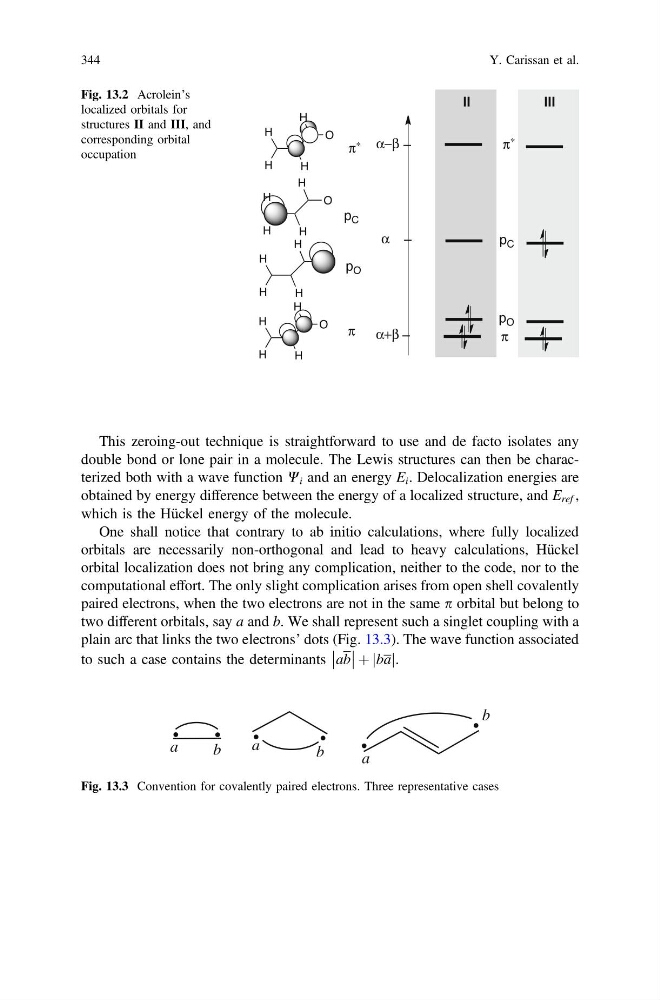
Fig. 13.2 Acrolein’s
localized orbitals for
structures II and III, and
corresponding orbital
occupation
Fig. 13.3 Convention for covalently paired electrons. Three representative cases
344
Y. Carissan et al.
double bond or lone pair in a molecule. The Lewis structures can then be characterized both with a wave function W i and an energy E i . Delocalization energies are
obtained by energy difference between the energy of a localized structure, and E ref ,
which is the Hückel energy of the molecule.
One shall notice that contrary to ab initio calculations, where fully localized
orbitals are necessarily non-orthogonal and lead to heavy calculations, Hückel
orbital localization does not bring any complication, neither to the code, nor to the
computational effort. The only slight complication arises from open shell covalently
paired electrons, when the two electrons are not in the same p orbital but belong to
two different orbitals, say a and b. We shall represent such a singlet coupling with a
plain arc that links the two electrons’ dots (Fig. 13.3). The wave function associated
to such a case contains the determinants ab
þ ba
j j.
Fig. 13.2 Acrolein’s
localized orbitals for
structures II and III, and
corresponding orbital
occupation
Fig. 13.3 Convention for covalently paired electrons. Three representative cases
344
Y. Carissan et al.