

H ¼
a A
k AB b 0 . . .
0
k AB b a B
. .
.
0
0
0
. .
.
a C
. .
.
. .
.
0
. .
.
. .
.
. .
.
0
0
. .
.
a n
0
B
B
B
B
B
B
B
@
1
C
C
C
C
C
C
C
A
ð13:12Þ
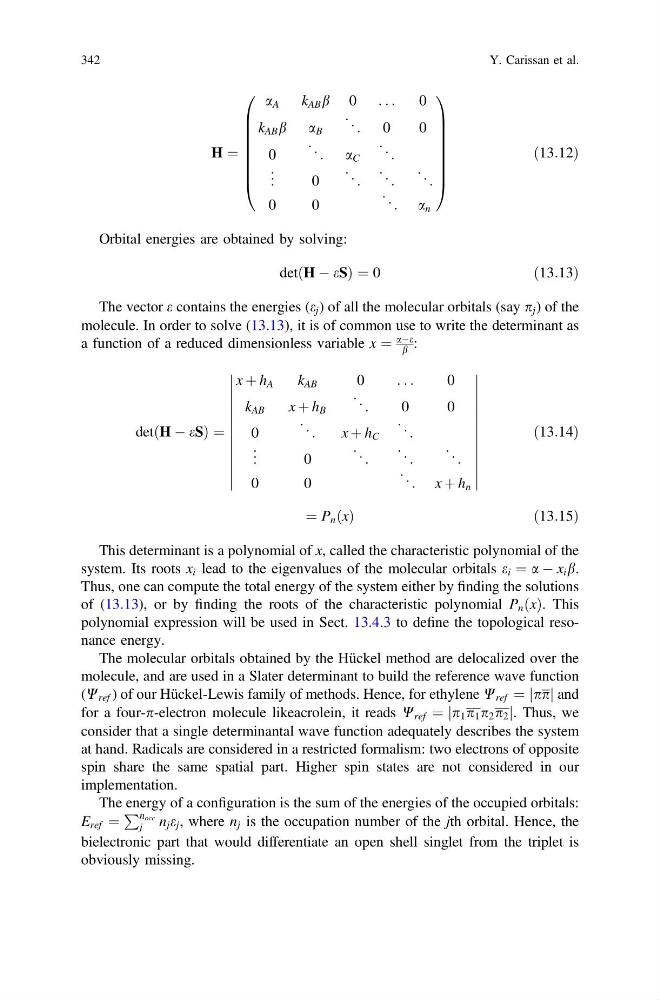
Orbital energies are obtained by solving:
detðH À eSÞ ¼ 0
ð13:13Þ
The vector e contains the energies (e j ) of all the molecular orbitals (say p j ) of the
molecule. In order to solve (13.13), it is of common use to write the determinant as
a function of a reduced dimensionless variable x ¼
aÀe
b :
det H À eS
ð
Þ¼
x þ h A
k AB
0
. . .
0
k AB
x þ h B
. .
.
0
0
0
. .
.
x þ h C
. .
.
. .
.
0
. .
.
. .
.
. .
.
0
0
. .
.
x þ h n
ð13:14Þ
¼ P n ðxÞ
ð 13:15Þ
This determinant is a polynomial of x, called the characteristic polynomial of the
system. Its roots x i lead to the eigenvalues of the molecular orbitals e i ¼ a À x i b.
Thus, one can compute the total energy of the system either by finding the solutions
of (13.13), or by finding the roots of the characteristic polynomial P n ðxÞ. This
polynomial expression will be used in Sect. 13.4.3 to define the topological resonance energy.
The molecular orbitals obtained by the Hückel method are delocalized over the
molecule, and are used in a Slater determinant to build the reference wave function
(W ref ) of our Hückel-Lewis family of methods. Hence, for ethylene W ref ¼ jppj and
for a four-p-electron molecule likeacrolein, it reads W ref ¼ jp 1 p 1 p 2 p 2 j. Thus, we
consider that a single determinantal wave function adequately describes the system
at hand. Radicals are considered in a restricted formalism: two electrons of opposite
spin share the same spatial part. Higher spin states are not considered in our
implementation.
The energy of a configuration is the sum of the energies of the occupied orbitals:
E ref ¼
P n occ
j
n j e j , where n j is the occupation number of the jth orbital. Hence, the
bielectronic part that would differentiate an open shell singlet from the triplet is
obviously missing.
342
Y. Carissan et al.
a A
k AB b 0 . . .
0
k AB b a B
. .
.
0
0
0
. .
.
a C
. .
.
. .
.
0
. .
.
. .
.
. .
.
0
0
. .
.
a n
0
B
B
B
B
B
B
B
@
1
C
C
C
C
C
C
C
A
ð13:12Þ
Orbital energies are obtained by solving:
detðH À eSÞ ¼ 0
ð13:13Þ
The vector e contains the energies (e j ) of all the molecular orbitals (say p j ) of the
molecule. In order to solve (13.13), it is of common use to write the determinant as
a function of a reduced dimensionless variable x ¼
aÀe
b :
det H À eS
ð
Þ¼
x þ h A
k AB
0
. . .
0
k AB
x þ h B
. .
.
0
0
0
. .
.
x þ h C
. .
.
. .
.
0
. .
.
. .
.
. .
.
0
0
. .
.
x þ h n
ð13:14Þ
¼ P n ðxÞ
ð 13:15Þ
This determinant is a polynomial of x, called the characteristic polynomial of the
system. Its roots x i lead to the eigenvalues of the molecular orbitals e i ¼ a À x i b.
Thus, one can compute the total energy of the system either by finding the solutions
of (13.13), or by finding the roots of the characteristic polynomial P n ðxÞ. This
polynomial expression will be used in Sect. 13.4.3 to define the topological resonance energy.
The molecular orbitals obtained by the Hückel method are delocalized over the
molecule, and are used in a Slater determinant to build the reference wave function
(W ref ) of our Hückel-Lewis family of methods. Hence, for ethylene W ref ¼ jppj and
for a four-p-electron molecule likeacrolein, it reads W ref ¼ jp 1 p 1 p 2 p 2 j. Thus, we
consider that a single determinantal wave function adequately describes the system
at hand. Radicals are considered in a restricted formalism: two electrons of opposite
spin share the same spatial part. Higher spin states are not considered in our
implementation.
The energy of a configuration is the sum of the energies of the occupied orbitals:
E ref ¼
P n occ
j
n j e j , where n j is the occupation number of the jth orbital. Hence, the
bielectronic part that would differentiate an open shell singlet from the triplet is
obviously missing.
342
Y. Carissan et al.