

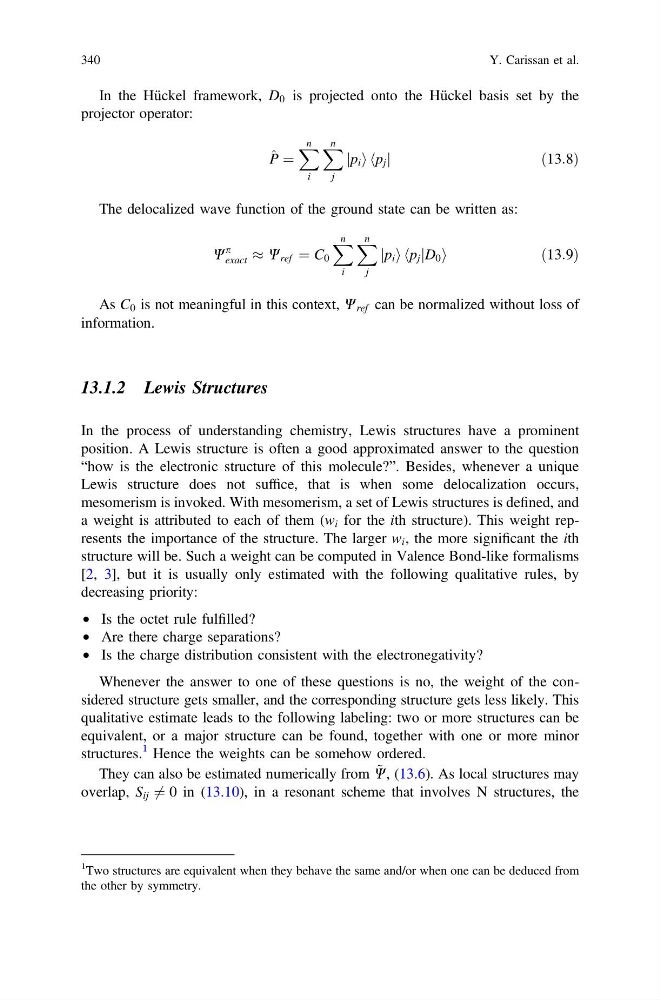
In the Hückel framework, D 0 is projected onto the Hückel basis set by the
projector operator:
^
P ¼
X n
i
X n
j
jp i i hp j j
ð 13:8Þ
The delocalized wave function of the ground state can be written as:
W
p
exact % W ref ¼ C 0
X n
i
X n
j
jp i i hp j jD 0 i
ð 13:9Þ
As C 0 is not meaningful in this context, W ref can be normalized without loss of
information.
13.1.2 Lewis Structures
In the process of understanding chemistry, Lewis structures have a prominent
position. A Lewis structure is often a good approximated answer to the question
“how is the electronic structure of this molecule?”. Besides, whenever a unique
Lewis structure does not suffice, that is when some delocalization occurs,
mesomerism is invoked. With mesomerism, a set of Lewis structures is defined, and
a weight is attributed to each of them (w i for the ith structure). This weight represents the importance of the structure. The larger w i , the more significant the ith
structure will be. Such a weight can be computed in Valence Bond-like formalisms
[2, 3], but it is usually only estimated with the following qualitative rules, by
decreasing priority:
• Is the octet rule fulfilled?
• Are there charge separations?
• Is the charge distribution consistent with the electronegativity?
Whenever the answer to one of these questions is no, the weight of the considered structure gets smaller, and the corresponding structure gets less likely. This
qualitative estimate leads to the following labeling: two or more structures can be
equivalent, or a major structure can be found, together with one or more minor
structures.
1 Hence the weights can be somehow ordered.
They can also be estimated numerically from ~
W, (13.6). As local structures may
overlap, S ij 6 ¼ 0 in (13.10), in a resonant scheme that involves N structures, the
1
Two structures are equivalent when they behave the same and/or when one can be deduced from
the other by symmetry.
340
Y. Carissan et al.
projector operator:
^
P ¼
X n
i
X n
j
jp i i hp j j
ð 13:8Þ
The delocalized wave function of the ground state can be written as:
W
p
exact % W ref ¼ C 0
X n
i
X n
j
jp i i hp j jD 0 i
ð 13:9Þ
As C 0 is not meaningful in this context, W ref can be normalized without loss of
information.
13.1.2 Lewis Structures
In the process of understanding chemistry, Lewis structures have a prominent
position. A Lewis structure is often a good approximated answer to the question
“how is the electronic structure of this molecule?”. Besides, whenever a unique
Lewis structure does not suffice, that is when some delocalization occurs,
mesomerism is invoked. With mesomerism, a set of Lewis structures is defined, and
a weight is attributed to each of them (w i for the ith structure). This weight represents the importance of the structure. The larger w i , the more significant the ith
structure will be. Such a weight can be computed in Valence Bond-like formalisms
[2, 3], but it is usually only estimated with the following qualitative rules, by
decreasing priority:
• Is the octet rule fulfilled?
• Are there charge separations?
• Is the charge distribution consistent with the electronegativity?
Whenever the answer to one of these questions is no, the weight of the considered structure gets smaller, and the corresponding structure gets less likely. This
qualitative estimate leads to the following labeling: two or more structures can be
equivalent, or a major structure can be found, together with one or more minor
structures.
1 Hence the weights can be somehow ordered.
They can also be estimated numerically from ~
W, (13.6). As local structures may
overlap, S ij 6 ¼ 0 in (13.10), in a resonant scheme that involves N structures, the
1
Two structures are equivalent when they behave the same and/or when one can be deduced from
the other by symmetry.
340
Y. Carissan et al.