

structures as Lewis structures. For higher numbers, they would be called
non-Lewis:
W
p
exact ¼ W
p=Lewis
exact
þ W
p=nonÀLewis
exact
ð13:2Þ
with:
W
p=Lewis
exact
¼
X 1
i¼1
c
p=Lewis
i
W
p=Lewis
i
ð13:3Þ
W
p=nonÀLewis
exact
¼
X 1
i¼1
c
p=nonÀLewis
i
W
p=nonÀLewis
i
ð13:4Þ
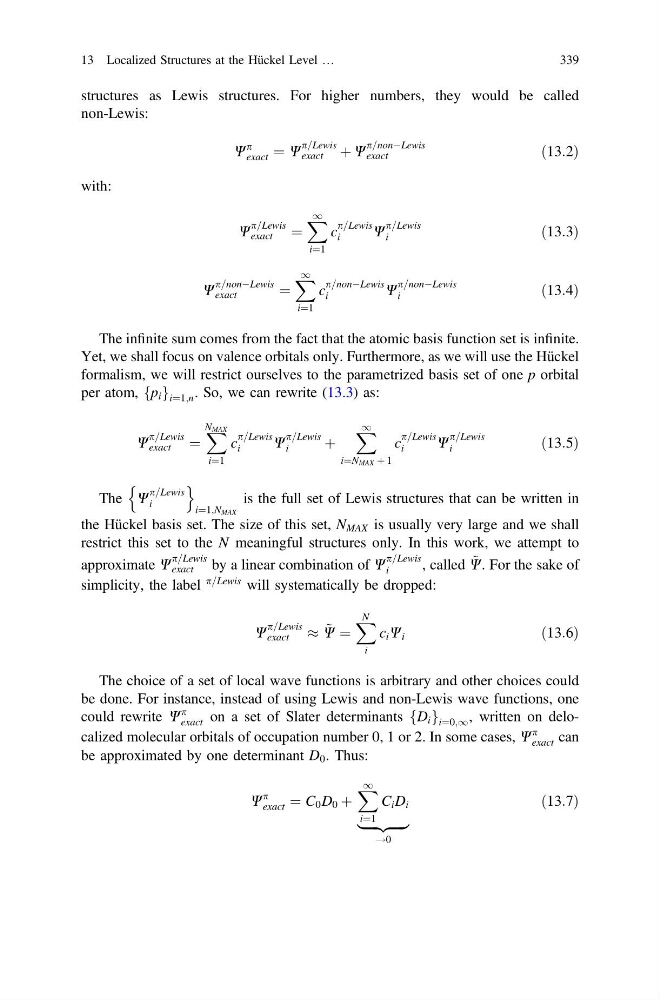
The infinite sum comes from the fact that the atomic basis function set is infinite.
Yet, we shall focus on valence orbitals only. Furthermore, as we will use the Hückel
formalism, we will restrict ourselves to the parametrized basis set of one p orbital
per atom, p i
f g i¼1;n . So, we can rewrite (13.3) as:
W
p=Lewis
exact
¼
X
N MAX
i¼1
c
p=Lewis
i
W
p=Lewis
i
þ
X 1
i¼N MAX þ 1
c
p=Lewis
i
W
p=Lewis
i
ð13:5Þ
The W
p=Lewis
i
n
o
i¼1;N MAX
is the full set of Lewis structures that can be written in
the Hückel basis set. The size of this set, N MAX is usually very large and we shall
restrict this set to the N meaningful structures only. In this work, we attempt to
approximate W
p=Lewis
exact
by a linear combination of W
p=Lewis
i
, called ~
W. For the sake of
simplicity, the label
p=Lewis will systematically be dropped:
W
p=Lewis
exact
% ~
W ¼
X N
i
c i W i
ð13:6Þ
The choice of a set of local wave functions is arbitrary and other choices could
be done. For instance, instead of using Lewis and non-Lewis wave functions, one
could rewrite W
p
exact on a set of Slater determinants D i
f g i¼0;1 , written on delocalized molecular orbitals of occupation number 0, 1 or 2. In some cases, W
p
exact can
be approximated by one determinant D 0 . Thus:
W
p
exact ¼ C 0 D 0 þ
X 1
i¼1
C i D i
|fflfflfflffl ffl{zfflfflfflffl ffl}
!0
ð13:7Þ
13 Localized Structures at the Hückel Level …
339
non-Lewis:
W
p
exact ¼ W
p=Lewis
exact
þ W
p=nonÀLewis
exact
ð13:2Þ
with:
W
p=Lewis
exact
¼
X 1
i¼1
c
p=Lewis
i
W
p=Lewis
i
ð13:3Þ
W
p=nonÀLewis
exact
¼
X 1
i¼1
c
p=nonÀLewis
i
W
p=nonÀLewis
i
ð13:4Þ
The infinite sum comes from the fact that the atomic basis function set is infinite.
Yet, we shall focus on valence orbitals only. Furthermore, as we will use the Hückel
formalism, we will restrict ourselves to the parametrized basis set of one p orbital
per atom, p i
f g i¼1;n . So, we can rewrite (13.3) as:
W
p=Lewis
exact
¼
X
N MAX
i¼1
c
p=Lewis
i
W
p=Lewis
i
þ
X 1
i¼N MAX þ 1
c
p=Lewis
i
W
p=Lewis
i
ð13:5Þ
The W
p=Lewis
i
n
o
i¼1;N MAX
is the full set of Lewis structures that can be written in
the Hückel basis set. The size of this set, N MAX is usually very large and we shall
restrict this set to the N meaningful structures only. In this work, we attempt to
approximate W
p=Lewis
exact
by a linear combination of W
p=Lewis
i
, called ~
W. For the sake of
simplicity, the label
p=Lewis will systematically be dropped:
W
p=Lewis
exact
% ~
W ¼
X N
i
c i W i
ð13:6Þ
The choice of a set of local wave functions is arbitrary and other choices could
be done. For instance, instead of using Lewis and non-Lewis wave functions, one
could rewrite W
p
exact on a set of Slater determinants D i
f g i¼0;1 , written on delocalized molecular orbitals of occupation number 0, 1 or 2. In some cases, W
p
exact can
be approximated by one determinant D 0 . Thus:
W
p
exact ¼ C 0 D 0 þ
X 1
i¼1
C i D i
|fflfflfflffl ffl{zfflfflfflffl ffl}
!0
ð13:7Þ
13 Localized Structures at the Hückel Level …
339