

simplicity due to the underlying Hückel approximations, and its failures are easy to
understand. Finally, it conveys some clear understanding of the electronic
delocalization.
13.1 Understanding Delocalization: Lewis Drawings
and Mesomerism Versus Molecular Orbitals
(Hückel) Method
This section introduces the context and the notation of the Hückel-Lewis
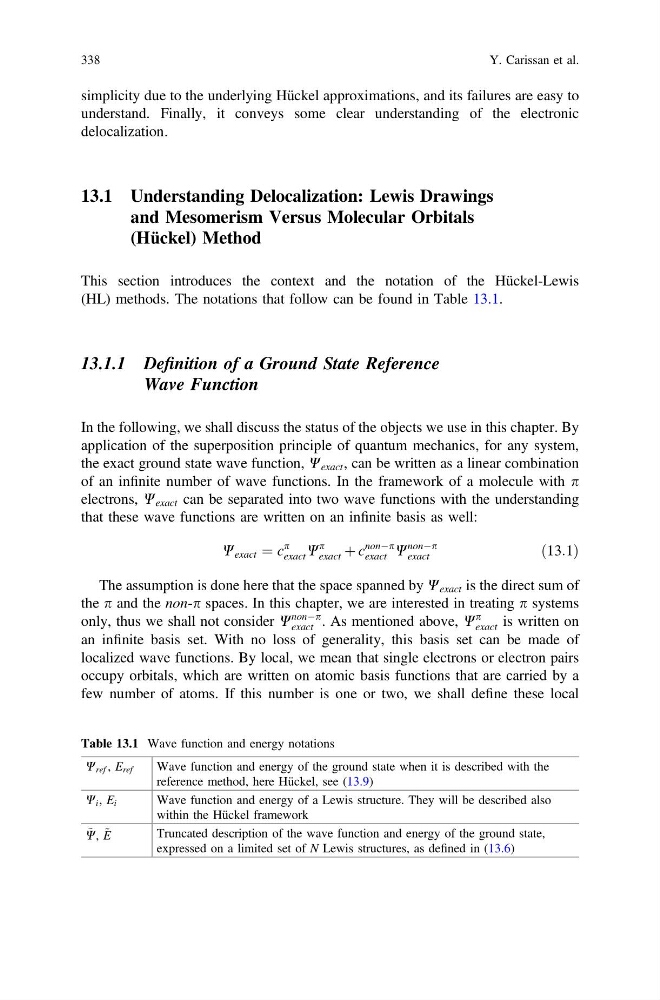
(HL) methods. The notations that follow can be found in Table 13.1.
13.1.1 Definition of a Ground State Reference
Wave Function
In the following, we shall discuss the status of the objects we use in this chapter. By
application of the superposition principle of quantum mechanics, for any system,
the exact ground state wave function, W exact , can be written as a linear combination
of an infinite number of wave functions. In the framework of a molecule with p
electrons, W exact can be separated into two wave functions with the understanding
that these wave functions are written on an infinite basis as well:
W exact ¼ c
p
exact W
p
exact þ c
nonÀp
exact W
nonÀp
exact
ð13:1Þ
The assumption is done here that the space spanned by W exact is the direct sum of
the p and the non-p spaces. In this chapter, we are interested in treating p systems
only, thus we shall not consider W
nonÀp
exact . As mentioned above, W
p
exact is written on
an infinite basis set. With no loss of generality, this basis set can be made of
localized wave functions. By local, we mean that single electrons or electron pairs
occupy orbitals, which are written on atomic basis functions that are carried by a
few number of atoms. If this number is one or two, we shall define these local
Table 13.1 Wave function and energy notations
W ref , E ref
Wave function and energy of the ground state when it is described with the
reference method, here Hückel, see (13.9)
W i , E i
Wave function and energy of a Lewis structure. They will be described also
within the Hückel framework
~
W, ~
E
Truncated description of the wave function and energy of the ground state,
expressed on a limited set of N Lewis structures, as defined in (13.6)
338
Y. Carissan et al.
understand. Finally, it conveys some clear understanding of the electronic
delocalization.
13.1 Understanding Delocalization: Lewis Drawings
and Mesomerism Versus Molecular Orbitals
(Hückel) Method
This section introduces the context and the notation of the Hückel-Lewis
(HL) methods. The notations that follow can be found in Table 13.1.
13.1.1 Definition of a Ground State Reference
Wave Function
In the following, we shall discuss the status of the objects we use in this chapter. By
application of the superposition principle of quantum mechanics, for any system,
the exact ground state wave function, W exact , can be written as a linear combination
of an infinite number of wave functions. In the framework of a molecule with p
electrons, W exact can be separated into two wave functions with the understanding
that these wave functions are written on an infinite basis as well:
W exact ¼ c
p
exact W
p
exact þ c
nonÀp
exact W
nonÀp
exact
ð13:1Þ
The assumption is done here that the space spanned by W exact is the direct sum of
the p and the non-p spaces. In this chapter, we are interested in treating p systems
only, thus we shall not consider W
nonÀp
exact . As mentioned above, W
p
exact is written on
an infinite basis set. With no loss of generality, this basis set can be made of
localized wave functions. By local, we mean that single electrons or electron pairs
occupy orbitals, which are written on atomic basis functions that are carried by a
few number of atoms. If this number is one or two, we shall define these local
Table 13.1 Wave function and energy notations
W ref , E ref
Wave function and energy of the ground state when it is described with the
reference method, here Hückel, see (13.9)
W i , E i
Wave function and energy of a Lewis structure. They will be described also
within the Hückel framework
~
W, ~
E
Truncated description of the wave function and energy of the ground state,
expressed on a limited set of N Lewis structures, as defined in (13.6)
338
Y. Carissan et al.