

12.4 Rules of Spherical Aromaticity
In 2000, Hirsch’s 2(n + 1)
2 rule of aromaticity for spherical compounds [18, 46, 47]
was introduced as the spherical analog of Hückel’s 4n + 2 rule. Hirsch’s rule is
based on the fact that the π-electron system of an icosahedral fullerene can be, in a
first approximation, considered as a spherical electron gas surrounding the surface
of a sphere. The corresponding wave functions of this electron gas are characterized
by the angular momentum quantum number l (l = 0, 1, 2,…), with each energy level
2 l + 1 times degenerated, and thus all π-shells are completely filled when we have 2
(n + 1)
2 electrons. For such reason, spherical species with 2(n + 1)
2
π-electrons are
aromatic, like icosahedral C 20
2+ , C 60
10+ or C 80
8+ .
In the same way that Baird’s 4n rule represented the extension of Hückel’s 4n + 2
rule to triplet state systems, those spherical systems having a same-spin half-filled
last energy level with the rest of the levels being fully filled should be aromatic.
Thus, recently Poater and Solà proved that the spherical compounds with
2n
2 + 2n + 1 electrons and with a spin S = n + ½ accomplish this latter statement [19].
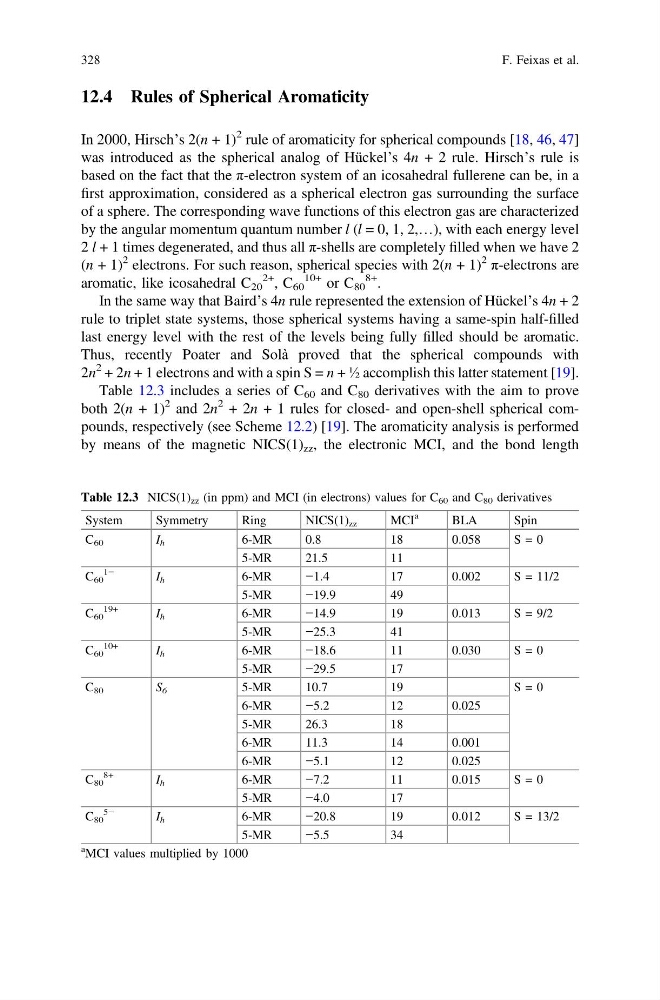
Table 12.3 includes a series of C 60 and C 80 derivatives with the aim to prove
both 2(n + 1)
2 and 2n
2 + 2n + 1 rules for closed- and open-shell spherical compounds, respectively (see Scheme 12.2) [19]. The aromaticity analysis is performed
by means of the magnetic NICS(1) zz , the electronic MCI, and the bond length
Table 12.3 NICS(1) zz (in ppm) and MCI (in electrons) values for C 60 and C 80 derivatives
System
Symmetry
Ring
NICS(1) zz
MCI
a
BLA
Spin
C 60
I h
6-MR
0.8
18
0.058
S = 0
5-MR
21.5
11
C 60
1−
I h
6-MR
−1.4
17
0.002
S = 11/2
5-MR
−19.9
49
C 60
19+
I h
6-MR
−14.9
19
0.013
S = 9/2
5-MR
−25.3
41
C 60
10+
I h
6-MR
−18.6
11
0.030
S = 0
5-MR
−29.5
17
C 80
S 6
5-MR
10.7
19
S = 0
6-MR
−5.2
12
0.025
5-MR
26.3
18
6-MR
11.3
14
0.001
6-MR
−5.1
12
0.025
C 80
8+
I h
6-MR
−7.2
11
0.015
S = 0
5-MR
−4.0
17
C 80
5−
I h
6-MR
−20.8
19
0.012
S = 13/2
5-MR
−5.5
34
a MCI values multiplied by 1000
328
F. Feixas et al.
In 2000, Hirsch’s 2(n + 1)
2 rule of aromaticity for spherical compounds [18, 46, 47]
was introduced as the spherical analog of Hückel’s 4n + 2 rule. Hirsch’s rule is
based on the fact that the π-electron system of an icosahedral fullerene can be, in a
first approximation, considered as a spherical electron gas surrounding the surface
of a sphere. The corresponding wave functions of this electron gas are characterized
by the angular momentum quantum number l (l = 0, 1, 2,…), with each energy level
2 l + 1 times degenerated, and thus all π-shells are completely filled when we have 2
(n + 1)
2 electrons. For such reason, spherical species with 2(n + 1)
2
π-electrons are
aromatic, like icosahedral C 20
2+ , C 60
10+ or C 80
8+ .
In the same way that Baird’s 4n rule represented the extension of Hückel’s 4n + 2
rule to triplet state systems, those spherical systems having a same-spin half-filled
last energy level with the rest of the levels being fully filled should be aromatic.
Thus, recently Poater and Solà proved that the spherical compounds with
2n
2 + 2n + 1 electrons and with a spin S = n + ½ accomplish this latter statement [19].
Table 12.3 includes a series of C 60 and C 80 derivatives with the aim to prove
both 2(n + 1)
2 and 2n
2 + 2n + 1 rules for closed- and open-shell spherical compounds, respectively (see Scheme 12.2) [19]. The aromaticity analysis is performed
by means of the magnetic NICS(1) zz , the electronic MCI, and the bond length
Table 12.3 NICS(1) zz (in ppm) and MCI (in electrons) values for C 60 and C 80 derivatives
System
Symmetry
Ring
NICS(1) zz
MCI
a
BLA
Spin
C 60
I h
6-MR
0.8
18
0.058
S = 0
5-MR
21.5
11
C 60
1−
I h
6-MR
−1.4
17
0.002
S = 11/2
5-MR
−19.9
49
C 60
19+
I h
6-MR
−14.9
19
0.013
S = 9/2
5-MR
−25.3
41
C 60
10+
I h
6-MR
−18.6
11
0.030
S = 0
5-MR
−29.5
17
C 80
S 6
5-MR
10.7
19
S = 0
6-MR
−5.2
12
0.025
5-MR
26.3
18
6-MR
11.3
14
0.001
6-MR
−5.1
12
0.025
C 80
8+
I h
6-MR
−7.2
11
0.015
S = 0
5-MR
−4.0
17
C 80
5−
I h
6-MR
−20.8
19
0.012
S = 13/2
5-MR
−5.5
34
a MCI values multiplied by 1000
328
F. Feixas et al.