

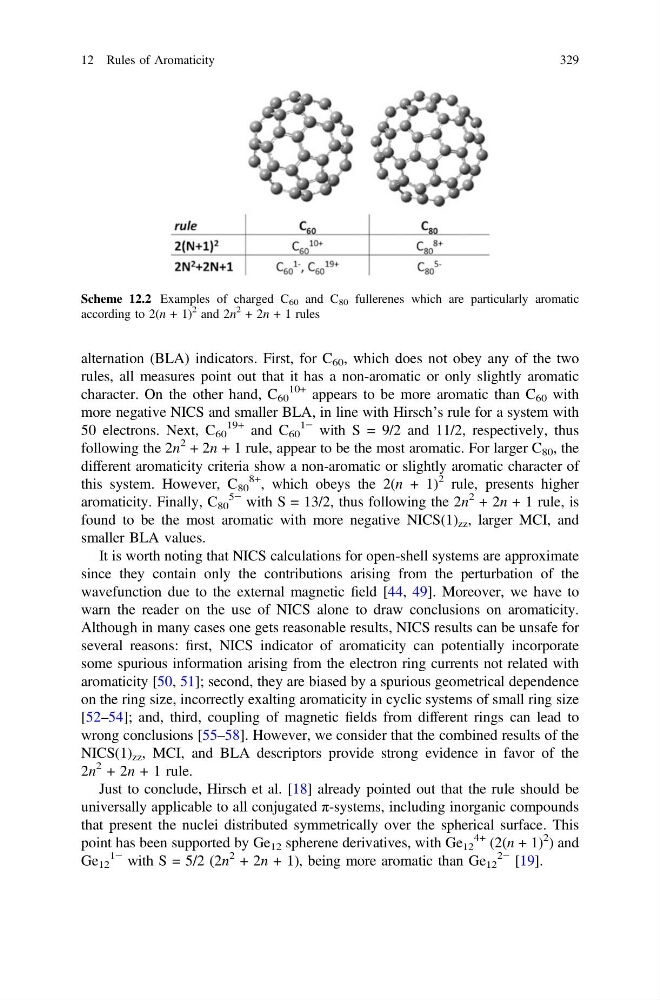
alternation (BLA) indicators. First, for C 60 , which does not obey any of the two
rules, all measures point out that it has a non-aromatic or only slightly aromatic
character. On the other hand, C 60
10+ appears to be more aromatic than C 60 with
more negative NICS and smaller BLA, in line with Hirsch’s rule for a system with
50 electrons. Next, C 60
19+ and C 60
1− with S = 9/2 and 11/2, respectively, thus
following the 2n
2 + 2n + 1 rule, appear to be the most aromatic. For larger C 80 , the
different aromaticity criteria show a non-aromatic or slightly aromatic character of
this system. However, C 80
8+ , which obeys the 2(n + 1)
2 rule, presents higher
aromaticity. Finally, C 80
5− with S = 13/2, thus following the 2n
2 + 2n + 1 rule, is
found to be the most aromatic with more negative NICS(1) zz , larger MCI, and
smaller BLA values.
It is worth noting that NICS calculations for open-shell systems are approximate
since they contain only the contributions arising from the perturbation of the
wavefunction due to the external magnetic field [44, 49]. Moreover, we have to
warn the reader on the use of NICS alone to draw conclusions on aromaticity.
Although in many cases one gets reasonable results, NICS results can be unsafe for
several reasons: first, NICS indicator of aromaticity can potentially incorporate
some spurious information arising from the electron ring currents not related with
aromaticity [50, 51]; second, they are biased by a spurious geometrical dependence
on the ring size, incorrectly exalting aromaticity in cyclic systems of small ring size
[52–54]; and, third, coupling of magnetic fields from different rings can lead to
wrong conclusions [55–58]. However, we consider that the combined results of the
NICS(1) zz , MCI, and BLA descriptors provide strong evidence in favor of the
2n
2 + 2n + 1 rule.
Just to conclude, Hirsch et al. [18] already pointed out that the rule should be
universally applicable to all conjugated π-systems, including inorganic compounds
that present the nuclei distributed symmetrically over the spherical surface. This
point has been supported by Ge 12 spherene derivatives, with Ge 12
4+ (2(n + 1)
2 ) and
Ge 12
1− with S = 5/2 (2n
2 + 2n + 1), being more aromatic than Ge 12
2− [19].
Scheme 12.2 Examples of charged C 60 and C 80 fullerenes which are particularly aromatic
according to 2(n + 1)
2 and 2n
2 + 2n + 1 rules
12 Rules of Aromaticity
329
rules, all measures point out that it has a non-aromatic or only slightly aromatic
character. On the other hand, C 60
10+ appears to be more aromatic than C 60 with
more negative NICS and smaller BLA, in line with Hirsch’s rule for a system with
50 electrons. Next, C 60
19+ and C 60
1− with S = 9/2 and 11/2, respectively, thus
following the 2n
2 + 2n + 1 rule, appear to be the most aromatic. For larger C 80 , the
different aromaticity criteria show a non-aromatic or slightly aromatic character of
this system. However, C 80
8+ , which obeys the 2(n + 1)
2 rule, presents higher
aromaticity. Finally, C 80
5− with S = 13/2, thus following the 2n
2 + 2n + 1 rule, is
found to be the most aromatic with more negative NICS(1) zz , larger MCI, and
smaller BLA values.
It is worth noting that NICS calculations for open-shell systems are approximate
since they contain only the contributions arising from the perturbation of the
wavefunction due to the external magnetic field [44, 49]. Moreover, we have to
warn the reader on the use of NICS alone to draw conclusions on aromaticity.
Although in many cases one gets reasonable results, NICS results can be unsafe for
several reasons: first, NICS indicator of aromaticity can potentially incorporate
some spurious information arising from the electron ring currents not related with
aromaticity [50, 51]; second, they are biased by a spurious geometrical dependence
on the ring size, incorrectly exalting aromaticity in cyclic systems of small ring size
[52–54]; and, third, coupling of magnetic fields from different rings can lead to
wrong conclusions [55–58]. However, we consider that the combined results of the
NICS(1) zz , MCI, and BLA descriptors provide strong evidence in favor of the
2n
2 + 2n + 1 rule.
Just to conclude, Hirsch et al. [18] already pointed out that the rule should be
universally applicable to all conjugated π-systems, including inorganic compounds
that present the nuclei distributed symmetrically over the spherical surface. This
point has been supported by Ge 12 spherene derivatives, with Ge 12
4+ (2(n + 1)
2 ) and
Ge 12
1− with S = 5/2 (2n
2 + 2n + 1), being more aromatic than Ge 12
2− [19].
Scheme 12.2 Examples of charged C 60 and C 80 fullerenes which are particularly aromatic
according to 2(n + 1)
2 and 2n
2 + 2n + 1 rules
12 Rules of Aromaticity
329