

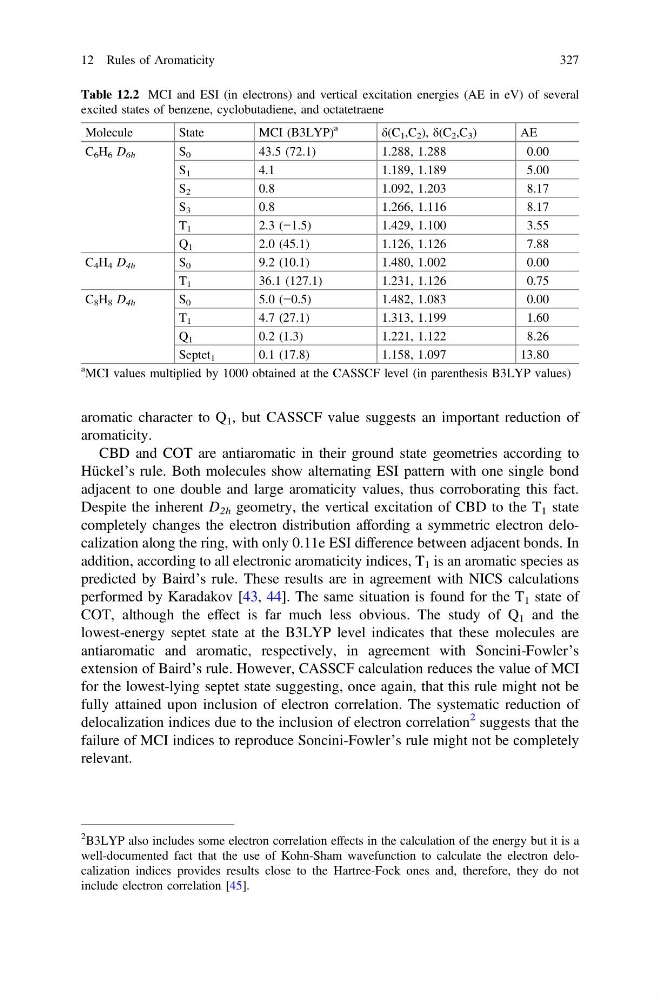
aromatic character to Q 1 , but CASSCF value suggests an important reduction of
aromaticity.
CBD and COT are antiaromatic in their ground state geometries according to
Hückel’s rule. Both molecules show alternating ESI pattern with one single bond
adjacent to one double and large aromaticity values, thus corroborating this fact.
Despite the inherent D 2h geometry, the vertical excitation of CBD to the T 1 state
completely changes the electron distribution affording a symmetric electron delocalization along the ring, with only 0.11e ESI difference between adjacent bonds. In
addition, according to all electronic aromaticity indices, T 1 is an aromatic species as
predicted by Baird’s rule. These results are in agreement with NICS calculations
performed by Karadakov [43, 44]. The same situation is found for the T 1 state of
COT, although the effect is far much less obvious. The study of Q 1 and the
lowest-energy septet state at the B3LYP level indicates that these molecules are
antiaromatic and aromatic, respectively, in agreement with Soncini-Fowler’s
extension of Baird’s rule. However, CASSCF calculation reduces the value of MCI
for the lowest-lying septet state suggesting, once again, that this rule might not be
fully attained upon inclusion of electron correlation. The systematic reduction of
delocalization indices due to the inclusion of electron correlation
2 suggests that the
failure of MCI indices to reproduce Soncini-Fowler’s rule might not be completely
relevant.
Table 12.2 MCI and ESI (in electrons) and vertical excitation energies (AE in eV) of several
excited states of benzene, cyclobutadiene, and octatetraene
Molecule
State
MCI (B3LYP)
a
δ(C 1 ,C 2 ), δ(C 2 ,C 3 )
A E
C 6 H 6 D 6h
S 0
43.5 (72.1)
1.288, 1.288
0.00
S 1
4.1
1.189, 1.189
5.00
S 2
0.8
1.092, 1.203
8.17
S 3
0.8
1.266, 1.116
8.17
T 1
2.3 (−1.5)
1.429, 1.100
3.55
Q 1
2.0 (45.1)
1.126, 1.126
7.88
C 4 H 4 D 4h
S 0
9.2 (10.1)
1.480, 1.002
0.00
T 1
36.1 (127.1)
1.231, 1.126
0.75
C 8 H 8 D 4h
S 0
5.0 (−0.5)
1.482, 1.083
0.00
T 1
4.7 (27.1)
1.313, 1.199
1.60
Q 1
0.2 (1.3)
1.221, 1.122
8.26
Septet 1
0.1 (17.8)
1.158, 1.097
13.80
a MCI values multiplied by 1000 obtained at the CASSCF level (in parenthesis B3LYP values)
2
B3LYP also includes some electron correlation effects in the calculation of the energy but it is a
well-documented fact that the use of Kohn-Sham wavefunction to calculate the electron delocalization indices provides results close to the Hartree-Fock ones and, therefore, they do not
include electron correlation [45].
12 Rules of Aromaticity
327
aromaticity.
CBD and COT are antiaromatic in their ground state geometries according to
Hückel’s rule. Both molecules show alternating ESI pattern with one single bond
adjacent to one double and large aromaticity values, thus corroborating this fact.
Despite the inherent D 2h geometry, the vertical excitation of CBD to the T 1 state
completely changes the electron distribution affording a symmetric electron delocalization along the ring, with only 0.11e ESI difference between adjacent bonds. In
addition, according to all electronic aromaticity indices, T 1 is an aromatic species as
predicted by Baird’s rule. These results are in agreement with NICS calculations
performed by Karadakov [43, 44]. The same situation is found for the T 1 state of
COT, although the effect is far much less obvious. The study of Q 1 and the
lowest-energy septet state at the B3LYP level indicates that these molecules are
antiaromatic and aromatic, respectively, in agreement with Soncini-Fowler’s
extension of Baird’s rule. However, CASSCF calculation reduces the value of MCI
for the lowest-lying septet state suggesting, once again, that this rule might not be
fully attained upon inclusion of electron correlation. The systematic reduction of
delocalization indices due to the inclusion of electron correlation
2 suggests that the
failure of MCI indices to reproduce Soncini-Fowler’s rule might not be completely
relevant.
Table 12.2 MCI and ESI (in electrons) and vertical excitation energies (AE in eV) of several
excited states of benzene, cyclobutadiene, and octatetraene
Molecule
State
MCI (B3LYP)
a
δ(C 1 ,C 2 ), δ(C 2 ,C 3 )
A E
C 6 H 6 D 6h
S 0
43.5 (72.1)
1.288, 1.288
0.00
S 1
4.1
1.189, 1.189
5.00
S 2
0.8
1.092, 1.203
8.17
S 3
0.8
1.266, 1.116
8.17
T 1
2.3 (−1.5)
1.429, 1.100
3.55
Q 1
2.0 (45.1)
1.126, 1.126
7.88
C 4 H 4 D 4h
S 0
9.2 (10.1)
1.480, 1.002
0.00
T 1
36.1 (127.1)
1.231, 1.126
0.75
C 8 H 8 D 4h
S 0
5.0 (−0.5)
1.482, 1.083
0.00
T 1
4.7 (27.1)
1.313, 1.199
1.60
Q 1
0.2 (1.3)
1.221, 1.122
8.26
Septet 1
0.1 (17.8)
1.158, 1.097
13.80
a MCI values multiplied by 1000 obtained at the CASSCF level (in parenthesis B3LYP values)
2
B3LYP also includes some electron correlation effects in the calculation of the energy but it is a
well-documented fact that the use of Kohn-Sham wavefunction to calculate the electron delocalization indices provides results close to the Hartree-Fock ones and, therefore, they do not
include electron correlation [45].
12 Rules of Aromaticity
327