

11.3.4 Chevrons—the Ultimate Anomaly
The partisans of Kekulé–structure–based models may argue that all examples
considered in the previous subsections contain fixed single and double bonds, and
that their models actually work only if such fixed bonds are absent. To their dismay,
we now describe a case of “anomalous” behavior in benzenoid systems in which no
carbon–carbon bond is fixed.
In this subsection we focus our attention to a class of benzenoid molecules called
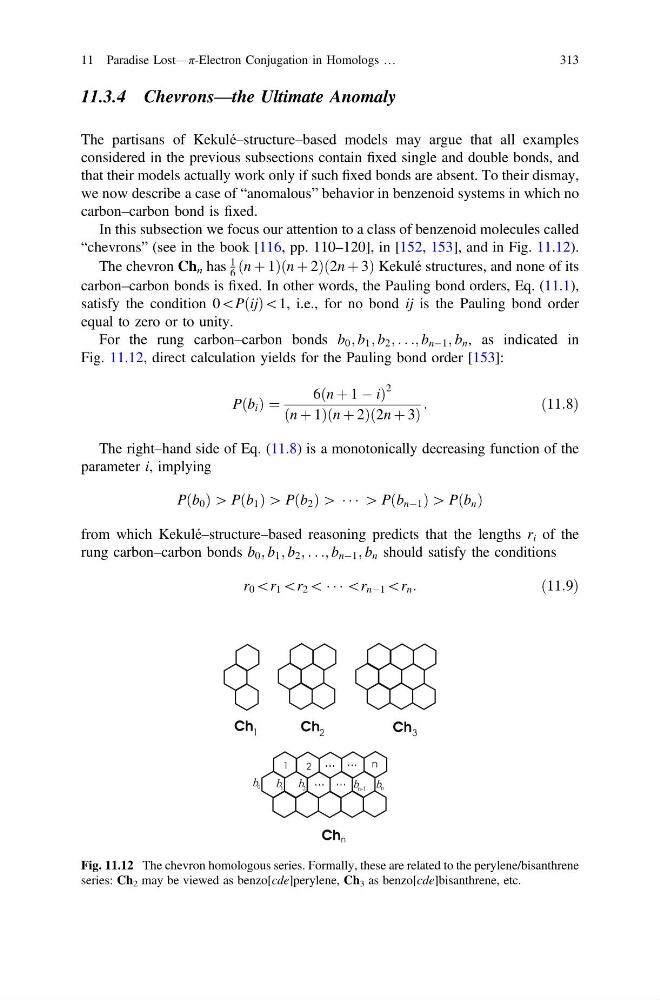
“chevrons” (see in the book [116, pp. 110–120], in [152, 153], and in Fig. 11.12).
The chevron Ch n has
1
6 ðn þ 1Þðn þ 2Þð2n þ 3Þ Kekulé structures, and none of its
carbon–carbon bonds is fixed. In other words, the Pauling bond orders, Eq. (11.1),
satisfy the condition 0\PðijÞ\1, i.e., for no bond ij is the Pauling bond order
equal to zero or to unity.
For the rung carbon–carbon bonds b 0 ; b 1 ; b 2 ; . . .; b nÀ1 ; b n , as indicated in
Fig. 11.12, direct calculation yields for the Pauling bond order [153]:
Pðb i Þ ¼
6ðn þ 1 À iÞ
2
ðn þ 1Þðn þ 2Þð2n þ 3Þ
:
ð11:8Þ
The right–hand side of Eq. (11.8) is a monotonically decreasing function of the
parameter i, implying
Pðb 0 Þ [ Pðb 1 Þ [ Pðb 2 Þ [ Á Á Á [ Pðb nÀ1 Þ [ Pðb n Þ
from which Kekulé–structure–based reasoning predicts that the lengths r i of the
rung carbon–carbon bonds b 0 ; b 1 ; b 2 ; . . .; b nÀ1 ; b n should satisfy the conditions
r 0 \r 1 \r 2 \ Á Á Á \r nÀ1 \r n :
ð11:9Þ
Fig. 11.12 The chevron homologous series. Formally, these are related to the perylene/bisanthrene
series: Ch 2 may be viewed as benzo[cde]perylene, Ch 3 as benzo[cde]bisanthrene, etc.
11 Paradise Lost—π-Electron Conjugation in Homologs …
313
The partisans of Kekulé–structure–based models may argue that all examples
considered in the previous subsections contain fixed single and double bonds, and
that their models actually work only if such fixed bonds are absent. To their dismay,
we now describe a case of “anomalous” behavior in benzenoid systems in which no
carbon–carbon bond is fixed.
In this subsection we focus our attention to a class of benzenoid molecules called
“chevrons” (see in the book [116, pp. 110–120], in [152, 153], and in Fig. 11.12).
The chevron Ch n has
1
6 ðn þ 1Þðn þ 2Þð2n þ 3Þ Kekulé structures, and none of its
carbon–carbon bonds is fixed. In other words, the Pauling bond orders, Eq. (11.1),
satisfy the condition 0\PðijÞ\1, i.e., for no bond ij is the Pauling bond order
equal to zero or to unity.
For the rung carbon–carbon bonds b 0 ; b 1 ; b 2 ; . . .; b nÀ1 ; b n , as indicated in
Fig. 11.12, direct calculation yields for the Pauling bond order [153]:
Pðb i Þ ¼
6ðn þ 1 À iÞ
2
ðn þ 1Þðn þ 2Þð2n þ 3Þ
:
ð11:8Þ
The right–hand side of Eq. (11.8) is a monotonically decreasing function of the
parameter i, implying
Pðb 0 Þ [ Pðb 1 Þ [ Pðb 2 Þ [ Á Á Á [ Pðb nÀ1 Þ [ Pðb n Þ
from which Kekulé–structure–based reasoning predicts that the lengths r i of the
rung carbon–carbon bonds b 0 ; b 1 ; b 2 ; . . .; b nÀ1 ; b n should satisfy the conditions
r 0 \r 1 \r 2 \ Á Á Á \r nÀ1 \r n :
ð11:9Þ
Fig. 11.12 The chevron homologous series. Formally, these are related to the perylene/bisanthrene
series: Ch 2 may be viewed as benzo[cde]perylene, Ch 3 as benzo[cde]bisanthrene, etc.
11 Paradise Lost—π-Electron Conjugation in Homologs …
313