

The validity of inequalities (11.9) can be checked by Kekulé–structure–independent approaches. In [153], the geometries of the chevron molecules
Ch n ; n ¼ 2; 3; . . .; 8, were calculated by means of the B3LYP/6-311G(d,p)
method. The optimized geometries of all studied molecules were found to be
perfectly planar and to correspond to minima on the potential energy hypersurface.
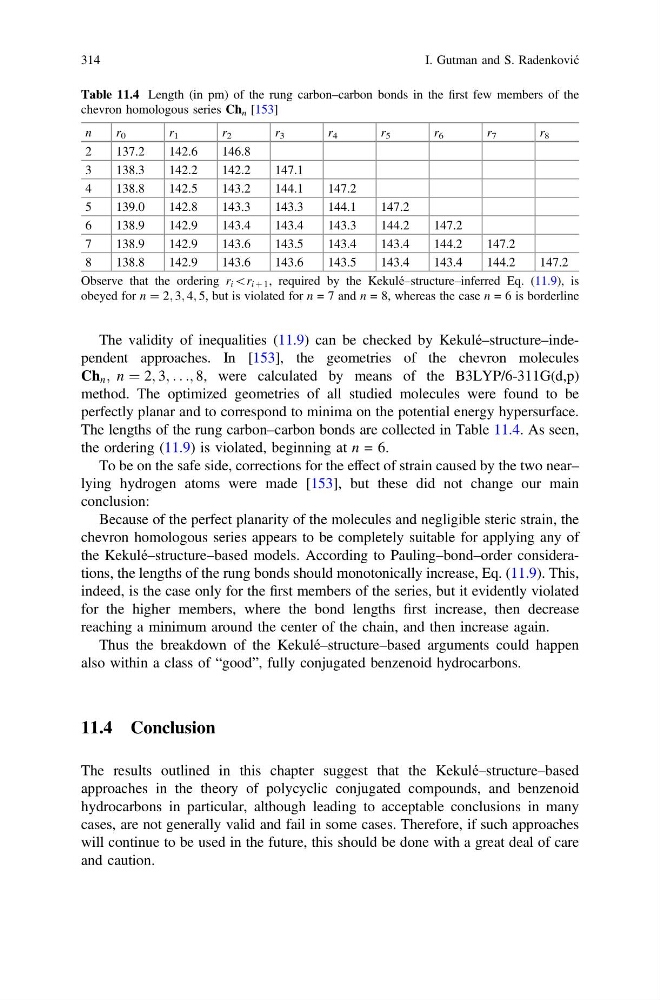
The lengths of the rung carbon–carbon bonds are collected in Table 11.4. As seen,
the ordering (11.9) is violated, beginning at n = 6.
To be on the safe side, corrections for the effect of strain caused by the two near–
lying hydrogen atoms were made [153], but these did not change our main
conclusion:
Because of the perfect planarity of the molecules and negligible steric strain, the
chevron homologous series appears to be completely suitable for applying any of
the Kekulé–structure–based models. According to Pauling–bond–order considerations, the lengths of the rung bonds should monotonically increase, Eq. (11.9). This,
indeed, is the case only for the first members of the series, but it evidently violated
for the higher members, where the bond lengths first increase, then decrease
reaching a minimum around the center of the chain, and then increase again.
Thus the breakdown of the Kekulé–structure–based arguments could happen
also within a class of “good”, fully conjugated benzenoid hydrocarbons.
11.4 Conclusion
The results outlined in this chapter suggest that the Kekulé–structure–based
approaches in the theory of polycyclic conjugated compounds, and benzenoid
hydrocarbons in particular, although leading to acceptable conclusions in many
cases, are not generally valid and fail in some cases. Therefore, if such approaches
will continue to be used in the future, this should be done with a great deal of care
and caution.
Table 11.4 Length (in pm) of the rung carbon–carbon bonds in the first few members of the
chevron homologous series Ch n [153]
n
r 0
r 1
r 2
r 3
r 4
r 5
r 6
r 7
r 8
2
137.2
142.6
146.8
3
138.3
142.2
142.2
147.1
4
138.8
142.5
143.2
144.1
147.2
5
139.0
142.8
143.3
143.3
144.1
147.2
6
138.9
142.9
143.4
143.4
143.3
144.2
147.2
7
138.9
142.9
143.6
143.5
143.4
143.4
144.2
147.2
8
138.8
142.9
143.6
143.6
143.5
143.4
143.4
144.2
147.2
Observe that the ordering r i \r i þ 1 , required by the Kekulé–structure–inferred Eq. (11.9), is
obeyed for n ¼ 2; 3; 4; 5, but is violated for n = 7 and n = 8, whereas the case n = 6 is borderline
314
I. Gutman and S. Radenković
Ch n ; n ¼ 2; 3; . . .; 8, were calculated by means of the B3LYP/6-311G(d,p)
method. The optimized geometries of all studied molecules were found to be
perfectly planar and to correspond to minima on the potential energy hypersurface.
The lengths of the rung carbon–carbon bonds are collected in Table 11.4. As seen,
the ordering (11.9) is violated, beginning at n = 6.
To be on the safe side, corrections for the effect of strain caused by the two near–
lying hydrogen atoms were made [153], but these did not change our main
conclusion:
Because of the perfect planarity of the molecules and negligible steric strain, the
chevron homologous series appears to be completely suitable for applying any of
the Kekulé–structure–based models. According to Pauling–bond–order considerations, the lengths of the rung bonds should monotonically increase, Eq. (11.9). This,
indeed, is the case only for the first members of the series, but it evidently violated
for the higher members, where the bond lengths first increase, then decrease
reaching a minimum around the center of the chain, and then increase again.
Thus the breakdown of the Kekulé–structure–based arguments could happen
also within a class of “good”, fully conjugated benzenoid hydrocarbons.
11.4 Conclusion
The results outlined in this chapter suggest that the Kekulé–structure–based
approaches in the theory of polycyclic conjugated compounds, and benzenoid
hydrocarbons in particular, although leading to acceptable conclusions in many
cases, are not generally valid and fail in some cases. Therefore, if such approaches
will continue to be used in the future, this should be done with a great deal of care
and caution.
Table 11.4 Length (in pm) of the rung carbon–carbon bonds in the first few members of the
chevron homologous series Ch n [153]
n
r 0
r 1
r 2
r 3
r 4
r 5
r 6
r 7
r 8
2
137.2
142.6
146.8
3
138.3
142.2
142.2
147.1
4
138.8
142.5
143.2
144.1
147.2
5
139.0
142.8
143.3
143.3
144.1
147.2
6
138.9
142.9
143.4
143.4
143.3
144.2
147.2
7
138.9
142.9
143.6
143.5
143.4
143.4
144.2
147.2
8
138.8
142.9
143.6
143.6
143.5
143.4
143.4
144.2
147.2
Observe that the ordering r i \r i þ 1 , required by the Kekulé–structure–inferred Eq. (11.9), is
obeyed for n ¼ 2; 3; 4; 5, but is violated for n = 7 and n = 8, whereas the case n = 6 is borderline
314
I. Gutman and S. Radenković