

(1) The predictions of Kekulé–structure–based models are reasonably correct in
case of the first few members of the perylene/bisanthrene family P n , especially
for n = 1 and n = 2.
(2) In the case of higher member of this family, P n ; n ! 5, there are significant
violations of the Kekulé–structure–based predictions. The magnitude of cyclic
conjugation in the rings lying near the center of the “empty” ring-system
E 1 ; E 2 ; . . .; E n is high and surpasses the cyclic conjugation of some of the rings
belonging to the “full” ring-system F 1 ; F 2 ; . . .; F n þ 1 .
(3) The central domain of the higher members of the perylene/bisanthrene series
has a pronounced degree of local aromaticity, not anticipated by any of the
Kekulé–structure–based models.
(4) The behavior of the members of the P n series for n = 3 and n = 4 is borderline.
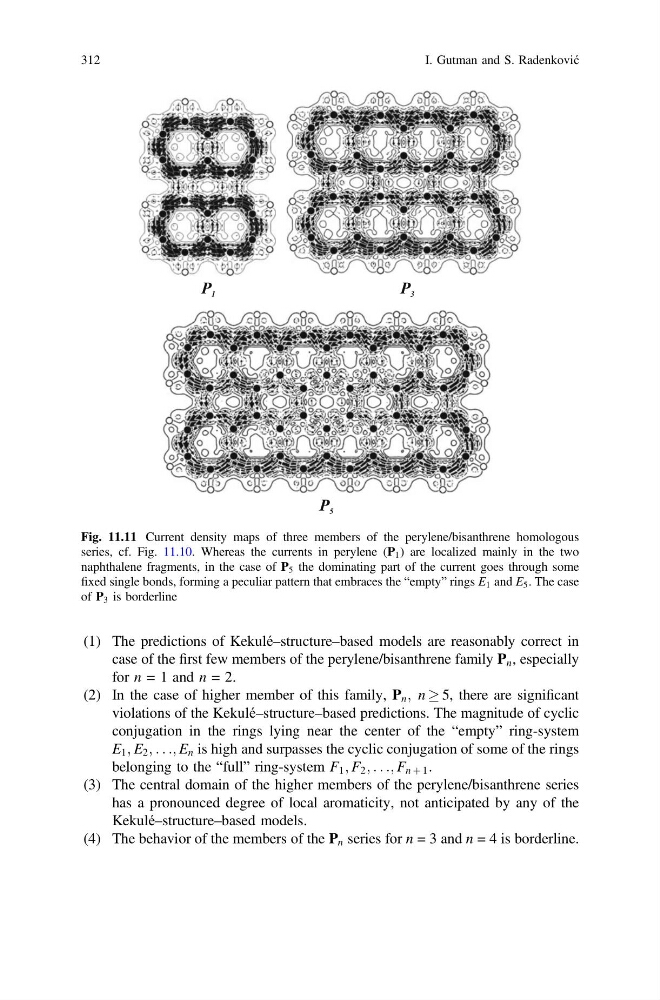
Fig. 11.11 Current density maps of three members of the perylene/bisanthrene homologous
series, cf. Fig. 11.10. Whereas the currents in perylene (P 1 ) are localized mainly in the two
naphthalene fragments, in the case of P 5 the dominating part of the current goes through some
fixed single bonds, forming a peculiar pattern that embraces the “empty” rings E 1 and E 5 . The case
of P 3 is borderline
312
I. Gutman and S. Radenković
case of the first few members of the perylene/bisanthrene family P n , especially
for n = 1 and n = 2.
(2) In the case of higher member of this family, P n ; n ! 5, there are significant
violations of the Kekulé–structure–based predictions. The magnitude of cyclic
conjugation in the rings lying near the center of the “empty” ring-system
E 1 ; E 2 ; . . .; E n is high and surpasses the cyclic conjugation of some of the rings
belonging to the “full” ring-system F 1 ; F 2 ; . . .; F n þ 1 .
(3) The central domain of the higher members of the perylene/bisanthrene series
has a pronounced degree of local aromaticity, not anticipated by any of the
Kekulé–structure–based models.
(4) The behavior of the members of the P n series for n = 3 and n = 4 is borderline.
Fig. 11.11 Current density maps of three members of the perylene/bisanthrene homologous
series, cf. Fig. 11.10. Whereas the currents in perylene (P 1 ) are localized mainly in the two
naphthalene fragments, in the case of P 5 the dominating part of the current goes through some
fixed single bonds, forming a peculiar pattern that embraces the “empty” rings E 1 and E 5 . The case
of P 3 is borderline
312
I. Gutman and S. Radenković