

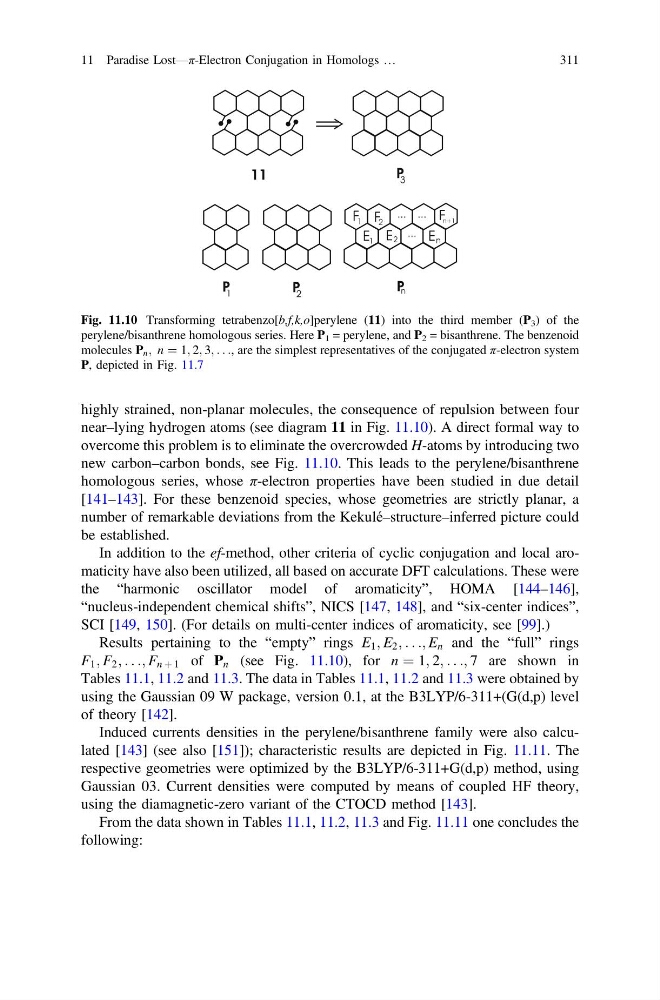
highly strained, non-planar molecules, the consequence of repulsion between four
near–lying hydrogen atoms (see diagram 11 in Fig. 11.10). A direct formal way to
overcome this problem is to eliminate the overcrowded H-atoms by introducing two
new carbon–carbon bonds, see Fig. 11.10. This leads to the perylene/bisanthrene
homologous series, whose π-electron properties have been studied in due detail
[141–143]. For these benzenoid species, whose geometries are strictly planar, a
number of remarkable deviations from the Kekulé–structure–inferred picture could
be established.
In addition to the ef-method, other criteria of cyclic conjugation and local aromaticity have also been utilized, all based on accurate DFT calculations. These were
the “harmonic oscillator model of aromaticity”, HOMA [144–146],
“nucleus-independent chemical shifts”, NICS [147, 148], and “six-center indices”,
SCI [149, 150]. (For details on multi-center indices of aromaticity, see [99].)
Results pertaining to the “empty” rings E 1 ; E 2 ; . . .; E n and the “full” rings
F 1 ; F 2 ; . . .; F n þ 1 of P n (see Fig. 11.10), for n ¼ 1; 2; . . .; 7 are shown in
Tables 11.1, 11.2 and 11.3. The data in Tables 11.1, 11.2 and 11.3 were obtained by
using the Gaussian 09 W package, version 0.1, at the B3LYP/6-311+(G(d,p) level
of theory [142].
Induced currents densities in the perylene/bisanthrene family were also calculated [143] (see also [151]); characteristic results are depicted in Fig. 11.11. The
respective geometries were optimized by the B3LYP/6-311+G(d,p) method, using
Gaussian 03. Current densities were computed by means of coupled HF theory,
using the diamagnetic-zero variant of the CTOCD method [143].
From the data shown in Tables 11.1, 11.2, 11.3 and Fig. 11.11 one concludes the
following:
Fig. 11.10 Transforming tetrabenzo[b,f,k,o]perylene (11) into the third member (P 3 ) of the
perylene/bisanthrene homologous series. Here P 1 = perylene, and P 2 = bisanthrene. The benzenoid
molecules P n ; n ¼ 1; 2; 3; . . ., are the simplest representatives of the conjugated π-electron system
P, depicted in Fig. 11.7
11 Paradise Lost—π-Electron Conjugation in Homologs …
311
near–lying hydrogen atoms (see diagram 11 in Fig. 11.10). A direct formal way to
overcome this problem is to eliminate the overcrowded H-atoms by introducing two
new carbon–carbon bonds, see Fig. 11.10. This leads to the perylene/bisanthrene
homologous series, whose π-electron properties have been studied in due detail
[141–143]. For these benzenoid species, whose geometries are strictly planar, a
number of remarkable deviations from the Kekulé–structure–inferred picture could
be established.
In addition to the ef-method, other criteria of cyclic conjugation and local aromaticity have also been utilized, all based on accurate DFT calculations. These were
the “harmonic oscillator model of aromaticity”, HOMA [144–146],
“nucleus-independent chemical shifts”, NICS [147, 148], and “six-center indices”,
SCI [149, 150]. (For details on multi-center indices of aromaticity, see [99].)
Results pertaining to the “empty” rings E 1 ; E 2 ; . . .; E n and the “full” rings
F 1 ; F 2 ; . . .; F n þ 1 of P n (see Fig. 11.10), for n ¼ 1; 2; . . .; 7 are shown in
Tables 11.1, 11.2 and 11.3. The data in Tables 11.1, 11.2 and 11.3 were obtained by
using the Gaussian 09 W package, version 0.1, at the B3LYP/6-311+(G(d,p) level
of theory [142].
Induced currents densities in the perylene/bisanthrene family were also calculated [143] (see also [151]); characteristic results are depicted in Fig. 11.11. The
respective geometries were optimized by the B3LYP/6-311+G(d,p) method, using
Gaussian 03. Current densities were computed by means of coupled HF theory,
using the diamagnetic-zero variant of the CTOCD method [143].
From the data shown in Tables 11.1, 11.2, 11.3 and Fig. 11.11 one concludes the
following:
Fig. 11.10 Transforming tetrabenzo[b,f,k,o]perylene (11) into the third member (P 3 ) of the
perylene/bisanthrene homologous series. Here P 1 = perylene, and P 2 = bisanthrene. The benzenoid
molecules P n ; n ¼ 1; 2; 3; . . ., are the simplest representatives of the conjugated π-electron system
P, depicted in Fig. 11.7
11 Paradise Lost—π-Electron Conjugation in Homologs …
311