

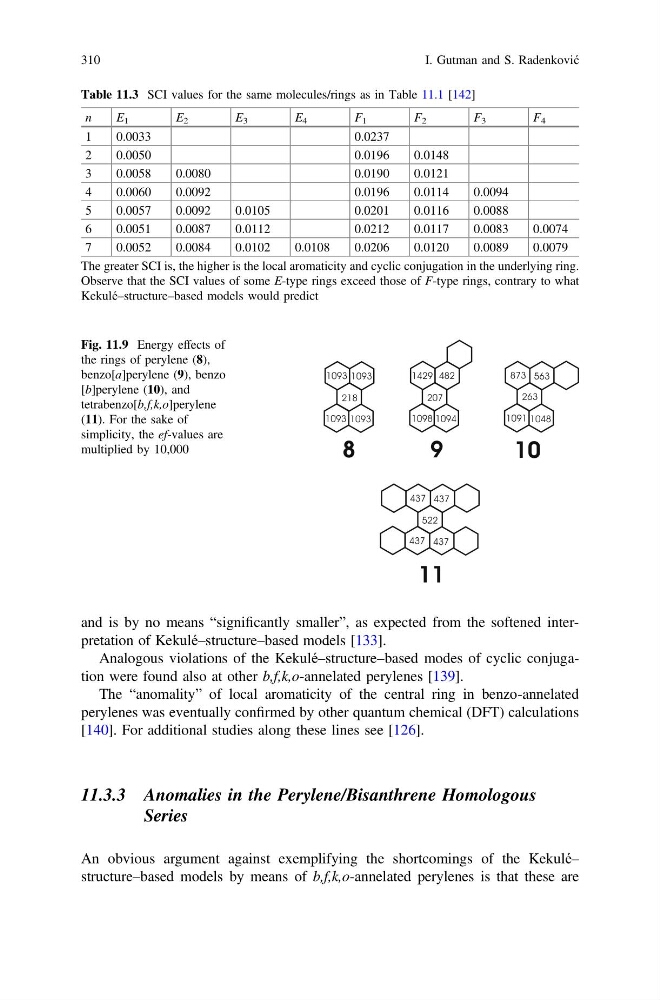
and is by no means “significantly smaller”, as expected from the softened interpretation of Kekulé–structure–based models [133].
Analogous violations of the Kekulé–structure–based modes of cyclic conjugation were found also at other b,f,k,o-annelated perylenes [139].
The “anomality” of local aromaticity of the central ring in benzo-annelated
perylenes was eventually confirmed by other quantum chemical (DFT) calculations
[140]. For additional studies along these lines see [126].
11.3.3 Anomalies in the Perylene/Bisanthrene Homologous
Series
An obvious argument against exemplifying the shortcomings of the Kekulé–
structure–based models by means of b,f,k,o-annelated perylenes is that these are
Table 11.3 SCI values for the same molecules/rings as in Table 11.1 [142]
n
E 1
E 2
E 3
E 4
F 1
F 2
F 3
F 4
1
0.0033
0.0237
2
0.0050
0.0196
0.0148
3
0.0058
0.0080
0.0190
0.0121
4
0.0060
0.0092
0.0196
0.0114
0.0094
5
0.0057
0.0092
0.0105
0.0201
0.0116
0.0088
6
0.0051
0.0087
0.0112
0.0212
0.0117
0.0083
0.0074
7
0.0052
0.0084
0.0102
0.0108
0.0206
0.0120
0.0089
0.0079
The greater SCI is, the higher is the local aromaticity and cyclic conjugation in the underlying ring.
Observe that the SCI values of some E-type rings exceed those of F-type rings, contrary to what
Kekulé–structure–based models would predict
Fig. 11.9 Energy effects of
the rings of perylene (8),
benzo[a]perylene (9), benzo
[b]perylene (10), and
tetrabenzo[b,f,k,o]perylene
(11). For the sake of
simplicity, the ef-values are
multiplied by 10,000
310
I. Gutman and S. Radenković
Analogous violations of the Kekulé–structure–based modes of cyclic conjugation were found also at other b,f,k,o-annelated perylenes [139].
The “anomality” of local aromaticity of the central ring in benzo-annelated
perylenes was eventually confirmed by other quantum chemical (DFT) calculations
[140]. For additional studies along these lines see [126].
11.3.3 Anomalies in the Perylene/Bisanthrene Homologous
Series
An obvious argument against exemplifying the shortcomings of the Kekulé–
structure–based models by means of b,f,k,o-annelated perylenes is that these are
Table 11.3 SCI values for the same molecules/rings as in Table 11.1 [142]
n
E 1
E 2
E 3
E 4
F 1
F 2
F 3
F 4
1
0.0033
0.0237
2
0.0050
0.0196
0.0148
3
0.0058
0.0080
0.0190
0.0121
4
0.0060
0.0092
0.0196
0.0114
0.0094
5
0.0057
0.0092
0.0105
0.0201
0.0116
0.0088
6
0.0051
0.0087
0.0112
0.0212
0.0117
0.0083
0.0074
7
0.0052
0.0084
0.0102
0.0108
0.0206
0.0120
0.0089
0.0079
The greater SCI is, the higher is the local aromaticity and cyclic conjugation in the underlying ring.
Observe that the SCI values of some E-type rings exceed those of F-type rings, contrary to what
Kekulé–structure–based models would predict
Fig. 11.9 Energy effects of
the rings of perylene (8),
benzo[a]perylene (9), benzo
[b]perylene (10), and
tetrabenzo[b,f,k,o]perylene
(11). For the sake of
simplicity, the ef-values are
multiplied by 10,000
310
I. Gutman and S. Radenković