

Other, DFT-based, calculations also indicate that the properties of perylene are
in good agreement with the predictions inferred from their Kekulé structures; see
the data for P 1 given in Tables 11.1, 11.2, 11.3 and in Fig. 11.11.
In the case of monobenzo-annelated perylenes, the situation is similar: in benzo
[a]perylene (9) and benzo[b]perylene (10), the ef-values of the central ring have
been only slightly changed relative to perylene, see Fig. 11.9. (The decrease and
increase of the magnitude of cyclic conjugation caused, respectively, by a- and
b-type benzo–annelation, was later found to be a general regularity [134–138].)
Now the bad news start.
The extent of cyclic conjugation in the central “empty” ring of benzo[b]perylene
is somewhat greater than in non-annelated perylene. Because perylene has three
additional annelation sites symmetry–equivalent to position b, namely, positions f,k,
o, the effect observed at benzo[b]perylene can be magnified by considering tetrabenzo[b,f,k,o]perylene (11, Fig. 11.9). In this derivative of perylene, cyclic conjugation in the central “empty” ring, ef ð11; EÞ ¼ 0:0522, exceeds that of the normal,
naphthalene–like rings, ef ð11; AÞ ¼ ef ð11; BÞ ¼ ef ð11; CÞ ¼ ef ð11; DÞ ¼ 0:0437,
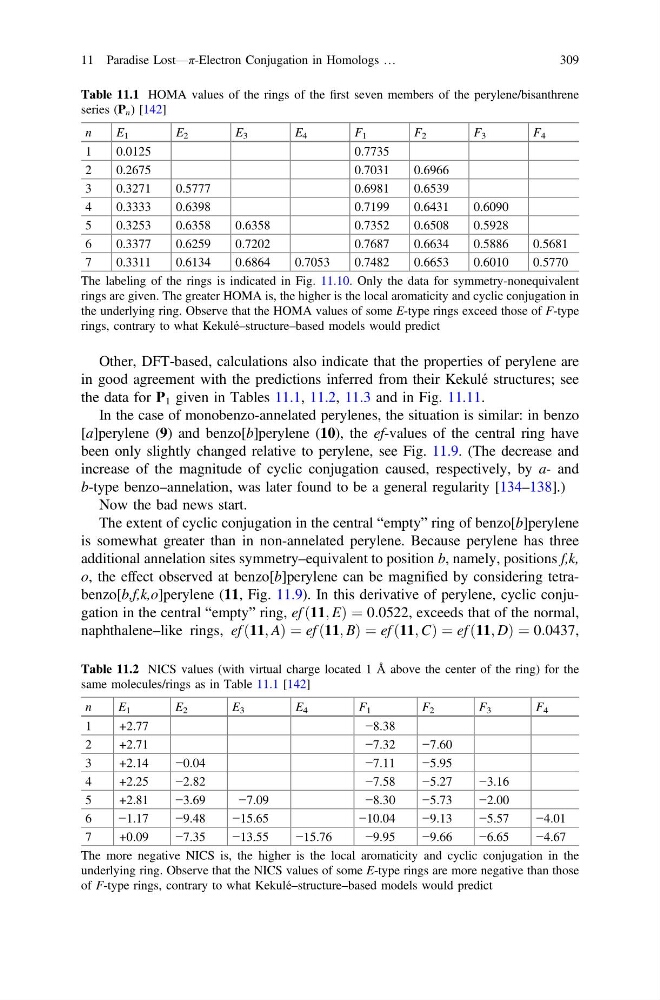
Table 11.2 NICS values (with virtual charge located 1 Å above the center of the ring) for the
same molecules/rings as in Table 11.1 [142]
n
E 1
E 2
E 3
E 4
F 1
F 2
F 3
F 4
1
+2.77
−8.38
2
+2.71
−7.32
−7.60
3
+2.14
−0.04
−7.11
−5.95
4
+2.25
−2.82
−7.58
−5.27
−3.16
5
+2.81
−3.69
−7.09
−8.30
−5.73
−2.00
6
−1.17
−9.48
−15.65
−10.04
−9.13
−5.57
−4.01
7
+0.09
−7.35
−13.55
−15.76
−9.95
−9.66
−6.65
−4.67
The more negative NICS is, the higher is the local aromaticity and cyclic conjugation in the
underlying ring. Observe that the NICS values of some E-type rings are more negative than those
of F-type rings, contrary to what Kekulé–structure–based models would predict
Table 11.1 HOMA values of the rings of the first seven members of the perylene/bisanthrene
series (P n ) [142]
n
E 1
E 2
E 3
E 4
F 1
F 2
F 3
F 4
1
0.0125
0.7735
2
0.2675
0.7031
0.6966
3
0.3271
0.5777
0.6981
0.6539
4
0.3333
0.6398
0.7199
0.6431
0.6090
5
0.3253
0.6358
0.6358
0.7352
0.6508
0.5928
6
0.3377
0.6259
0.7202
0.7687
0.6634
0.5886
0.5681
7
0.3311
0.6134
0.6864
0.7053
0.7482
0.6653
0.6010
0.5770
The labeling of the rings is indicated in Fig. 11.10. Only the data for symmetry-nonequivalent
rings are given. The greater HOMA is, the higher is the local aromaticity and cyclic conjugation in
the underlying ring. Observe that the HOMA values of some E-type rings exceed those of F-type
rings, contrary to what Kekulé–structure–based models would predict
11 Paradise Lost—π-Electron Conjugation in Homologs …
309
in good agreement with the predictions inferred from their Kekulé structures; see
the data for P 1 given in Tables 11.1, 11.2, 11.3 and in Fig. 11.11.
In the case of monobenzo-annelated perylenes, the situation is similar: in benzo
[a]perylene (9) and benzo[b]perylene (10), the ef-values of the central ring have
been only slightly changed relative to perylene, see Fig. 11.9. (The decrease and
increase of the magnitude of cyclic conjugation caused, respectively, by a- and
b-type benzo–annelation, was later found to be a general regularity [134–138].)
Now the bad news start.
The extent of cyclic conjugation in the central “empty” ring of benzo[b]perylene
is somewhat greater than in non-annelated perylene. Because perylene has three
additional annelation sites symmetry–equivalent to position b, namely, positions f,k,
o, the effect observed at benzo[b]perylene can be magnified by considering tetrabenzo[b,f,k,o]perylene (11, Fig. 11.9). In this derivative of perylene, cyclic conjugation in the central “empty” ring, ef ð11; EÞ ¼ 0:0522, exceeds that of the normal,
naphthalene–like rings, ef ð11; AÞ ¼ ef ð11; BÞ ¼ ef ð11; CÞ ¼ ef ð11; DÞ ¼ 0:0437,
Table 11.2 NICS values (with virtual charge located 1 Å above the center of the ring) for the
same molecules/rings as in Table 11.1 [142]
n
E 1
E 2
E 3
E 4
F 1
F 2
F 3
F 4
1
+2.77
−8.38
2
+2.71
−7.32
−7.60
3
+2.14
−0.04
−7.11
−5.95
4
+2.25
−2.82
−7.58
−5.27
−3.16
5
+2.81
−3.69
−7.09
−8.30
−5.73
−2.00
6
−1.17
−9.48
−15.65
−10.04
−9.13
−5.57
−4.01
7
+0.09
−7.35
−13.55
−15.76
−9.95
−9.66
−6.65
−4.67
The more negative NICS is, the higher is the local aromaticity and cyclic conjugation in the
underlying ring. Observe that the NICS values of some E-type rings are more negative than those
of F-type rings, contrary to what Kekulé–structure–based models would predict
Table 11.1 HOMA values of the rings of the first seven members of the perylene/bisanthrene
series (P n ) [142]
n
E 1
E 2
E 3
E 4
F 1
F 2
F 3
F 4
1
0.0125
0.7735
2
0.2675
0.7031
0.6966
3
0.3271
0.5777
0.6981
0.6539
4
0.3333
0.6398
0.7199
0.6431
0.6090
5
0.3253
0.6358
0.6358
0.7352
0.6508
0.5928
6
0.3377
0.6259
0.7202
0.7687
0.6634
0.5886
0.5681
7
0.3311
0.6134
0.6864
0.7053
0.7482
0.6653
0.6010
0.5770
The labeling of the rings is indicated in Fig. 11.10. Only the data for symmetry-nonequivalent
rings are given. The greater HOMA is, the higher is the local aromaticity and cyclic conjugation in
the underlying ring. Observe that the HOMA values of some E-type rings exceed those of F-type
rings, contrary to what Kekulé–structure–based models would predict
11 Paradise Lost—π-Electron Conjugation in Homologs …
309