

RE ¼
1
K
X
n ! 1
q n R n
ð11:6Þ
where R n ; n ¼ 1; 2; 3; . . . are parameters whose values are adjusted so as to best
reproduce molecular–orbital resonance energies. In [72], the following values were
recommended:
R 1 ¼ 0:869 eV; R 2 ¼ 0:247 eV; R 3 ¼ 0:100 eV
and R k ¼ 0 for k ! 4 (see also [73]). More details on the conjugated circuits model
and on its relation to Herndon and Clar resonance theory can be found in
[38, pp. 79–91] and [74].
11.2.3 π-Electron Content of Rings
In a series of papers published in 2004 [75–78], Milan Randić and Alexandru
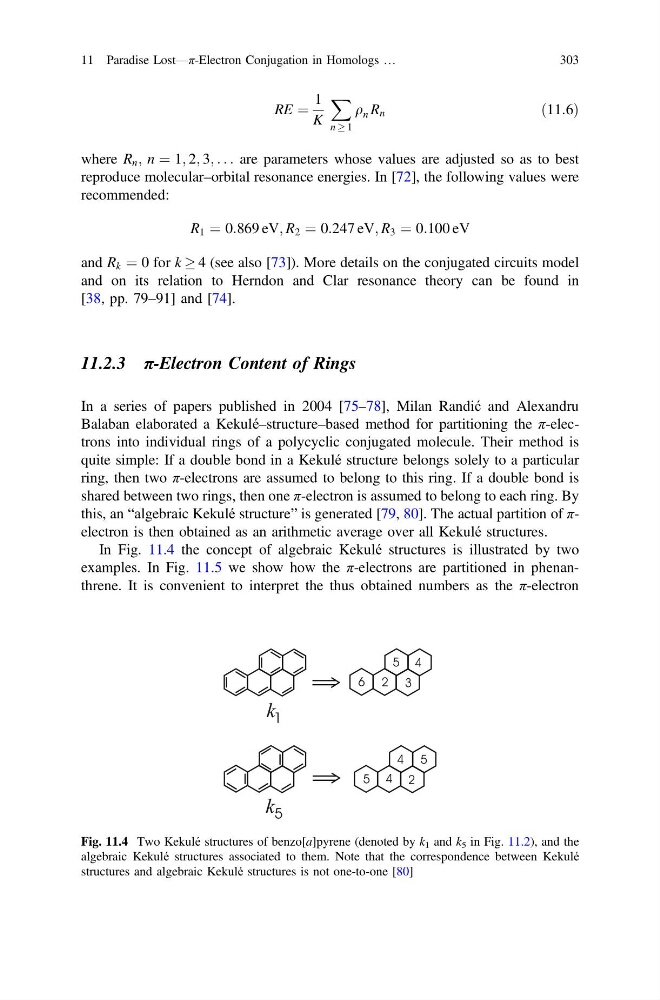
Balaban elaborated a Kekulé–structure–based method for partitioning the π-electrons into individual rings of a polycyclic conjugated molecule. Their method is
quite simple: If a double bond in a Kekulé structure belongs solely to a particular
ring, then two π-electrons are assumed to belong to this ring. If a double bond is
shared between two rings, then one π-electron is assumed to belong to each ring. By
this, an “algebraic Kekulé structure” is generated [79, 80]. The actual partition of πelectron is then obtained as an arithmetic average over all Kekulé structures.
In Fig. 11.4 the concept of algebraic Kekulé structures is illustrated by two
examples. In Fig. 11.5 we show how the π-electrons are partitioned in phenanthrene. It is convenient to interpret the thus obtained numbers as the π-electron
Fig. 11.4 Two Kekulé structures of benzo[a]pyrene (denoted by k 1 and k 5 in Fig. 11.2), and the
algebraic Kekulé structures associated to them. Note that the correspondence between Kekulé
structures and algebraic Kekulé structures is not one-to-one [80]
11 Paradise Lost—π-Electron Conjugation in Homologs …
303
1
K
X
n ! 1
q n R n
ð11:6Þ
where R n ; n ¼ 1; 2; 3; . . . are parameters whose values are adjusted so as to best
reproduce molecular–orbital resonance energies. In [72], the following values were
recommended:
R 1 ¼ 0:869 eV; R 2 ¼ 0:247 eV; R 3 ¼ 0:100 eV
and R k ¼ 0 for k ! 4 (see also [73]). More details on the conjugated circuits model
and on its relation to Herndon and Clar resonance theory can be found in
[38, pp. 79–91] and [74].
11.2.3 π-Electron Content of Rings
In a series of papers published in 2004 [75–78], Milan Randić and Alexandru
Balaban elaborated a Kekulé–structure–based method for partitioning the π-electrons into individual rings of a polycyclic conjugated molecule. Their method is
quite simple: If a double bond in a Kekulé structure belongs solely to a particular
ring, then two π-electrons are assumed to belong to this ring. If a double bond is
shared between two rings, then one π-electron is assumed to belong to each ring. By
this, an “algebraic Kekulé structure” is generated [79, 80]. The actual partition of πelectron is then obtained as an arithmetic average over all Kekulé structures.
In Fig. 11.4 the concept of algebraic Kekulé structures is illustrated by two
examples. In Fig. 11.5 we show how the π-electrons are partitioned in phenanthrene. It is convenient to interpret the thus obtained numbers as the π-electron
Fig. 11.4 Two Kekulé structures of benzo[a]pyrene (denoted by k 1 and k 5 in Fig. 11.2), and the
algebraic Kekulé structures associated to them. Note that the correspondence between Kekulé
structures and algebraic Kekulé structures is not one-to-one [80]
11 Paradise Lost—π-Electron Conjugation in Homologs …
303